National Guard deployment raises concerns
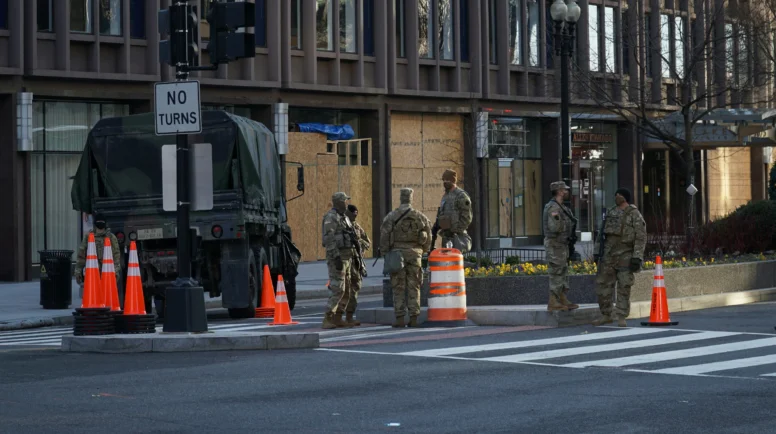
This week, more than 800 National Guardsmen were deployed to Washington, D.C., to take over law enforcement efforts in the capital city, a show of force by President Donald Trump’s administration that has put church leaders in National Capital Presbytery on high alert.
Congregations in Washington are anxious, according to Tara Spuhler McCabe, transitional director of congregational development and mission at National Capital Presbytery. On Wednesday, the president said he will pursue longer, more permanent control of the capital city’s police force, claiming crime is rampant in the city. He also placed U.S. Attorney General Pam Bondi in charge of the Washington Metropolitan Police Department.
Statistics from the U.S. Justice Department show crime in Washington is at a 30-year low. A January 2025 report states, “total violent crime for 2024 in the District of Columbia is down 35% from 2023 and is the lowest it has been in over 30 years, according to data collected by the Metropolitan Police Department.”
Churches organize to protect the vulnerable
“Our presbytery continues to organize in a multilateral way around the pervasive threats towards members of our churches who are federal employees, people experiencing homelessness, and youth who live in D.C. and participate in ministry programs from our churches,” McCabe told the Outlook in an email.
John Molina-Moore, general presbyter of National Capital Presbytery, joined with other religious leaders in a statement on Wednesday: “As religious leaders, we remain firm in our commitment to serve those in need and to work collaboratively toward solutions to our city’s most pressing problems. We call on our political and civic leaders to reject fear-based governance and work together in a spirit of dignity and respect — so that safety, justice and compassion prevail in our city.”
“As religious leaders, we remain firm in our commitment to serve those in need and to work collaboratively toward solutions to our city’s most pressing problems.” — John Molina-Moore
“There is a lot of unease around all of this,” said David Ensign, bridge pastor at Western Presbyterian Church, also the home of Miriam’s Kitchen, an independent non-profit providing services for the unhoused.
Shani McIlwain, a ruling elder in National Capital Presbytery and a member of Faith Presbyterian Church in Southwest Washington, finds the increased police presence “disheartening.”
 On Wednesday, Ensign reported a larger-than-usual police presence around his church in Foggy Bottom, a neighborhood in Washington’s northwest side. He felt like “this show of security theatre” was designed to intimidate. President Trump visited the nearby Kennedy Center that day, but dozens of Washington metropolitan police were parked around the church.
Because of that, pastoral colleagues were on hand Wednesday to lend support to guests at Miriam’s Kitchen, Ensign said. The increased police presence was a reminder that this situation is “capricious and not logical.”
“This is not new, but is now heightened …” — Shani McIlwain
“Next time this show of force could be aimed at our unhoused neighbors and Miriam’s Kitchen guests,” Ensign said. McCabe noted the presbytery has several congregations in the area that are centralized spaces for people experiencing homelessness: Western Presbyterian Church, as well as New York Avenue Presbyterian Church, Westminster Presbyterian Church, and Northeastern Presbyterian Church, all of which also hold programming for the city’s youth.

“Western Pres and Miriam’s Kitchen have been in that particular location and ministry through multiple presidencies and announcements at the Kennedy Center,” McCabe wrote in her email.
“There is a significant distance from the church and the Kennedy Center. Buses of law enforcement have never been placed in front of Western/Miriam’s before for a visit or announcement that is being made by a president before. As a presbytery that is here to support our congregations, I see this difference in a threatening way. Maybe somebody with security or law enforcement got lost, but I am concerned.
“Through our ecumenical partnerships and pastoral relationships, we were able to have some pastors immediately on the premises to walk around and protect as best as possible,” McCabe wrote. “Once the law enforcement presence moved to the Kennedy Center, there has not been any more presence.”
“Our allegiance is to the gospel, not the White House.” — David Ensign
White House press secretary Karoline Leavitt has said those who are unhoused and “refuse to move into shelters will face prosecution or fines,” according to a report on NPR.
“This is not new, but is now heightened,” said McIlwain, who has lived in Washington for more than 30 years. She interprets this federalizing of law enforcement in the district as a “direct attack against Black youth.” According to the World Population Review, Washington’s racial makeup is largely Black, at 43.26% of the population.
She is very concerned about children being detained by federal law enforcement, especially at transit stops.
“As a parent, I’ve always had the talk with my children: remain silent and ask for a lawyer,” McIlwain said. Washington’s mayor, Muriel Bowser, also addressed concerns over youth policing, specifically mentioning “teen takeovers” at Navy Yard and other hangouts, particularly in light of outside law enforcement acting in situations for which they lack training.
Commitment to the gospel
Presbytery pastors and leaders remain focused on their gospel imperative. “We are deeply committed to caring for the most vulnerable and don’t care who is in the White House. Our allegiance is to the gospel, not the White House,” said Ensign.
“We need to have more conversation around what it really means to love our neighbor,” McIlwain said. She quoted Cornell West, “Never forget that justice is what love looks like in public.”
McIlwain said her job over the next 30 days will be to “keep our kids safe and bring them home every night.”
She urged people outside Washington to call their members of Congress to vote against a continued increase in police presence in the District. “We have power in numbers in this country.”
“If it’s happening here, it’s a matter of time before this comes to your city,” McIlwain said.
“To know they are not alone is essential.” — Tara Spuhler McCabe
“Our presbytery continues to organize in a multi-lateral way around the pervasive threats towards members of our churches who are federal employees, people experiencing homelessness, and youth who live in D.C. and participate in ministry programs from our churches,” McCabe said.
A ministry of presence
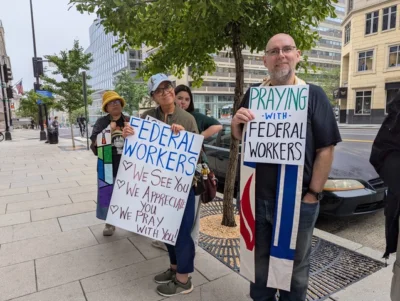
National Capital Presbytery will host a Ministry of Presence on September 2 from 7-9 a.m. throughout the metro area, McCabe said. The presbytery is inviting participants to arrive in collars and stoles and have their phone ready. Training is available.
“We have also directed pastors to reach out to their colleagues at our D.C. congregations and check in,” McCabe wrote. “And there are members and pastors in our Virginia and Maryland congregations who are ready to be sent into D.C. now as a ministry of presence.
“To know they are not alone is essential.”