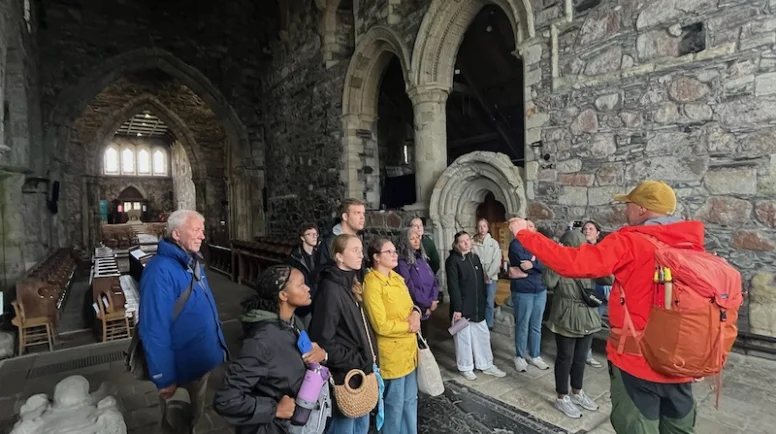
Healing silence
I carried much more than luggage across the ocean. I arrived in Scotland worn down, weighed down. Like many young adults of faith, I’ve spent years holding space for others: listening, caring, creating room for healing. But somewhere along the way, I forgot how to keep that space for myself. Scotland offered me a reintroduction to my spirit. It became a place of restoration and revelation.
On Iona, as we gathered in worship and silence, I heard “Arioso” by Bach playing gently in the background one morning. Its slow, aching melody seemed to rise with the mist. That music, full of longing and light, mirrored the stillness of the waters surrounding us. And in that stillness, something became clear: God does not rush us. God meets us in the pause.
I’ve spent years holding space for others … But somewhere along the way, I forgot how to keep that space for myself.
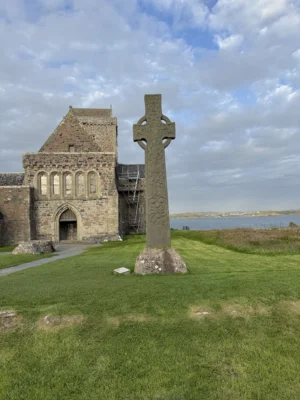
The island itself spoke in quiet ways. The stone beneath our feet and around us, ancient, weathered, unmoved, became a metaphor. While history, language, and human institutions have all shifted and changed, the stone remained. And so does God. Even as humans alter the form of faith over time through colonization, assimilation, or even social innovation, God’s nature does not waver. The stone, like God, remains a witness.
Iona also gave voice to loss and hope. The Iona Community once spoke the native Gaelic language. Now, the tongue is nearly erased, but the community is still thriving. It reminded me of the Gullah-Geechee community in my home state of South Carolina, where language, land and cultural memory are also under threat. Language is more than words; it’s a way of seeing and being. Losing it is a kind of exile. Recovering it is resurrection.
The sacred work of caring
One of the most formative moments came when John Richard Phillips preached that stewardship is not an obligation but a holy act of love and repair. His message cut through the noise filling my head since graduation: Will I be ready for grad school? Who are my people now? What is my call? He reminded me that caring for creation, for community, and for ourselves is sacred work, and it’s a way of connecting to the Creator himself.
Through conversations with Young Adult Volunteers and church leaders like our tour guide Richard Fraizer, I began to see the parallels and distinctions in how injustice lives in Scotland and the United States. Racism, homelessness and access to healthcare are issues that take different forms across borders, but they wound in similar ways. And yet, in both countries, people are rising, organizing and building new ways forward rooted in justice and communal care.
Renewal
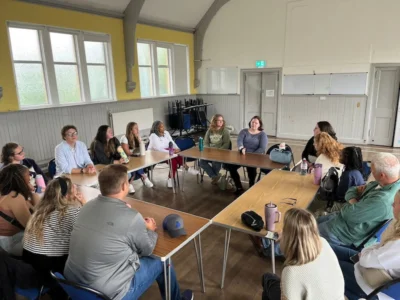
This pilgrimage renewed my hope. Worship on Iona was unlike anything I’ve experienced, embodied in lament, silence, song, and communal prayer. The Holy Spirit moved in the unspoken spaces, reminding me that faith is not always loud but always alive. I began to see myself more clearly again, not for the sake of striving, but so I could pour into others from a place of healing, not depletion, where often intercessors and servants of ministry struggle.
I left Scotland knowing this: the church must become inclusive.
As a young Black woman intrigued by the intersection of public policy, faith, religion and justice, I left Scotland knowing this: the church must become inclusive. Inclusive enough to hold lament and laughter, culture, tradition, and transformation. Inclusive enough to make room for young people not just as the future but as the now because we are here, we are listening, and we are ready to lead with grace and wisdom.
What is the Celtic Cross program?
By the Rev. Dr. L. “British” Hyrams, Jack and Jane Presseau Associate Chaplain at Presbyterian College
Celtic Cross is a well-established church leadership development program at Presbyterian College. Relaunched in 2023-2024, the program includes student participants from diverse denominational backgrounds. These students share a common commitment to continued leadership within the church, with some planning to pursue seminary education.
The program offers a multifaceted approach to leadership development. Participants are paired with PC(USA) churches across Spartanburg, Greenville, and Columbia, South Carolina, for mentoring and practical experience. Additionally, an annual spring retreat provides exposure to how churches in Charleston, Charlotte, and Atlanta are addressing contemporary societal issues, with locations rotating each year.
Thanks to the generous support of the Lilly Endowment’s Thriving Congregations Initiative, the next five summers will feature international trips. These trips will broaden the program’s scope, offering participants an international perspective on church history and an opportunity to explore innovative responses to needs within diverse global contexts.
Read more about Presbyterian College’s 2025 trip to Scotland in M.C. Dailey’s reflection, “A quieter, grounded faith: Discoveries on a Celtic Cross pilgrimage.”