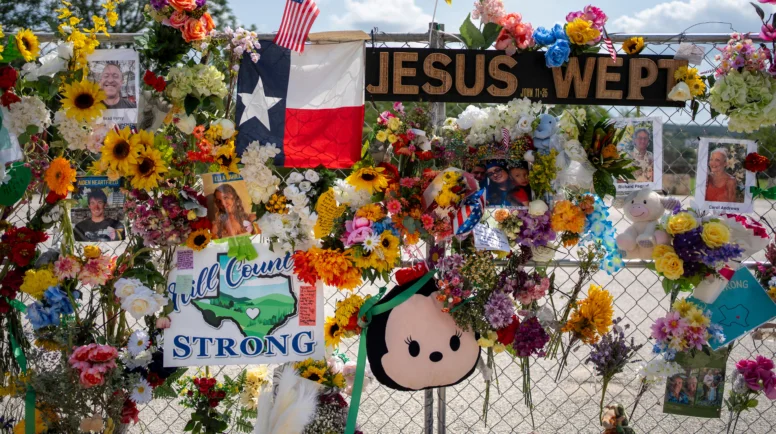
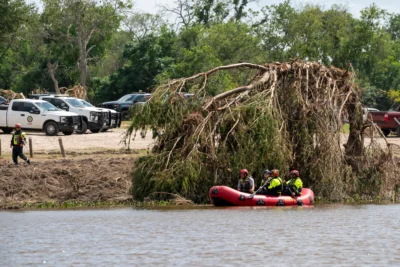
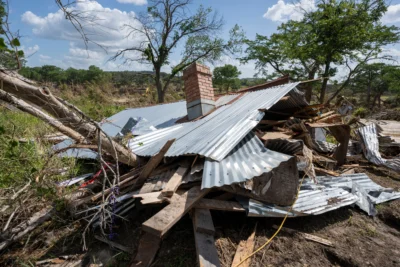
More than a month after flooding ravaged the Guadalupe River in Central Texas and killed at least 119 people on July 4 weekend, debris lines the riverbanks for miles and search efforts continue for two people who remain missing. Funerals and memorial services are held almost daily in Kerry County, and shock and grief are deeply palpable in the Presbyterian community and beyond.
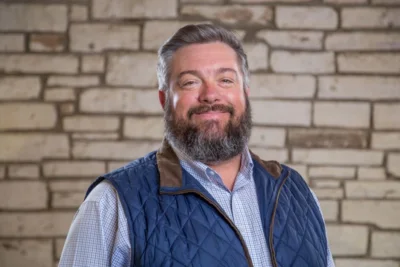
Tim Huchton, president and CEO of Presbyterian Mo-Ranch Assembly camp and conference center in Hunt, Texas, says some sense of normalcy has returned, but recovery and rebuilding are faraway notions.
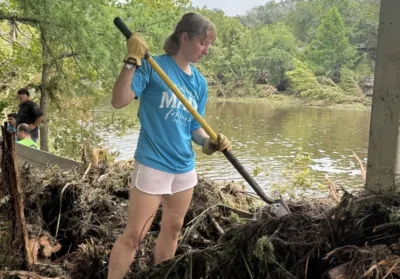
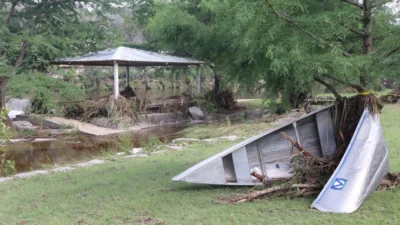
“The cleanup has started around us, but that’s nowhere near being concluded,” Huchton adds. “There are piles of debris everywhere. There’s still stuff in trees 20 feet up. I don’t even know what it is.”
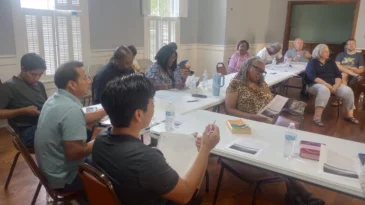
In the midst of the devastation and sadness, Mo-Ranch and two other longtime local Presbyterian institutions – Schreiner University and First Presbyterian Church of Kerrville – have leaned on each other to offer spiritual support, share resources and learn how to move forward together.
‘It still seems unreal’
Mo-Ranch, which sits on 500 acres on the north fork of the Guadalupe, had almost 600 people on the property the night of July 3 for conferences, summer camps and family reunions, with over 100 more scheduled to arrive the next day.
“Fourth of July weekend was supposed to be a really big weekend for Kerr County as a whole,” he says.
The staff evacuated people in the cabins by the river when they heard of the possibility of floods, but fortunately, the water didn’t rise as high as it did on the south fork of the river, where camps like Camp Mystic and Heart O’ the Hills saw massive devastation and loss of life.
“We knew that the river was coming up, but we didn’t necessarily know to what level,” Huchton says. “We were very fortunate that the water never made it into any of our buildings.”
The camp lost power around 3 a.m. July 4, while campers were still being evacuated, and it didn’t come back on until Saturday night. During those first two dark days after the flooding, Mo-Ranch staff communicated with families about their children’s safety and advised on alternate routes for picking them up. Cooks at Mo-Ranch continued making food for 600 people under lanterns and cellphone lights.
About 26 miles east down the river, waters had reached the Sidney Baker Bridge in the bustling city of Kerrville. Schreiner University President Charlie McCormick says it’s still hard to convey how unreal it seems that the waters rose to such a level — and so quickly. “I didn’t think the bridge was going to hold,” he says.
McCormick describes the first day as a “fog of war” experience. “I don’t like this phrase, but I think it’s very descriptive,” he says. “You couldn’t get phone calls through, and we were trying to reach people to see what was needed. Everybody was just trying to do something.”
First Presbyterian, Kerrville, is located just a few blocks from the bridge, and the first call Jasiel Hernandez Garcia received on July 4 was from a church member whose parents were stuck in a parking lot nearby. He headed to the church around 7 a.m. and saw the bridge, which is about .2 miles long, nearly flooded.
“That was when I knew this was major,” he says. “I couldn’t even begin to think about the devastation happening in other areas” where the river is not as wide.
Garcia and his team began trying to account for church members, especially those who lived in the Hunt and Ingram areas.
One of his main concerns was Heart O’ the Hills camp in Hunt, where First Presbyterian member and beloved community figure Jane Ragsdale was the longtime director.
But first, he received a call from Camp La Junta in Hunt, asking if the church could serve as a reunification center for campers and their families.
“I think that was one of the most difficult moments of that weekend, just seeing children come back with mud on them, without shoes and with dirty blankets,” he says. “They were hungry because they hadn’t really eaten all day. Thankfully, everyone was accounted for at the camp.”
The next day, the church received news that Ragsdale had perished in the flood. “At that point, we began shifting our ministry to communicating the news and providing spiritual care for people,” Garcia says, “because she was well known and loved by many here in our community.”
Ragsdale was an important part of all three institutions for decades, serving on the board of trustees at Schreiner and on the legacy council at Mo-Ranch.
“Every loss has been significant in our community,” Huchton says, “but Jane Ragsdale was a significant loss for each of our institutions. Just a truly special woman.”
Places of respite
With students out for the summer at Schreiner, campers vacated from Mo-Ranch, and space available at the church, all three Presbyterian institutions had room to begin housing – and often feeding – first responders and volunteers.
Schreiner housed around 400-500 groups for a few weeks, with boats, ambulances, fire trucks and more packing the parking lot.
“It’s just extraordinary to see … You get a better sense of the scope of the tragedy when you see how much equipment they have brought with them,” McCormick said.
Work teams don’t stay in one place long, often moving up and down the river as needs shift. Mo-Ranch hosted many canine teams who assisted with search and rescue and recovery, and the church hosted relief groups like the Red Cross and Crisis Response International.
The three institutions have also received an outpouring of aid and support from across the country and world, from individuals and small groups to other Presbyterian camps and churches.
Mo-Ranch, a member of the Presbyterian Church Camp and Conference Association, heard from leaders at places like Montreat Conference Center and Black Mountain Presbyterian Church in Western North Carolina, which suffered deadly flooding from Hurricane Helene in September 2024.

“Spaces like Mo-Ranch and Montreat are not in competition with each other,” Huchton says. “There’s a space for both of us, and the work that we do is sacred.”
McCormick heard from leadership at the Association of Presbyterian Colleges and Universities as well as the University of Pikeville in Kentucky, which has suffered from heavy flooding in 2021, 2022 and in February 2025. Pikeville President Burton Webb “was a trusted friend and counselor in those first 48 hours as someone I could talk to,” McCormick said.
“Words will never describe the level of gratitude we have for the amount of support that’s poured into our area,” Huchton says. “We would hope that that level of support and care follows us as we all continue the journey of rebuilding this community.”
‘Something new is coming’
The groups are channeling the support they’ve received into providing spiritual care and other services to the community.
First Presbyterian has established a case manager to coordinate grief services and financial assistance for congregants and beyond. And at Mo-Ranch, there’s a weekly chapel service and spiritual quiet room open to the community and people of all faiths.
“It’s a place for the community to come out if they need a break and a peaceful place to get away,” Huchton says. “We’ve really used this as an opportunity to branch out to the community and invite them to come be a part of the worshiping community out here.”
Despite the devastation, sadness and grief, they’ve all found moments of joy, beauty and spiritual sustenance in connections with others, and the three institutions look forward to continuing to build on the strong foundation of trust they have with each other.
“This recovery is going to take years, and I think we’re going to continue to find ways over the coming weeks and months and years to partner with each other,” Huchton says, noting that food scarcity and other societal needs could become larger issues after the flooding.
“The reality is, all of these emergency responders, their efforts will be redirected elsewhere at some point. There’s going to be another issue they have to address,” McCormick said. “But our three organizations and institutions will still be here and will remain. I think our opportunities for collaboration moving forward are going to be really pronounced and important.
“It’s not just restoration,” he adds. “It’s creating something new. … Something new is coming from all of this.”