“Do I really want to be integrated into a burning house?”
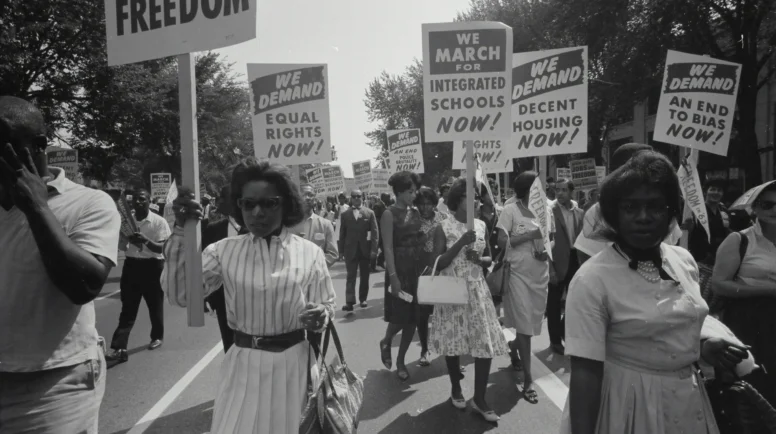
In his 1963 book The Fire Next Time, James Baldwin asked this question in the context of an America that was on fire over desegregation mandates. The question reflected African Americans’ concerns about the meaning of racial integration in 1962, eight years after the U.S. Supreme Court declared racial segregation unconstitutional and then mandated desegregation of the public school system. That same year, James Meredith, a 29-year-old army veteran, enrolled at the University of Mississippi as the first Black student admitted to the White institution.
But Americans who hoped that Black people’s inclusion in the nation’s public schools would create Martin Luther King Jr.’s Beloved Community were disappointed. That is because Black history reveals a persistent pattern in America: White supremacist institutions cannot be reformed enough to become spaces for King’s freedom dream of ecumenical, international communities marked by love. We must build new structures to fulfill those dreams.
Later that year, killers of that dream voted to elect George Wallace as governor of Alabama. His election reinforced America’s White supremacist pattern and demonstrated that calls for inclusion were not enough. Wallace declared in opposition: “Segregation now, segregation tomorrow, segregation forever!” His inaugural declaration spoke loudly to the masses who resisted Black freedom.
“Do I really want to be integrated into a burning house?”
Massive resistance was a movement that began in Virginia and spread throughout the South. More than a declaration, massive resistance was a Southern strategy to sustain White supremacist laws and policies that would guarantee elite White men control over public institutions and private property. The varied strategies included closing public schools while opening private Christian ones, as well as supporting White citizen rallies to block Black children’s entrance to school buildings. The movement grew to embrace violent bombings of churches and homes as well as drive-by shootings of pro-integration sites. Ultimately, the movement created conditions that set parts of the American homeland ablaze. The American empire was crashing in on itself. Anti-imperialists had predicted that outcome for years — because empires, being parasitic plunderers of labor and resources, always crash and burn.
Almost three-quarters of a century later, the American empire is still aflame. Immigrants and citizens alike fear for their safety. Students struggle in schools that ban books and hide histories. Politicians debate the validity of the climate crisis while corporations build energy-sucking data centers that promise unlimited revenue at the price of the nation’s water supply. Young people, who want only to believe they have a future, have become targets in the culture wars. Families stress over rising food costs and house payments. The gap between the rich and the poor grows. Houses of worship appear more content to serve national interests and less inclined to serve the least of these. In this context, Baldwin’s question feels ever more pressing to ever more people: Do we want to be integrated into a burning house?
Related reading: Damned Whiteness by David F. Evans, reviewed by Jessica Rigel
As I travel the nation, sharing insights from my 2025 book Damned Whiteness: How White Christian Allies Failed the Black Freedom Movement, concerned people respond with earnest questions. Where are the Black leaders like those of yesteryear? Are we adequately prepared for the crises that are growing and coming our way? Can we vote our way out of these problems? What can we do?
These questions represent the existential urgency of the many issues that threaten our communities. I am sometimes tempted to allow the moment to carry me away. However, my historical sensibilities remind me, as Oscar Romero once said, “to take the long view.”
The long view
From where I sit, the long view in America looks through the lens of Black freedom history. This view reminds me that Black people have built structures that are strong enough to withstand the worst of times. Through the Middle Passage, enslavement, segregation and mass incarceration, Black folks have long fought imperialism and its tools of White supremacy, patriarchy and capitalism. Sometimes militantly and other times nonviolently, Black folks have fought for freedom by building strategies, philosophies, movements and institutions that sustained them through urgent crises.
It is in this spirit that I propose that our best response to the burning house of America is to learn from Black freedom fighters about the importance of consistently building structures for planting, growing, organizing, informing and connecting. The patterns of American history predict that we will face hard times again and again, but we must persist.
The patterns of American history predict that we will face hard times again and again, but we must persist.
Many Americans today agree that the American house is on fire. Some want us to become firefighters to save the house, while others say the house is unsalvageable and that it is time to build a new one. We are asked to choose between reform and revolution. In my research, I have found that White allies’ calls for reform often appeal to the idea of forming friendships. These pleas take the form of diversity and inclusion initiatives in predominantly White institutions, where Black and brown people must assimilate to White norms and experience tokenization. In my assessment, such reformist measures keep too many oppressive structures intact.
I do not want to integrate into a burning house. So I suggest we move beyond inclusion to build a new house that is structurally sound and fire-resistant. This work takes time, skills and materials that many of us do not think we have. The structures in which we currently live have not prepared us for what we will need to maintain the structures of the new home or to interact with the people with whom we are to live.
The structures in which we currently live have not prepared us for what we will need to maintain the structures of the new home or to interact with the people with whom we are to live.
But we cannot wait. We cannot wait for politicians to fix our problems, and we cannot afford to go without a home. What are we to do between the burning house and the time needed to complete the new one?
Moving from inclusion to revolution
First, we must recognize that social transformations are built through sustained practices. Second, we must understand that for the revolution to last, it must be marked by love.
In other words, we must practice King’s concept of Beloved Community. Practice involves unlearning what empire has taught us and then learning together how to build a community skilled in loving actions like listening, study, mutuality, confrontation, repair, laughter, safety, challenge, communication and accountability. Such a community requires that people commit to building solidarity based in freedom movements.
In this spirit, I explore two priorities to which people interested in such a community should dedicate their time and resources:
- Join or support a community organization that is rooted in the Black freedom tradition.
- Build neighborhood networks where people can organize for freedom, build community, practice life skills and rely on one another.
Supporting Black freedom organizations
First, look for Black community organizations to support or join. One lesson I learned in my research was that good intentions can waste time and resources. We must prioritize impact over intentions, and we must value being effective over staying busy.
If we value social transformation, then we need to learn how to effectively achieve freedom goals. I know of no better way to learn than to seek out organizations that can mentor people in Black freedom traditions. I think here of long-standing organizations like the National Association for the Advancement of Colored People and more recently formed movements like Black Lives Matter. These nationally recognized Black freedom organizations are important for what they have accomplished in the past — and for what they are working toward in the present.
Local community leaders have also historically provided the foundation for movements before they achieve national renown. These lesser-known community leaders and organizations are often overlooked by people outside Black communities.
A few years ago, a White friend moved to a major East Coast city with a large Black population. He had decades of experience in ministry, government aid leadership and community organizing. He was aware of major initiatives to fight injustice and support struggling people. However, he was unaware of any efforts in his new city that were working to deal with gun violence. Troubled by what he saw, he called me to share his desire to start a conversation in the city — to do something about the problem. Though I had no personal community experience with the city – I had only visited a few times – I assured him that at least three organizations were discussing the issue and organizing to address it. He was not so certain. I asked him to do some research and call me back in a week. The next week, he called to let me know he had found several community organizations he could support.
But moving beyond inclusion requires us to do more than look for the helpers. We must also endeavor to become the helpers. The best helping is practiced together with folks who have knowledge of the region — its people, its history and its structures of power.
I have found that concerned people are meeting in every city or county where I have lived. Sometimes the gatherings only bring two or three people. Other gatherings may be standing-room only. This reality reminds me of something Mr. Rogers said years ago: “Look for the helpers. You will always find people who are helping.” But moving beyond inclusion requires us to do more than look for the helpers. We must also endeavor to become the helpers. The best helping is practiced together with folks who have knowledge of the region — its people, its history and its structures of power.
What could community organizations accomplish if churches and politically minded individuals were just as passionate about joining community organizations that tutor underprivileged children as they were about registering people to vote?
Experienced community organizers are untapped resources in a world on fire with crises. They also generally have fewer financial resources and fewer people working closely with them than national organizations have. What could community organizations accomplish if churches and politically minded individuals were just as passionate about joining community organizations that tutor underprivileged children as they were about registering people to vote?
I lament the deferred freedom dreams of people who are taught to wait two to four years to enter a voting booth to choose a political party candidate, but who have never known they can practice debt relief politics in their community every day.
Building local systems to support the common good
Waiting for politicians to put out fires that they started is not working. We cannot wait. So the second thing we must do is to recognize that the structures of our society have not been built for the ecumenical, international, loving community we envision.
The good news is that we can begin building the common structures that we need right now.
Related reading: Presbyterian Outlook’s February 2025 issue on civil rights
We can follow the advice of Kali Akuno, cofounder and codirector of Cooperate Jackson in Jackson, Mississippi, who recommends that every lawn can become a garden and every garage can become a workshop. Imagine if, instead of wasting water and fertilizer on grass, we turned our lawns into spaces of food sovereignty. Imagine if garages, instead of serving only as warehouses for surplus belongings or containers for our cars, could become workshops where neighbors could share tools and building plans.
What if we allowed that vision to inspire us to make every porch a town hall and every house a community center? Can you imagine neighbors gathering for porch-sits, eating snacks and drinking refreshments, while they organized to transform their community? Can you imagine if homes with empty rooms or underutilized spaces could offer shelter or recreation for neighbors? What a wonderful world this could be!
Building neighborhood networks is not all work. In addition to providing recreation spaces, our backyards and streets could become gathering spaces for cookouts and celebrations. One of the exciting activities in my local community organization, Cooperate Shenandoah, is making our backyards into cookout spaces where like-minded community members come together to share good music, good food and fun. This gathering with friends in pursuit of freedom is also a space where serious conversations break out among people doing great work around town, but who might not know each other well. New initiatives are born out of these gatherings, and the work continues.
We do not always accomplish everything we set out to do on our porches, in our gardens, out in the backyard, in the garage or in the streets — but we understand that learning how to build and then building together are essential to the work.
Firefighting alternatives
My work is not primarily of the firefighting variety. I believe that we will not overcome the most pressing issues of our day merely by including more people in structures that are designed to accommodate imperialism, capitalism, racism, sexism, materialism or militarism. We must work instead to build alternative houses of mutuality in which we organize for freedom.
Certainly, we must also put out fires because we are all affected directly or indirectly by the flames that engulf the nation in which we live. That said, I do not want to be integrated into a house on fire with injustice and oppression or into a structure smoldering with embers that could burst into flames at any moment. Rather than being included in the imperial, White supremacist, patriarchal, capitalist spaces destroying the world, I want to join movements that are made for freedom — where love binds people together, and where mutual support empowers international and ecumenical communities to determine their own destiny. Such a destiny can be realized only by dreaming beyond inclusion. To fulfill these destinies, our collective dreaming must be grounded in building new freedom-seeking structures where we can practice living in Beloved Community.