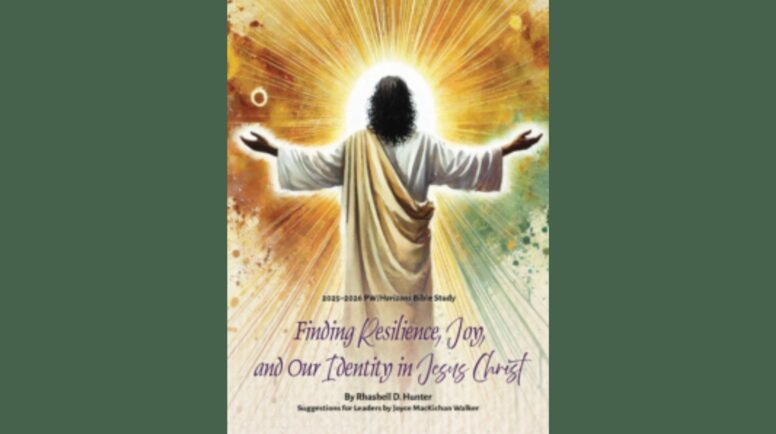
Finding resilience, joy and our identity in Jesus Christ
Rhashell D. Hunter’s Horizons Bible Study
Lesson 9: Luke 24:13-35 — The Road to Emmaus
The story of the road to Emmaus is a tale of raw emotion. The despondency of two disciples following the death of Jesus is met with the sudden thrill of the resurrected Christ walking beside them. Initially, they do not recognize him. How could they? They believe Jesus is stone-cold dead. Their doubt is tangled with perplexity over the women’s report of an empty tomb.
We often share this doubt. It arises when a prognosis is grim, during financial hardship, or when national turmoil leads to the deaths of foreigners and U.S. citizens alike. As I write this, thousands are protesting the lethal force used by Immigration and Customs Enforcement. Watching the news cycle, it is easy to doubt that Christ is at work.
A disciple named Cleopas says, “We had hoped that Jesus was the one to redeem Israel.” There is such poignancy in that phrase of longing. We know the disappointment of hope unfulfilled: “We had hoped the medicine would work.” “We had hoped she would get the job.” “I had hoped the marriage would last.”
Cleopas is walking with another disciple, perhaps his wife. Jesus listens to their disillusionment, but he does not offer a standard pastoral response. He doesn’t say, “I understand your disappointment.” Instead, he grows indignant.
“So thick-headed! So slow-hearted!” he says. “Why can’t you simply believe all that the prophets said?” Like a teacher determined not to let his students fail, Jesus addresses their “denseness” by explaining the Scriptures, from Moses through the prophets.
As the day fades into dusk, the disciples invite Jesus to stay. At dinner, Jesus takes the bread, blesses it, and breaks it. In that moment, they recognize him — and then he vanishes. The disciples turn to each other: “Did not our hearts burn within us as he explained the scriptures? (Luke 24:32)”
Have you ever had the experience of Scripture grabbing your imagination and changing you?
I think of several people “claimed” by the Word. A friend listening to a sermon on Isaiah 61 felt compelled to volunteer at an inner-city Bible school, despite her family’s fears. A wealthy woman, after nine months of Bible study, felt called to ministry in Haiti. A teenager struggling with his appearance listened to a preacher with a crooked spine speak of God’s love. The boy thought, “If he feels the love of God, then God can love me, too.”
I remember a college lecture on Genesis 1. For the first time, I truly heard that I was made in the image of God, and the realization felt like electricity. When Scripture penetrates us and changes us for the better, Christ is walking with us.
He is present at the sickbed and in the hospital room. I once saw a family keep vigil by a dying man, playing hymns and praying the Lord’s Prayer aloud. Christ was in that room.
Jesus is made known to us through Scripture, prayer, and hymns. Sometimes, he is present in the words of a stranger or a friend. Other times, he appears in a call to action. Believing all people are precious to God, 100 clergy members once blocked a terminal in Minneapolis where immigrants were being deported. They were arrested one by one. In such committed action, we see Christ at work.
You can purchase the PW/Horizons Bible study book through the PC(USA) Church Store.
Want to receive Horizons content in your inbox? Sign up for our worship resources newsletter here.