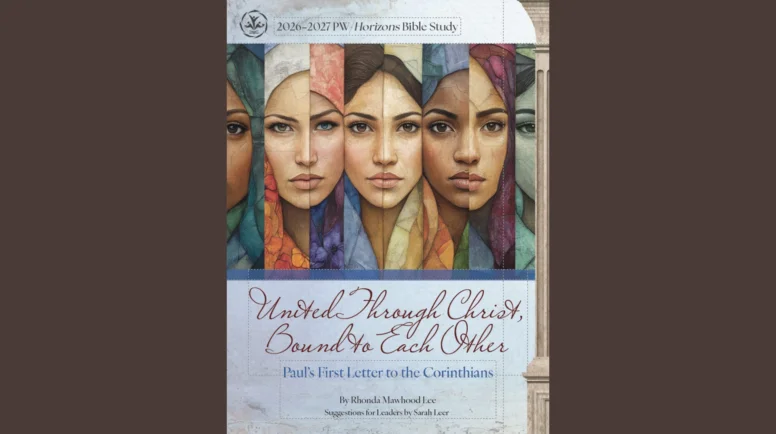
United through Christ, Bound to Each Other: Paul’s First Letter to the Corinthians
Rhonda Mawhood Lee’s Horizons Bible Study
Overview
It was one messed-up church. There were quarrels and divisions over leadership. People were judgmental toward others and arrogant, believing their opinions were right. There was disagreement about sexual relationships. Christians were filing lawsuits against each other instead of working things out as Christian siblings. There were divisions along economic lines, with a heartless attitude toward poor people. There were fights about who Jesus is, styles of worship and who was spiritually superior. The church in Corinth had an overabundance of problems, some of which we have today.
Surprisingly, the Apostle Paul begins his letter with thanksgiving for the grace given to them in Christ Jesus. He praises their knowledge and abundance of spiritual gifts. The greeting seems ironic because knowledge and gifts have also created such divisions in the community of faith.
Rhonda Mawhood Lee, author of the Bible study United in Christ, Bound to Each Other, describes the problem in the Corinthian church as “a lack of love that betrayed Christ’s saving act in resurrecting Christ.” That issue manifests in factions arising from reliance on cultural values rather than Christian ones. Christianity, then and now, was countercultural, and it was difficult for the small group of Christians to stand against societal norms.
Established in 44 B.C. by Julius Caesar, Corinth was made up of upwardly mobile freed persons. It was cosmopolitan, and material goods flowed in and out of its ports. It was known for its art, philosophy, athletic games and debauchery. Sailors brought their own gods with them, and there were structures dedicated to at least 24 different gods in Corinth.
J. Paul Sampley, in “The First Letter to the Corinthians,” The New Interpreter’s Bible, described the city as “wealthy without charm and not the least convivial.”
Paul reminds the Corinthian Christians of the basic conflict between the wisdom of culture and God’s wisdom, which comes from the Holy Spirit. Greeks look for well-reasoned arguments and Jews want miraculous signs, but Paul preaches Christ crucified, which is sheer lunacy according to the world’s values. Time and again, Paul contrasts what is happening in the church with the patterns of Christian belief.
Throughout the letter, Paul emphasizes unity in Christ and love and respect for each other. Is there a believer whose faith is weaker than your own? Do not do anything that causes a fellow Christian to falter. Do you have important spiritual gifts? Remember that all spiritual gifts are needed. Are you convinced that one leader is far better than another? Remember, we are all servants of Christ.
One of the Beatles’ songs is “All You Need Is Love.” Paul would agree. 1 Corinthians 13, “The Love Hymn,” sings to us of the more excellent way. This chapter is often read at weddings, and appropriately so, yet Paul is writing to a church in conflict, describing a way of life in which people show kindness and patience and do not insist on their own way. Such love rejoices in the truth and shuns boasting. It bears with one another and places hope in God. It is such a loving action that can bind the church together.
Except for lessons eight and nine, the study examines two or three chapters of 1 Corinthians at a time and asks how the letter applies to us today. Lesson five, covering chapters 8-10, is where Paul establishes appropriate behavioral boundaries. In Christ, all things are lawful, but not all things contribute to the well-being of others. Therefore, Paul argues that self-restraint is needed lest we cause others to waver in their faith. Though the issue for the early church was eating meat sacrificed to idols, contemporary parallels might include patriotism and faith, the consumption of violent media or how we safeguard the alcoholic among us.
In reading 1 Corinthians, it is important to remember that it is a letter, and we do not have the correspondence that prompted Paul to write. Rather, we have fragments of letters that have been pieced together. 1 Corinthians is probably the second letter Paul wrote to the church, with fragments of other epistles woven in.
A stumbling block for both Jewish and Gentile Christians was the resurrection of Christ. No one could have been prepared for Jesus being raised from the dead. Not all Jews believed in a bodily resurrection. “Among those that did, the question of whether Jesus himself had been raised divided Jews who would become Christians from the majority of other people,” according to the study. Some pagans emphasized the immortality of the soul. We, like those early Christians, may also find Jesus’ resurrection hard to swallow. Paul asserts that Jesus’ being raised from the dead is central to the Christian faith.
In United Through Christ, Bound to Each Other, we will come to understand early church conflicts and how some of the same problems persist today. It should provide an engaging study and rich discussion.
You can purchase the PW/Horizons Bible study book through the PC(USA) Church Store.
Want to receive Horizons content in your inbox? Sign up for our worship resources newsletter here.