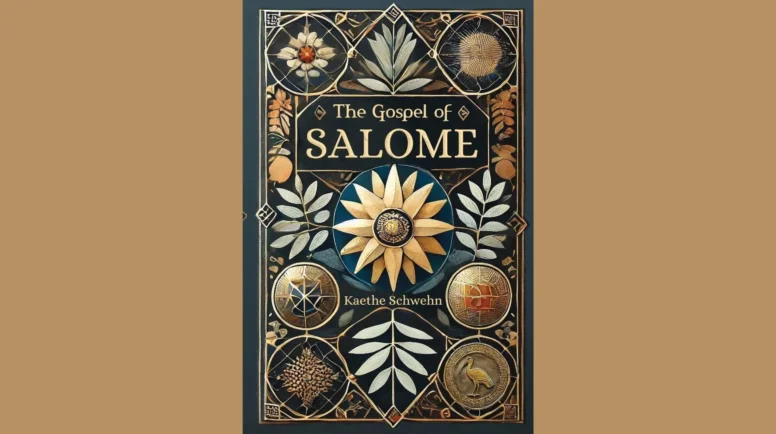
The Gospel of Salome
By Kaethe Schwehn
Wildhouse Fiction, 330 pages
Published October 15, 2025
With limited influence from and frequent subversion of the canonical gospel narratives, Kaethe Schwehn’s The Gospel of Salome boldly reimagines the life of the historical Jesus of Nazareth within a detailed portrait of the first-century Mediterranean world. Schwehn’s Jesus – Yeshua, in Aramaic – is distinct from the Jesus of the Gospels. He is a prophet with an indeterminate mission whose origins diverge significantly from familiar birth narratives. Schwehn presents Yeshua as thoroughly immanent and seems uninterested in what history can neither confirm nor disprove, such as divinity or resurrection. Instead, she invites readers to grapple with the historical Jesus’s humanity and to discover the intersecting worlds in which he lived. While Schwehn’s reduction of Jesus from Christ to Yeshua will invariably alienate some readers, her invitation to grapple with the historical Jesus’s humanity and to discover the intersecting worlds in which he lived is worth consideration.
[Schwehn] invites readers to grapple with the historical Jesus’s humanity and to discover the intersecting worlds in which he lived.
As the title indicates, however, The Gospel of Salome is an account not of the life of Jesus or even Yeshua, but rather the life of Salome — the female disciple from Mark 15 who was present at the crucifixion. Schwehn is at her most compelling when she centers how women survive and navigate their callings in circumstances beyond their control, and explores how unassuming lives are transformed in extraordinary circumstances. Schwehn imagines that Salome, once enslaved, lived alongside Yeshua’s family before studying medicine. Salome becomes singularly dedicated to her vocation, believing that without it she would be “an old woman of no real use to anyone.” Schwehn indulges this preoccupation to a digressive effect, bringing Salome to Alexandria, where the story unfolds over six days in the summer of 38 CE.
The arrival of John Mark (understood in early Christian tradition as the first preacher of the Gospel in Alexandria) further complicates Salome’s urgent duty to treat illness in the New Jewish Quarter. John Mark, whom Salome considers “the kind of person who is the first to die in a riot,” is tasked with recording her stories about Yeshua. The physician’s impatience with religious faith leaves her with little capacity to assist the evangelist, and she offers her recollections begrudgingly. While Mari (Mary) had offered Yeshua, her son, a robust education in the Torah, it was Salome who trained him to heal. Salome recalls that the long-standing tension between them regarding his vocation reached a breaking point when he met John the Baptist.
Salome’s instinctive determination to exercise agency is a liability that prevents her from recognizing events of spiritual significance for others and of personal consequence to her, particularly as she dismissed Yeshua’s calling: “If he wanted to become some sort of prophet, he had to understand the life he was not taking up, that there were other choices besides Nazareth and swindling bewitched faces around a fire.” Salome does not meet Yeshua again until the crucifixion, though their relationship continues to shape her years after his death.
Schwehn assumes few inevitabilities in her portrayal of Yeshua and enjoys offering him multiple trajectories. This approach invites readers to contemplate the competing expectations and obligations that the historical Jesus faced and to imagine that multiple paths were available to him. By focusing on Salome, mentioned only briefly in the Bible, Schwehn also invites us to imagine the obscured lives in the Gospels, transformed by a single man.
Presbyterian Outlook supports local bookstores. Join us! Click on the link below to purchase The Gospel of Salome from BookShop, an online bookstore with a mission to financially support local, independent bookstores. As an affiliate, Outlook will also earn a commission from your purchase.
Sign up for Page Turners, our monthly email newsletter, to receive book-related content in your inbox once a month.