Recently, I came across a poem by James Weldon Johnson called “The Prayer” from his collection God’s Trombones. When I read the first few lines, I smiled.
“O Lord, we come this morning
Knee-bowed and body-bent
Before Thy throne of grace.
O Lord—this morning—
Bow our hearts beneath our knees,
And our knees in some lonesome valley.”
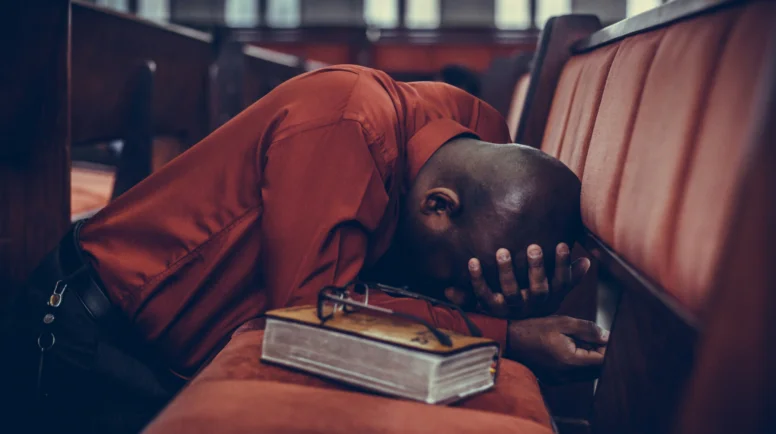
I smiled because I had heard those words before. Not Johnson’s exactly, but close enough. They took me back to my grandparents’ church in Chestnut, Louisiana. The deacons would sit up front singing hymns, and one of them would slowly bow down, place his elbows on the chair he had just been sitting in, fold his hands, lower his head, and begin to pray.
“Morning Lord, I come to you as humbly as I know how,
while the blood is still running warm in my veins.
Lord, I thank you that my bed was not my cooling board,
and my cover was not my winding-sheet.”
As a child, I did not know that a cooling board was where bodies were laid before burial, or that a winding-sheet was a burial shroud. I only knew that the deacon’s voice trembled with something I had not named yet, and that something holy was happening in the room.
The deacons knew something many of us have forgotten.
I keep returning to those prayers. Not because I miss being a child – I don’t, particularly – but because I want to know what those men knew. They prayed in a position of humility. Body bent. Heart, as Johnson said, lower still. What did that mean? And what does it have to do with how I pray now, in motion, distracted, and often already thinking of the next thing?
I think the deacons knew something many of us have forgotten. They learned it in the fields and on the railroad tracks. To bow is to confess. It is to admit, before a single petition is uttered, that I am not the center, that the throne is not mine, that I have come bringing nothing but the breath in my lungs — and even that was loaned to me overnight. There is no presumption in this deacon’s prayer. There is only wonder that the one praying is still here at all.
We do not pray this way much anymore. We have grown more intellectual, more articulate, more sophisticated — or so we tell ourselves. We have decided such posturing is unrefined, beneath us, behind us. Whatever we have gained in eloquence has not earned us the deacon’s certainty that the breath in our lungs is borrowed.
In Luke 18, Jesus tells a parable about two men who went up to the temple to pray. One stood and recited his accomplishments. The other “would not even lift up his eyes to heaven, but beat his breast, saying, ‘God, be merciful to me, a sinner!’” Jesus said it was the second man who went home justified. The position of his body was the position of his heart — and the position of his heart was the truth.
The valley is where prayer learns its true voice.
The apostle Paul wrote to the Ephesians, “For this reason I bow my knees before the Father” (Ephesians 3:14). He was not describing a posture for show. He was describing the only honest posture for a creature in the presence of the Creator. Even Jesus, in Gethsemane, fell on his face and prayed. If the Son of God knelt, who am I to stand stiff-necked before the throne of grace?
The position Johnson and the deacons described was not despair or groveling. “Bow our hearts beneath our knees, and our knees in some lonesome valley” — this is not the language of the defeated. It is the language of those who have been met in low places before, and who trust God will meet them there. They know the valley is where God shows up. The valley is where prayer learns its true voice.
A position of humility in prayer is not about whether we kneel or stand or sit or lie face down on the floor. The Reformed tradition has never been rigid about posture. But it does insist that we live by grace alone, that every breath is a gift, and that we have nothing to bring to God except ourselves and the blood that, by mercy, is still running warm.
I find that comforting. I also find it humbling — which may be the point. The position of prayer is not about my eloquence or my discipline or even my faithfulness. It is about the one who holds me up while I bow. I do not have to manufacture the prayer. I only have to come.
I find that comforting. I also find it humbling — which may be the point.
Johnson’s prayer does not end at the bowing. It ends at the grave.
“When I start down the steep and slippery steps of death—
When this old world begins to rock beneath my feet—
Lower me to my dusty grave in peace
To wait for that great gittin’-up morning—Amen.”
This is the prayer of someone who has bowed his whole life. He has practiced humility so often that even death does not surprise him into a different posture. He is still asking to be lowered. He is still trusting. And he is waiting on the morning.
The deacon who thanked God his bed was not his cooling board was already trusting that one day it would be, and that this would not be the end of him. The bow and the rising belong to the same prayer.
So, I am trying to come the way the deacons came. I want to learn what their bodies already knew. Knee-bowed and body-bent. Heart lower still. Trusting that the God who meets me in the lonesome valley will meet me on that great gittin’-up morning.