On Monday morning, General Assembly 227 completed all items of business from the Racial Justice Committee, including RAC-04, “Final Report of the Special Committee on the Presbyterian Church (U.S.A.) and Race,” which sparked debate about the inclusion of the phrase “White Christian nationalism.”
Perhaps the most controversial part of the RAC-04 discussion was the motion by Ruling Elder Commissioner (REC) Bisham Singh of the Presbytery of the Highlands of New Jersey, who moved to strike “White Christian nationalism” from the item of business, saying that the term is “unnecessarily inflammatory and serves no valid purpose.”
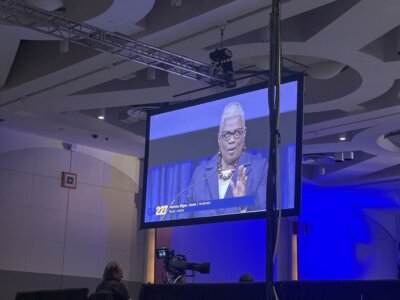
REC Hamilton Singleton from the Presbytery of the Pines spoke in favor of the amendment. “To leave the White Christian nationalist language in this motion is nothing more than racism,” he said.
“I thought we were all here to love even our enemies, and I’m not a White racist, but we have to be very careful, we have to be very careful indeed about who we label our enemies and even those we need to love.”
However, a number of people spoke against this amendment, including Teaching Elder Commissioner (TEC) Donna Elia from Albany Presbytery, who said naming White Christian nationalism is important to the Presbyterian Church (U.S.A.)’s commitment to anti-racism and that removing this phrase would weaken the work of RAC-04.
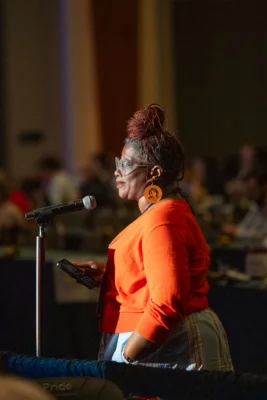
Shani McIlwain, a corresponding member of the Racial Equity and Advocacy Committee (REAC), said, “Naming White Christian nationalism helps us to be precise. We are not talking about Christianity as a whole, nor are we talking about all White Christians. We are naming a specific ideology that has historically shaped laws, institutions, and public life. If we refuse to name it, we risk normalizing harm and allowing oppressive systems to remain invisible.
“Naming it gives communities language to identify how faith is being weaponized or political or socially controlled,” McIlwain said, “and [the reason] the term ‘White’ matters is because race is central to how the ideology functions.”
The amendment was voted down by 92% of commissioners, and the discussion moved back to the main motion. Other amendments were made, however, including making anti-racism training required for General Assembly commissioners and advisory delegates, and setting a guideline of September 1, 2027, for making anti-racism training available. RAC-04 passed as amended with 95% approval.
RAC-01, on establishing a Special Committee on African American Ecclesiastical Repair, was referred to Presbyterian Life and Witness (PL&W) and passed by 94% without debate. The committee would study historic and ongoing harms African American Presbyterians have experienced in denominational structures and would include examining the impacts of White supremacy culture, implementing pilot repair processes, and recommending methods for repairing harms.
Commissioner’s resolution RAC-05, which asks Presbyterian Life & Witness to reinvest in and strengthen its racial equity and intercultural ministries, ensure they have a clear place in the denomination’s structure, and make them more accountable and better connected to the church’s domestic mission, was passed by 97% with some discussion and questions about the capacity of PL&W to take on this work, as well as the financial implications.

The Racial Justice Committee had concerns about its implementation process, as congregations and staff who would be affected by this item were not consulted in shaping the resolution. By referring this item to PL&W, the committee hoped for a more collaborative implementation process that promotes relationships and trust.
Jeny Carlson, teaching elder commissioner (TEC) from Seattle Presbytery, said, “The database and training required in this item are expensive. But the true reconciliation, reparation, and transformation cannot be bound by a price tag. Justice delayed is always justice denied…Why do people who preach resurrection refuse to let structures of harm die?”
Additionally, Corey Schlosser-Hall – PL&W senior director for partnerships within the PC(USA) – clarified the financial implications, stating that part of those resources will be allocated to a staff position to continue the work of the PC(USA)’s Matthew 25 initiative.
The assembly also approved RAC-03, the Resolution on Liberia Project 180, which directs the PC(USA) to begin examining its historic role in Liberia. The action calls for research into the denomination’s involvement with the American Colonization Society, a deeper partnership with the Presbyterian Church of Liberia, and the development of an acknowledgment and apology for the harms connected to that history. It also encourages long-term collaboration between U.S. and Liberian Presbyterians through theological education, historical study, and shared ministry, framing the work as an effort toward truth-telling, reconciliation and repair.
The resolution’s rationale states, “history warrants careful reading. The work of truth-telling is not symbolic; it clarifies why structured, sustained engagement is necessary.
“Liberia Project 180 emerged from a 2023 encounter between the Center for the Repair of Historic Harms and leaders of the Liberia Council of Churches,” the rationale says. “That encounter invited renewed reflection on the Presbyterian Church’s historical involvement in the American Colonization Society (ACS) and the long-term consequences of that involvement for the people of Liberia.”