The Pride parade in Cleveland, Ohio, had just emptied into the public square.
Participants moved toward food vendors, booths, and the main stage. Spectators stepped off the sidewalks and into the crowd. The energy was festive, chaotic and joyful.
Then I noticed the street preachers.
They shouted condemnation through amplified voices. Their message was loud, aggressive and reinforced by graphic displays intended to shock and intimidate.
Yet what I remember most from that moment was not the shouting. What I remember is the church.
As the hostility intensified, several Presbyterians from the Presbytery of the Western Reserve stepped forward. Pastors and church members alike positioned themselves between the preachers and those being targeted. They did not respond with arguments. They did not try to outshout the shouting. They simply stood in the space between.
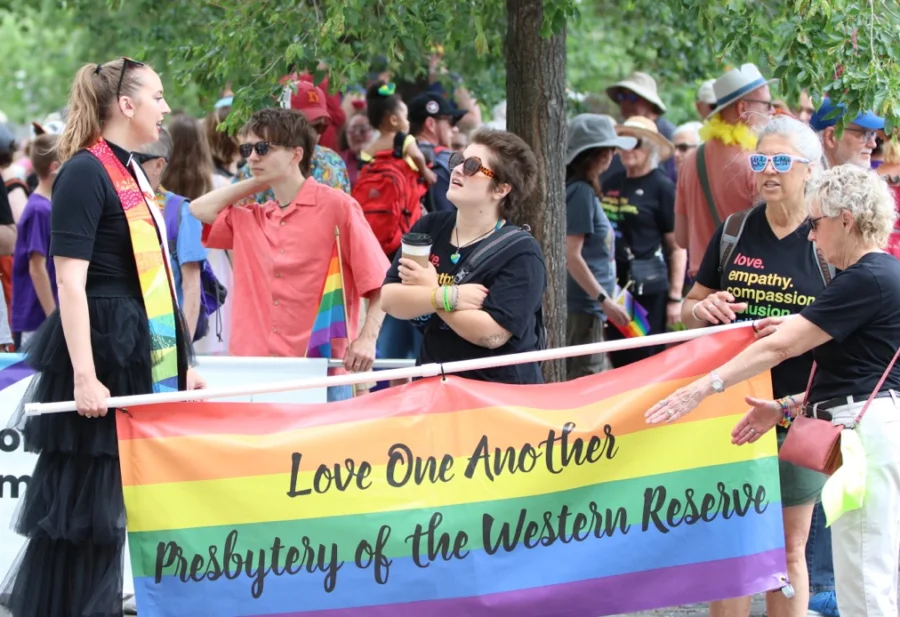
Among those who stepped forward were two pastors, Lindsay and Zoë.
Lindsay stood facing the crowd with her back toward the hostility. At one point, she stretched out her arms and remained there.
Watching her, I thought of how the Psalms repeatedly speak of finding refuge beneath the shadow of God’s wings. Again and again, Scripture returns to the image of God sheltering vulnerable people, drawing them close and providing safety amid danger.
As Lindsay stood, arms extended and body positioned between hate and its intended targets, it was as though she was creating shelter. I do not know what she was thinking in that moment. But I saw a pastor using her own presence to create a space of peace.
Nearby, Zoe began to dance.
Not perform. Not distract. Dance.
Slowly and joyfully, she moved within the crowd as though she were participating in a different reality than the one being proclaimed through the bullhorns.
I thought of Miriam, who, after generations of slavery and the threat of Pharaoh’s army, took a tambourine in her hand and danced on the far shore of the Red Sea. Her dance was not a denial of danger. It was testimony to God’s deliverance.
Watching Zoë, I sensed something similar.
The hateful words had not disappeared. The hostility remained present. Yet her joy refused to grant those voices ultimate authority. Her actions seemed to say, “You may speak words of condemnation, but I will rejoice in the faithfulness of God.”
Days after these events, I find myself continuing to think of Lindsey and Zoë’s actions, and it occurs to me that the preachers were proclaiming propositions, but the Presbyterians were embodying God’s reign of shalom.
One side was announcing what it believed.
The other was creating a small space where God’s peace, protection, joy and welcome could be experienced.
Shalom is more than the absence of conflict. It is the presence of God’s wholeness, where people are protected, welcomed, restored and free to rejoice. For a few moments in Cleveland, I watched Presbyterians create such a space.
Shalom is more than the absence of conflict. It is the presence of God’s wholeness…
We often assume that witness belongs to the loudest voice. We imagine that faithfulness requires winning arguments, dominating conversations, or finding increasingly effective ways to proclaim our convictions.
But the center of our faith is not a bullhorn. It is the incarnation — God taking on flesh.
It is Jesus standing among people, touching lepers, eating with outcasts, weeping at gravesides, washing feet and stretching out his arms in love even while surrounded by rejection and violence. Because Christianity is not a set of ideas to be defended. It is a way of life to be embodied.
Jesus did not simply teach about mercy. He showed mercy.
He did not simply preach about welcome. He welcomed.
He did not simply proclaim God’s reign. He enacted it.
That afternoon in Cleveland, I watched Presbyterians do the same. At the end of the day, the loudest voices belonged to the people with the amplifiers. Yet those voices are not what stayed with me. I will remember a group of Presbyterians who stepped into the space between hostility and vulnerability. I will remember Lindsay standing with arms spread wide. I will remember Zoe dancing.
And I will remember that, on a noisy afternoon in Cleveland, the gospel was not the loudest voice in the square. But it was the clearest.