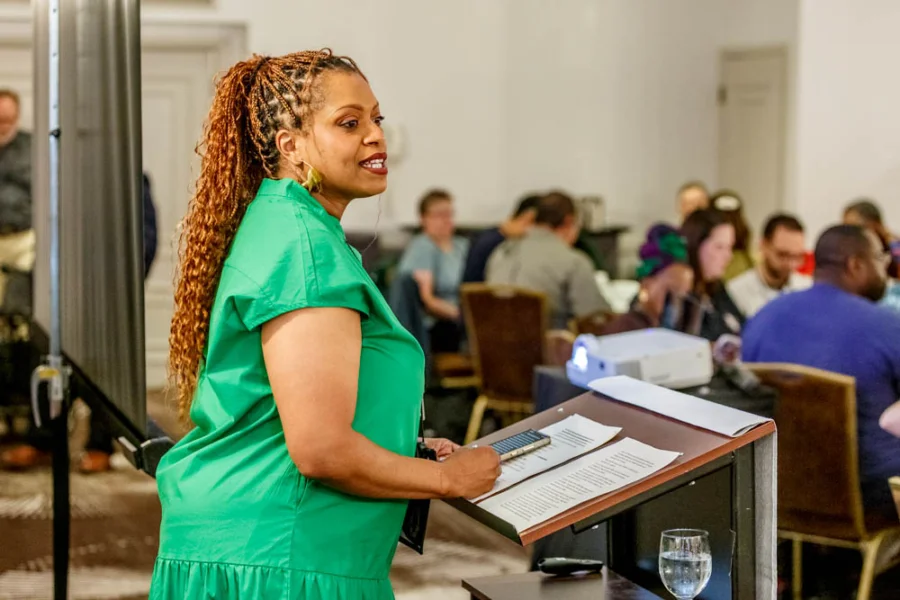
MILWAUKEE — Speaking to attendees of a gathering sponsored by Columbia Theological Seminary, Denise Anderson, a board member at the seminary, addressed “the elephant in the room” and spoke to a recent decision to eliminate 18 positions, many of whom were people of color.
“The board was prayerful and thoughtful and anguished,” Anderson said at the luncheon hosted by the Decatur, Georgia, seminary at the 227th General Assembly of the Presbyterian Church (U.S.A.). “And much hurt was caused.”
“I initially came on this board because … I deeply believe in this institution. And so I came on the board with joy, with much optimism, and I still believe in this institution,” Anderson said.
“But I also named the elephant in the room that recently the institution has had to make some difficult decisions, decisions that were not made capriciously — but were made thoughtfully with deep prayer, and with a lot of anguish.”
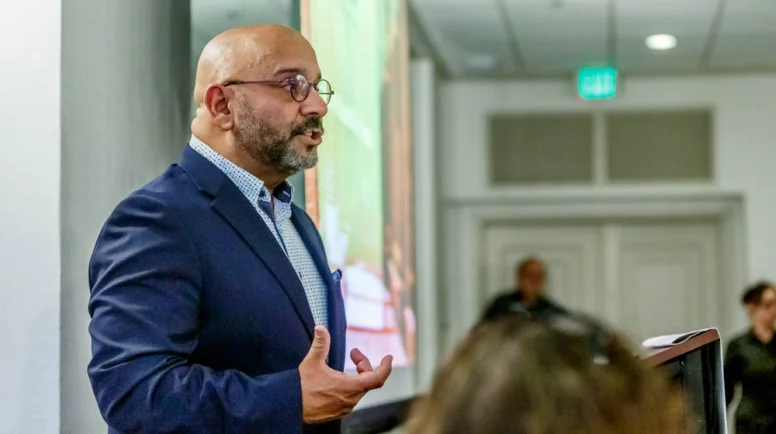
Victor Aloyo Jr., Columbia’s president, and board chair Elizabeth Cole Goodrich both acknowledged that a significant number of the eliminated positions had been held by people of color. Both denied race was a factor.
Aloyo, addressing the restructuring directly in his remarks, called the past year “one of significant institutional recalibration” and said the changes carried a real cost.
“These strategic mechanisms and other organizational changes have been painful, and have been painful for our entire community, and we acknowledge its profound human cost,” he said.
“Let me be clear,” Goodrich said in a pre-recorded video address. “While I understand these concerns, race was not a factor in these decisions. The decisions made were grounded in careful good-faith discernment guided by our mission and carried out with integrity and respect.”
Columbia announced on June 11 that seven employees had accepted early retirement and 11 others were let go through a reduction in force. The board had approved the realignment plan in May following a multi-year institutional assessment. A new organizational structure takes effect July 1.
Aloyo told the luncheon crowd, “We recognize that many members of our community have observed that a significant number of the positions eliminated in the reduction in force were occupied by persons of color. We understand why this reality has raised important concerns, and we take those concerns seriously. At the same time, the restructuring process focused on organizational functions, institutional priorities, and long-term alignment rather than personal characteristics and personnel performance.”
In response to questions about using the endowment to preserve faculty positions, Goodrich, appearing by video because of family commitments, said the endowment could not be used because those funds are restricted by donor intent, many dating to the seminary’s move from Columbia, South Carolina, to Decatur in 1927.
The assembly floor challenge
The restructuring had already drawn formal scrutiny at GA. According to Presbyterian News Service reporting, on the assembly’s first day of committee work, teaching elder commissioner Daniel McCurdy proposed an amendment to ORD-10 – confirmation of new trustees elected by PC(USA) theological institutions – that would have removed Columbia’s newly elected trustees from the approval roster.
PNS reported that McCurdy cited the board’s “discriminatory hiring and firing practices” dating back more than half a decade, including the seminary’s recent announcement, and said the decisions had repeatedly and disproportionately affected people of color despite the seminary’s stated commitment to diversity, equity and inclusion. “Don’t ask us to trust you … show us the work,” McCurdy said.
McCurdy’s amendment did not pass. Young Adult Advisory Delegate Alexander Boltz proposed a substitute comment calling on all the represented seminaries’ boards of trustees to “review hiring and firing practices in respect to increasing diversity, equity, and inclusion as restructuring and reorganization take place.” Boltz’s amendment passed 55-4, and ORD-10 was approved with that comment attached.
Enrollment gains amid the controversy
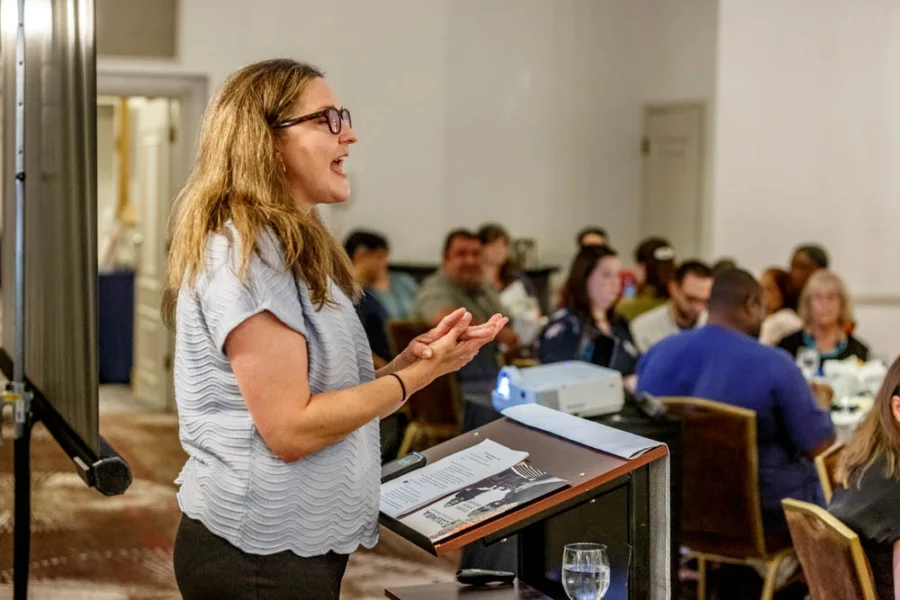
In defense of the seminary, Aloyo reported that 59 students have enrolled for 2026-27 – nearly double the previous year – and that 60% of the incoming class are people of color, 52% are women and 5% identify as transgender. The seminary graduated 51 students in May 2026. Four faculty hires over the past three years have all been people of color; the Biblical Studies department is now 71% women.
The seminary is also launching a redesigned Master of Divinity program at 77 credits, down from 90, with flexible 2-, 3- and 5-year completion options. The first cohort is being recruited for 2027-28.
Anderson, who did not graduate from Columbia, said she joined the board in part because of a personal connection to the seminary’s alumni and leadership. She framed the institution’s moment in terms the president and board chair had not. “I truly do believe that Columbia can provide a strong counter witness,” she said, adding that in this particular moment, it is important for the church to be prepared to counter harmful theologies.
Aloyo invited those with questions to contact him directly, saying he has responded personally to alumni correspondence since the restructuring was announced.