The debate behind CON-10
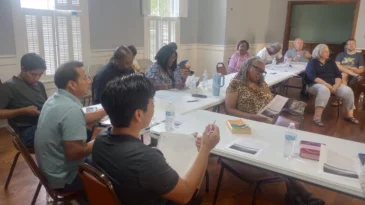
The Presbyterian Church (U.S.A.) 227th General Assembly Constitutional Interpretation Committee voted yesterday 45-12 in favor of a recommendation to forward the context and concerns of CON-10 to the Advisory Committee on Social Witness Policy (ACSWP) for inclusion on the recommended formation of GEN-09, “Beyond Changing Families: Flourishing Relationships and Belonging.”
Related reading: “Overture requiring PC(USA) ministers to be monogamous generates debate, confusion” by Gregg Brekke, Presbyterian Outlook reporting
While rampant online speculation about the PC(USA) debating whether its clergy should be required to be monogamous drew headlines, clicks, and heated debate, monogamy was not the core of the issue being discussed by the committee.
Related reading: “One flesh, one spouse: A clear standard for Presbyterian ministers” by Alexander Haines and “God’s love is not scarce: A Presbyterian case for polyamory” by David W. Congdon
To be clear, the committee did not vote for or against a proposal recommending monogamy. The committee, given the advice of parliamentary and constitutional authorities within the church, deemed the overture – as written – not acceptable for the action it requested. Still, several committee members recognized the concerns represented by the authors and those who spoke in favor of the overture. The group ultimately referred the overture’s contents to the larger theological study on families.
To be clear, the committee did not vote for or against a proposal recommending monogamy.
What CON-10 proposed
CON-10, originally appearing as OVT-044 and submitted by the Presbytery of Sierra Blanca, was co-authored by Richard Ackerman, a seminarian at University of Dubuque Theological Seminary and board member of Presbyterians for the Kingdom.
“The biggest stumbling block people joining [a church] is the perceived sexual anarchy of the PC(USA),” Ackerman told the committee during comments. “My generation grew up in a cesspool of moral chaos, and those seeking answers from the church need stability.”
In an interview with the Presbyterian Outlook, Ackerman noted a draft of the overture was sent to James Baylor, pastor at First Presbyterian Church of Alamogordo (New Mexico), who brought it to the presbytery for further refinement. In its final form, the overture asked to add an authoritative interpretation to the Book of Order by adding a new paragraph after G-2.0503a(3) reading:
“4) Display moral character in all personal relationships by loving all neighbors without exception; refraining from gossip or strife; exhibiting patience; extending grace; serving as agents of God’s reconciliation in the world; and, if engaged in any relationship of a sexual nature, living in a monogamous one.”
Although the overture received no concurrences from other presbyteries and had no overture advocate from the Presbytery of Sierra Blanca assigned, several people, including Ackerman, were allowed to address the overture after its introduction and spoke in favor of it, with some giving testimony of the harms of non-monogamous relationships.
Why the Advisory Committee on the Constitution objected
Comments on CON-10 from advocacy committees urged disapproval, saying discussions on monogamy – or, conversely, polyamory – were best deferred to the larger study recommended in GEN-09.
Advice from the Advisory Committee on the Constitution (ACC) to CON-10 stated, “the overture as it is written does not meet the standards for an amendment to the Constitution nor a request for an authoritative interpretation.”
The ACC’s rationale said the accountability concerns and moral character called for in the addition of the overture’s paragraph are already addressed in the current paragraph G-2.0503a(4) where ministries are to “be carried on in accountability for its character and conduct to the presbytery in addition to any organizations, agencies, and institutions served.”
The ACC also advised that requests for an authoritative interpretation of the Book of Order are ordinarily issued through the process described in G-6.02, generally in response to a remedial or disciplinary case. Secondly, of several avenues G-6.04 outlines by which the Book of Order can be amended, an authoritative interpretation is not one of them.
Related reading: “Polyamory, church policy and the limits of regulation” by April Stace
Request to dismiss the overture
On these grounds, Adam Anderson, a committee member from the Presbytery of St. Augustine, recommended dismissing CON-10 from consideration by the General Assembly. He said he believed the overture’s presentation was “not operating in good faith,” saying, “Should we give this any more airtime, we will simply add fuel to a fire, and I believe we are better than this as a denomination.”
Parliamentarian Kenneth Hockenberry addressed the recommendation to dismiss the overture’s consideration by the General Assembly. Referencing Robert’s Rules of Order sections 51.17 and 51.18 he said, “It should be noted that consideration of a matter that was referred to a committee cannot be objected to.”
Hockenberry continued by saying the motion to dismiss was out of order because CON-10 was presented to the Constitutional Interpretation Committee for consideration by the General Assembly Committee of Business Referral.
“[CON-10] is properly before us, since we are a committee of the assembly, we really can’t object to consider[ing] [it].” — Parliamentarian Kenneth Hockenberry
“[CON-10] is properly before us, since we are a committee of the assembly, we really can’t object to consider[ing] a question that’s been referred to us by the Committee on Business Referral,” he said, acknowledging the ACC’s advice that CON-10 did not meet the criteria for an authoritative interpretation. “So with some regret, I would encourage you to rule this motion [for dismissal] out of order.”
The options: approve, disapprove or refer
Moderator Miriam Hollar ordered the request to dismiss CON-10 out of order, and the business of the committee turned to how to proceed. Hockenberry outlined the possibilities to approve, disapprove, or to refer, each allowing comment.
Committee member Tyler Orem from Wabash Valley Presbytery submitted a motion to refer CON-10 to ACSWP and the broader study proposed in GEN-09, with the comment, “The General Assembly believes this overture is likely to result in deeper division and misunderstanding, and, indeed, that may be its intent. Rather than engage in this overture’s content, this action allows for a fuller consideration of marriage, families, and sexual ethics as part of a broader study with more time, adequate funding, deeper expertise, and intentional representation.”
After a lengthy debate that recognized the diversity of opinions and theological positions represented in the PC(USA), and an affirmation of trust for the work of ACSWP, a motion to remove language from the recommendation referencing “deeper division” and the accusation that “misunderstanding” was the intent of CON-10, was received, and the referral of CON-10 to ACSWP passed 45 to 12.
In its final form, the committee’s recommendation reads, with comment:
That CON-10 be referred to the Advisory Committee on Social Witness Policy for discussion as part of the comprehensive theological framework proposed in GEN-09.
Comment: This action allows for a fuller consideration of marriage, families and sexual ethics as part of a broader study with more time, adequate funding, deeper expertise, and intentional representation.
Going forward
The PC(USA) Plenary Consent Agenda calls for items receiving more than 75% approval in committee deliberations to be placed on the assembly consent agenda. Because CON-10’s referral was approved by nearly 79% of the committee, the 227th General Assembly of the Presbyterian Church (U.S.A.) will consider this referral as part of its consent agenda, and the overture will not be specifically addressed on the assembly floor.
Follow the Presbyterian Outlook for more in-depth reporting and analysis of the assembly’s work.
Read more about GEN-09
“Constitution committee rejects call for special study of Olympia Overture amendments” by Blake Brinegar, Outlook reporting
“General Assembly overture recommends comprehensive studies on sexuality and gender, relationships, and family” by Gregg Brekke, Outlook reporting