Why the exhibit hall mattered
Two years ago, as Presbyterians prepared to gather in Salt Lake City for the 226th General Assembly, the Presbyterian Outlook reported about something that would be missing from the assembly: the exhibit hall.
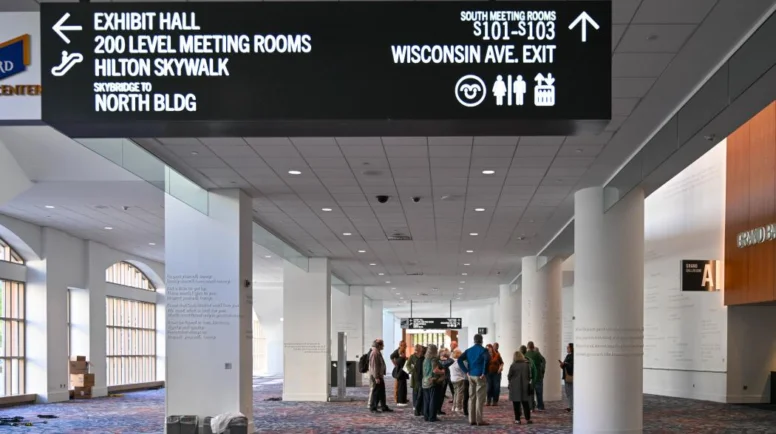
For decades, the exhibit hall was one of the most visible and vibrant expressions of the Presbyterian Church (U.S.A.)’s connectional identity. It was where commissioners could discover a ministry they had never heard of, reconnect with friends, browse books and artwork, and encounter the variety of organizations and agencies that make up our church.
Related reading: “Hybrid format + condensed schedule = no exhibit hall at #GA226” by Greg Allen-Pickett
The condensed in-person schedule of GA226 in 2024 made a traditional exhibit hall impractical. Committee meetings took place online, while commissioners and advisory delegates gathered in person primarily for plenary sessions. With little unstructured time in the schedule, planners concluded that commissioners would not have sufficient opportunities to visit an exhibit hall. The decision was understandable — but deeply lamented.
People described the exhibit hall as more than a collection of booths. It was a marketplace of ideas, a denominational family reunion and a place where Presbyterians experienced the diversity of the church’s mission. For first-time General Assembly attendees, particularly someone from a small congregation or a geographically isolated community, walking through the exhibit hall could offer a glimpse of the wider church.
At the 227th General Assembly in Milwaukee, a version of that experience is returning. Organizers are calling it the “Town Square.”
Enter the Town Square
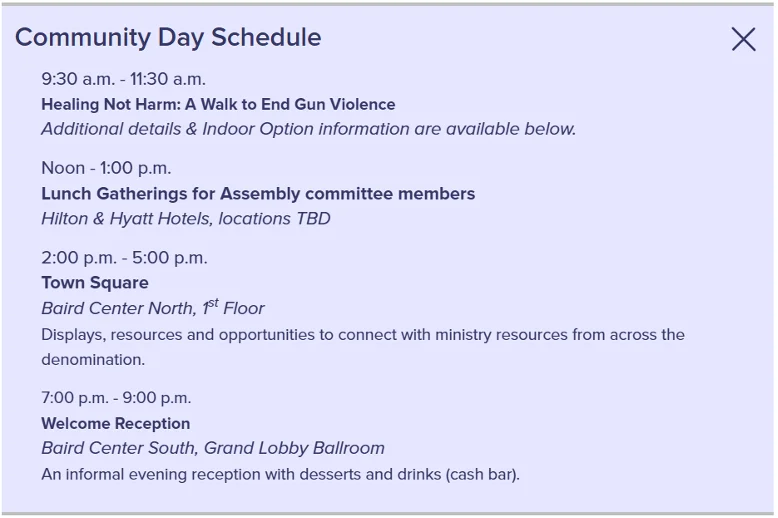
The Town Square will take place on Saturday, June 27, from 2-5 p.m. at the Baird Center, GA’s primary site. It is part of a larger “Community Day” set aside before in-person plenary deliberations begin. No assembly business is scheduled that day, giving commissioners, advisory delegates and other participants an opportunity to participate in public witness, reconnect and learn.
 The name “Town Square” is fitting. Historically, a town square is not simply a place of commerce; it is the center of communal life. It is where people exchange news, encounter neighbors, debate ideas, celebrate together and remember that they belong to something larger than themselves. That is also what the best General Assembly exhibit halls have offered in the past.
The Town Square will include more than 50 participants representing a cross-section of the PC(USA), including denominational agencies and entities like the Board of Pensions, Presbyterian Foundation, Presbyterian Investment and Loan Program, Presbyterian Women, Presbyterian Life and Witness, A Corporation and the PC(USA) Store.
Several General Assembly committees will also participate, including advocacy committees focused on racial equity, LGBTQIA+ equity, women and gender justice, social witness policy, representation, theological education, nominations, and ecumenical and interreligious relations.
Six Presbyterian seminaries will have a presence. So will networks and organizations supporting Christian education, church musicians, youth workers, older adult ministry, collegiate ministry, camps and conference centers, church growth, environmental stewardship, peace and justice, theological diversity and global mission.
The list of participants reminds those gathered that the Presbyterian Church is a web of relationships among those who have answered God’s call in distinct ways. The business of the assembly can sometimes obscure this reality. Commissioners spend long hours reading reports, considering amendments, parsing parliamentary language and voting on recommendations. That work is important. It is one of the ways we seek to discern the will of God together. But the life of the church cannot be reduced to the business before the assembly.
The church is also made visible in conversations across a table. It appears when someone discovers a resource, meets a mentor, learns about a ministry, or finds common ground with someone who sees things differently. Those encounters can’t be programmed or legislated. They happen in the spaces between formal proceedings. The hope is that the Town Square creates room for them.
The Town Square, however, is not a full restoration of the multi-day exhibit hall. The three-hour time slot within Community Day gives participants protected time to attend, but it does not provide repeated opportunities for informal engagement.
Related reading: “General Assembly Operations Committee is being asked the most basic GA question of all” by PNS
Additionally, some organizations from traditional exhibit halls in years past also appear to be absent. Costs, travel, staffing and the abbreviated schedule may make participation difficult, particularly for small organizations and businesses. One of the strengths of earlier exhibit halls was that denominational agencies stood alongside independent networks, advocacy groups, publishers, artists and service providers, creating a space for both established institutions and voices from the edges.
Beyond assembly business
Still, the Town Square represents a meaningful step. It responds to feedback from the last assembly and acknowledges that in-person gatherings should involve more than business. The deeper justification for an in-person General Assembly is the opportunity to build relationships, worship together, encounter the breadth of the church and experience the movement of the Holy Spirit through community.
Presbyterian polity is built on the conviction that discernment happens in councils. Yet a council is more than agendas and voting platforms. It is a community of people seeking Christ’s guidance. Sometimes that guidance comes through a carefully written report or a speech at a microphone. Sometimes it comes through the person we meet while wandering among exhibits, who tells us about a ministry, introduces us to a new idea or helps us see the church from another perspective.
Looking toward 2028
An overture from Olympia Presbytery calls for a return to fully in-person General Assemblies, including exhibit halls, beginning in 2028. The debate will involve legitimate questions about accessibility, inclusion, cost, technology, environmental impact and the quality of both online and in-person participation. The Town Square may offer a useful case study.
Does it attract commissioners, advisory delegates and observers? Do meaningful conversations occur? Do participants leave with broader denominational understanding? Does it strengthen relationships among ministries and leaders? Will three hours provide enough time? The answers may help shape what the General Assembly will look like in the future.
Two years ago, many Presbyterians worried something essential had been lost with the exhibit hall’s disappearance. This year, the church is experimenting with how to recover that connection within hybrid assembly constraints. The Town Square may not be the old exhibit hall. Perhaps it shouldn’t be expected to recreate it. But it is a place where the church can gather, tell stories, exchange ideas and encounter one another. In an era of institutional anxiety and social fragmentation, creating that kind of space is not incidental to the work of the church. It is part of the work itself.