MILWAUKEE — While a task force continues to review how the Presbyterian Church (U.S.A.) is funded, commissioners at the denomination’s 227th General Assembly approved a $188.4 million budget for the next two-year budget cycle, an increase of $5.8 million.
Earlier during the assembly, commissioners agreed to give the Funding Model Development Team another two years to complete its work to recommend a new way for the church to operate.

Finance and Accounting at PC(USA), A Corp, Denise Hampton (ASG) Photo by Jonathan Watson.
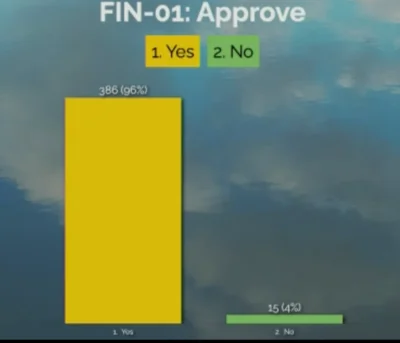
Commissioners approved the new budget, FIN-01, 386-15, setting GA per capita at $13.04 for 2027 and $12.72 for 2028, increases of $2.10 and $1.45, respectively. Of the budget, 42% ($37,802,707) is allocated for salaries and benefits in 2027, while 40% ($38,843,518) is allocated to salaries and benefits in fiscal year 2028.
Per capita, which is assessed on congregations based on the number of members, is used for the ecclesial functions of the denomination, Stated Clerk/Executive Director Jihyun Oh said, and has historically funded the denomination’s shared functions. Each of the denomination’s regional jurisdictions, synods and presbyteries sets its own per capita to cover its operations. All three together comprise the total per-capita amount that congregations pay.
The other primary funding source is general mission giving by congregations.

Commissioners’ questions generally were focused on whether other sources could be tapped to take pressure off the per capita budget, but they were told there is little alternative to cutting programs. Income from investments is based on a formula set by the Presbyterian Foundation; other reserves are also predetermined.
According to Ian Hall, who heads the Administrative Services Group, only about 40% of the budget is unrestricted, while 60% is restricted by donors, further limiting flexibility.
The Funding Model Development Team was created four years ago as the denomination embarked on combining its two major agencies — the Presbyterian Mission Agency and the Office of the General Assembly.
With membership continuing to decline, the existing funding model of general mission support and per capita had become unsustainable. The denomination is now testing two options: one based on a percentage of congregational or presbytery income plus voluntary shared mission support, and another that continues to use per capita. The team is scheduled to bring a recommendation to the 228th General Assembly in 2028.