
(RNS) — In a “State of the Force” address on Wednesday (Sept. 30), Defense Secretary Pete Hegseth announced the creation of an Office of Religious Affairs that would elevate “spiritual health at the same level as physical health.”
The office, and its director, would report directly to him, Hegseth said, to ensure soldiers have “religious support” in the form of chaplains with religious expertise rather than “secular careerists” and “lawyers.”
“Our department is, you might say, putting on the full armor of God, because while we wage physical war, we all know the real battle is spiritual. God is good; evil is not, and America’s military must understand the difference,” Hegseth said during an hour-long talk at a base in Virginia.
A memo announcing the establishment of the Office of Religious Affairs said it would “obtain sufficient funding and resources for religious affairs,” and “oversee research, technology, and analytical tools to support and assess spiritual fitness, spiritual readiness, and spiritual resilience” of soldiers.
The memo said the creation of the office should not be “construed to compel religious participation or to diminish the free exercise rights of any Service member, civilian employee, or family member of any faith or no faith.”
But prominent declarations of Christian faith have been central to Hegseth’s speeches and in his vision of the military. He is a member of a conservative denomination, the Communion of Reformed Evangelical Churches, that explicitly advocates for Christians to exert their faith’s influence over the government.
Pastor Doug Wilson, one of the founders of the denomination and Hegseth’s pastor, told RNS that while he knows “next to nothing about the scope of the new office,” he has hope it will be a good thing, “considering the source of it.”
Hegseth also spearheaded an initiative to bring prayer services to the Pentagon. Shortly after the start of the Iran War, he prayed for “overwhelming violence of action against those who deserve no mercy.”
And he regularly quotes from the Bible, including multiple times on Wednesday.
He cited Psalm 33:12, “blessed is the nation whose God is the Lord,” in addition to the passage from Ephesians that calls for believers to “put on the whole armor of God” and Isaiah 6, when the prophet says to God, “Here am I; send me!”
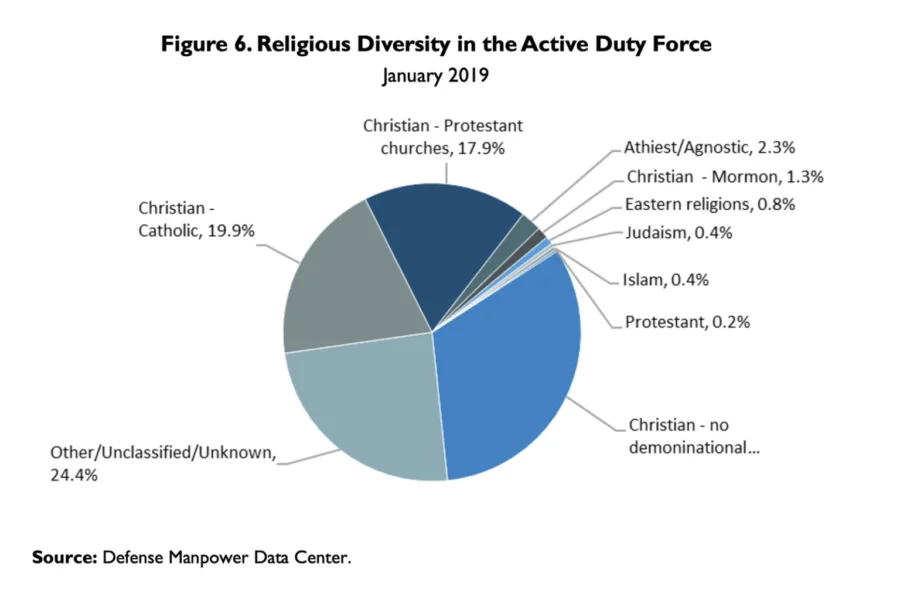
Hegseth also claimed that “less than 5% of our force identifies as non-religious.” A 2019 Congressional Research paper on military demographics reported that 2.3% of military troops identified as “atheist or agnostic;” however, an additional 24.4% of the military troops were religiously identified as “other, unclassified or unknown.”
According to the Rt. Rev. Ann Ritonia, who serves as the eighth bishop suffragan of Armed Forces and Federal Ministries of the Episcopal Church, the announcement of the new Office of Religious Affairs was met with confusion.
“My first reaction is: What is going on? Because this is completely out of the ordinary,” she said. “Nothing like this has been seen before in the military in regards to the Chaplain Corps.”
Ritonia said that upon reading the memo describing the new office, she found “really good things,” such as the possibility of helping underfunded chaplaincy programs. She noted concerns about the Armed Forces Chaplain Board being “understaffed” and “not adequately funded,” and celebrated the prospect of efforts to change that.
But Ritonia said she also has concerns about the structure of the new office.
“My initial assessment is that it violates the chain of command,” she said. “Chaplains have direct access to the Religious Affairs office, is how this reads, rather than going through their chain of command. That can undermine good order and discipline, particularly if a particular religious group has the ear of the director of the Office of Religious Affairs.”
“I think it could be very confusing, unless there’s real clarification about the role of the chiefs of chaplains,” she said.
The bishop also noted that some of the military chaplains she works with are wary of the new office in part because it is being created under Hegseth. She described the Defense Secretary’s rhetoric as “definitely Christocentric” and argued that at least some of his efforts amount to a “push of fundamentalist Christianity into the military.”
“It feels like the free exercise of faith for chaplains has become more important than protecting the free exercise of those they serve,” she said.
Franklin Graham, who sits on the Department of Justice’s Religious Liberty Commission, said he thought the new office was “a great idea.”
“Unfortunately, not all administrations have treated military chaplains as necessary — but they are some of the most necessary because they are entrusted with caring for the spiritual well-being of our men and women in uniform who put their lives on the line to protect our nation,” Graham told RNS.
Americans United for Separation of Church and State denounced the new office.
“It’s yet another example of Hegseth abusing the power of his government position to impose his beliefs on others — and worse, it puts the needs of America’s service members second to this administration’s Christian Nationalist agenda,” the organization said in a statement.
Mikey Weinstein of the Military Religious Freedom Foundation was more blunt.
‘This is the latest example of a pervasive and pernicious pattern and practice of the elevation of unconstitutional Christian nationalism to a position of total control of technologically the most lethal organization ever created by our species,” said Weinstein, whose nonprofit organization includes 100,000 active duty military and veterans seeking legal help to resolve religious freedom cases.
In June, the Department of Defense announced it was reducing the number of religions it officially recognizes from 211 to 31, the vast majority being various Christian denominations. Excluded were atheists, pagans, humanists and New Age faiths.
The U.S. Air Force recently announced that atheists have until Oct. 16 to reclassify their religious affiliations in accordance with the Department of Defense’s new “Religious Affiliation Codes” or risk being automatically reclassified.
In its memo announcing the establishment of the office for religious affairs, the Defense Department wrote that within 90 days, the office will deliver “a comprehensive baseline report of all unfunded and underfunded religious affairs requirements.”
By Yonat Shimron and Jack Jenkins, Religion News Service