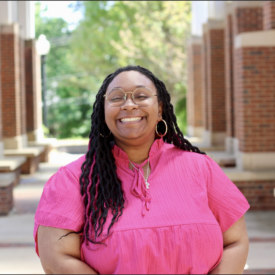
I am a lifelong member of the unofficial Sunday school fan club. Despite not wanting to wake up early, the 10 o’clock hour is easily my favorite hour of the week. Since childhood, I have been captured by the stories of the Bible and the cloud of witnesses that we were taught about. Looking back, I can see the different places where my faith has taken me and the ways it has developed and reshaped over time.
As a young child participating in my congregation’s Christian education programming, I began to have an increased curiosity around theology (although I didn’t know to call it that then). What is the difference between Episcopalian and Presbyterian churches? Is it bad to not believe in hell? Did Jesus really die for our sins, or did he die because of a homicidal empire? Such questions led me to see that while I strongly believe in the power of Sunday School as a space for faith development, I desired something different than what my beloved Sunday School could provide.
Engaging the world theologically and exploring the Bible weren’t just special interests or “side quests” for me. I found that I needed to be in community with others who also wanted to expand their theological imagination. This realization led me to seek formal theological education, specifically at a Presbyterian Church (U.S.A.) seminary.
One of the most formative experiences that education has given me is the opportunity to engage the larger church by serving as a theological seminary advisory delegate at the 227th General Assembly. Through this experience, I was able to view the church that I love from a more holistic and global perspective. I also connected with leaders and ministers across the denomination who are doing the work of seeking the welfare of those whom society casts aside.
With this in mind, I would be remiss if I didn’t acknowledge the decline in the pursuit of theological education in our Presbyterian context. Although nondenominational, conservative evangelical schools see a surge in enrollment, the 2026 report of the Association of Theological Schools reveals that classes of Presbyterian seminary students grow smaller each year. However, I think this finding speaks to something we can hold in tandem with this reality.
…providing resources to support students’ mental, emotional and spiritual well-being is essential.
Theological education has given me the space to explore my beliefs and deconstruct harmful frameworks with the support of my peers, along with faculty and staff. Vocational discernment, spiritual development and mental health supports are a combination that only formal theological education can provide. I believe this is due to the intentionality and concentration one must put forth when engaging with theological programs. As seminarians and divinity school students, we are given not only information but pastoral care and opportunities for spiritual reflection.
The one-size-fits-all approach to ministry is being left behind and is becoming increasingly more accessible for those who are bivocational or who are changing vocations completely. Instead of viewing ministry as something done only by pastors in a parish setting, the PC(USA) ordains ministers to a variety of validated ministries and offers pathways to ministry for lay ministers and commissioned ruling elders. The ministry of the church is becoming increasingly expansive — including non-profit leadership and national advocacy groups.
Amid challenges and uncertainty, we could find it helpful to hold our expectations of theological education a little more loosely than before. Seminary campuses and programs will change as the lived experiences of those in our denomination shift. Theological education remains central to developing leaders of the church, equipping us to serve in the church and the public square in rapidly changing cultural and societal contexts. So providing resources to support students’ mental, emotional and spiritual well-being is essential.
When the future of something we hold closely seems uncertain, hope is what brings us comfort amid the challenges. Those called to ministry often feel responsible for continuing our faith across time (cue the Wesleyan Quadrilateral). We as Christians, specifically those within the PC(USA), are pioneers of innovation. So yes, your fears about theological education are real — but so are your dreams.