Go and serve
Every summer, many churches across the United States send groups on mission trips. Often these trips go to places that have fewer material resources: inner cities, Native American reservations or other countries. These groups try to help those in need through service. Our own church, First Presbyterian Church of Hastings in Nebraska, has been doing this annually since 1968, long before short-term mission was a common practice among churches. We call our annual trip “Go and Serve,” and it is woven into the identity of our congregation, representing an incredible legacy of faith, service and learning.
This summer, we tried something new. Instead of sending a delegation to visit our ministry partner Frontera de Cristo on the U.S.-Mexico border, we hosted a delegation organized by our partners on the border here in Nebraska — in addition to our Go and Serve high school mission trip. The goal was not simply to host guests, but to share life, learn from one another, and co-create an experience of mutual mission. It was a sacred exchange grounded in partnership, hospitality, and the belief that all of us, regardless of geography, language, or background, are co-workers in God’s mission.
It was a sacred exchange grounded in partnership, hospitality, and the belief that all of us, regardless of geography, language, or background, are co-workers in God’s mission.
Come and connect
Mutual mission is not about one group giving and another receiving. Mutual mission is rooted in the belief that all of us are invited to participate together in God’s mission of love, justice and reconciliation (1 Corinthians 3:9). It is about giving and receiving, learning and teaching, serving and being served. It is about sharing life, faith and hope, side by side. And it is grounded in the idea that we are ultimately participating in God’s mission as co-workers.
The idea for this mutual mission trip began in October 2024 when our congregation sent a delegation of 20 pilgrims to the U.S.-Mexico border to participate in the 40th Anniversary celebration of Frontera de Cristo, a Presbyterian border ministry based in Douglas, Arizona, and Agua Prieta, Sonora, Mexico. It was the continuation of a years-long relationship between our church and our siblings in ministry at the border.
As often happens in mutual mission, one act of hospitality sparked another. During our October pilgrimage, we spoke with staff and board members about the possibility of having a delegation from the border come to Nebraska to share with us and help us minister to our Spanish-speaking neighbors. After nine months of planning, logistics (including procuring visas), and prayer, a delegation of church members and leaders, Frontera de Cristo staff, and Presbyterian mission workers from the U.S.-Mexico border came to share in life and ministry with us in Nebraska. And what a joyful, Spirit-filled week it was.
A week of mutual blessing
The church offered homestays to our partners from the border, and lifelong friendships were formed during the week. We also had a different church family host dinner each night for the delegation, providing an opportunity for hospitality and to share our homes and family recipes with our guests.
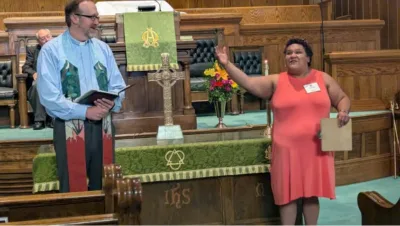
The team arrived on Saturday. On Sunday morning, they joined us in worship, with Mexico Coordinator for Frontera de Cristo Joca Gallegos joining me to mix a little bit of Spanish and English in our liturgy and hymns throughout the morning.
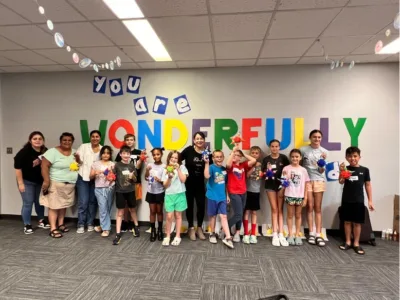
Together with the Hastings Community Music Academy (a local ministry partner of First Presbyterian Church of Hastings), we hosted a bilingual, bicultural music and arts camp for children from our church and the broader Hastings community with an intentional focus on reaching out to our Spanish-speaking and immigrant neighbors. Throughout the week, voices were raised in Spanish and English, instruments were played, and colorful artwork filled our church halls. Children danced and sang side by side, learning not only rhythms and melodies, but also friendship and understanding.
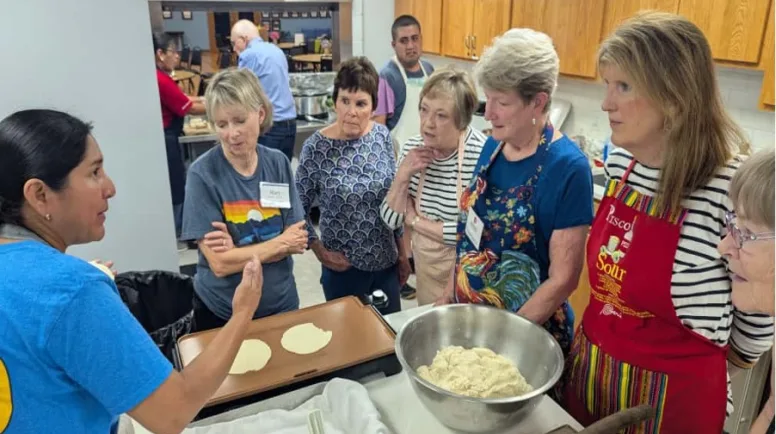
On Friday, we gathered in our church kitchen for a cooking class, where we chopped vegetables, stirred sauces, made tortillas by hand, cooked chicken tinga and mixed fresh salsas under the direction of our guests from the border. The smells were divine, but even more beautiful was the laughter, the teamwork and the joy of learning each other’s culinary traditions.
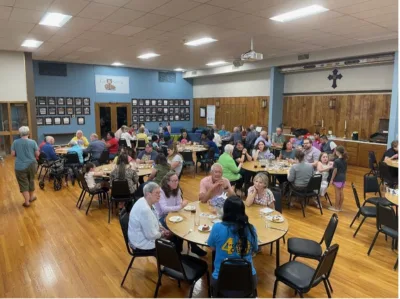
That evening, we shared a church-wide dinner, a feast of flavors and fellowship. People of all ages sat around tables and shared stories, hugs and second helpings. Barriers of language and culture melted away as we broke bread together and experienced the truth that the table of Christ is wide and welcoming.
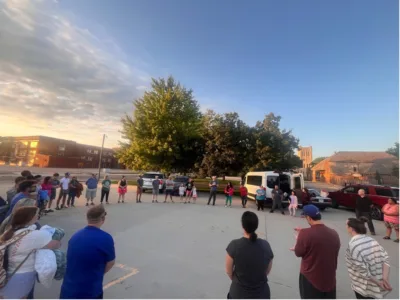
The week concluded with a mutual blessing and sending. On Saturday morning, the delegation from Frontera de Cristo prepared to return south to the border. At the same time, our high school Go and Serve team was loading vans to head north for a week of urban mission in the Twin Cities. We all gathered: missionaries from the South and the North, youth and elders, hosts and travelers, pastors and parents, 40 people in all, and circled up in the church parking lot.
With instruction from our partners from the border, we joined hands with our left hands up and our right hands down —a sign of our need to give and receive as we seek a more just, peace-filled and loving world in the name of Christ. We gave thanks together. We prayed in English and Spanish. And we remembered that, wherever we go, we are co-workers with God, united in one Spirit, sharing the love of Christ.
The gift of mutual mission
This is the marvel of mutual mission: it transforms both the giver and the receiver. It reminds us that we all have something to offer and something to receive. It is not a one-time event but an ongoing way of life, a holy rhythm of partnership and presence.
At the center of this model of mutual mission are Mark Adams and Miriam Maldonado, who served as Presbyterian mission co-workers for more than 20 years on the U.S.-Mexico border. Over the years, they have taught our church and countless other groups about this philosophy and theology of mission engagement. Unfortunately, in its restructuring efforts, the Presbyterian Church (U.S.A.) eliminated all mission co-worker roles and closed of the World Mission ministry area at the end of March 2025, which is a big loss for our denomination.
Fortunately, the Presbytery of the Grand Canyon and Presbytery de Cristo have decided to support Adams and Maldonado so they can continue to share this model of mutual mission for future generations.
Our church’s experience with mutual mission this summer helped me to imagine and wonder. I invite you to join me. Instead of only sending people out to serve others, what would it look like to invite your mission partners to come and serve, learn, and live alongside you? Imagine the joy of discovering how much you have in common. Imagine the growth that happens when we move beyond the borders, boundaries, and barriers, embracing each other as fellow workers in God’s mission.
You do not have to be a large church or have a big budget. You just need open hearts, a spirit of hospitality, and the willingness to be transformed by relationship.
You do not have to be a large church or have a big budget. You just need open hearts, a spirit of hospitality, and the willingness to be transformed by relationship. When we engage in mutual mission, we catch a glimpse of the kingdom of God; a kingdom built not on hierarchy or charity, but on partnership, justice and love.