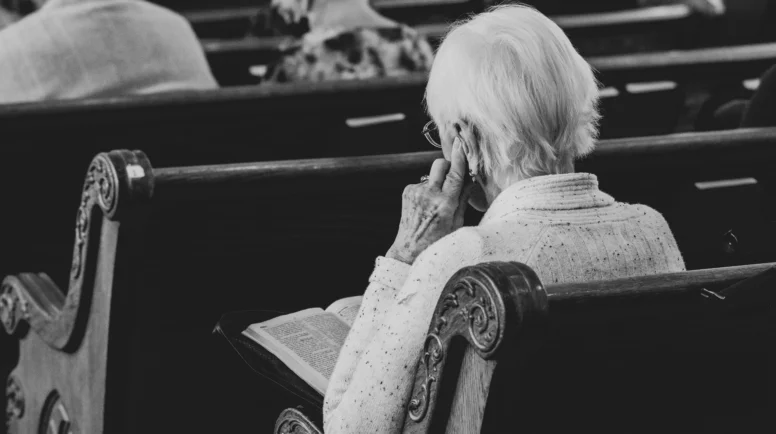
Most Tuesday mornings and Sunday afternoons, I lead worship at a care facility in Madison, Wisconsin. The congregation is almost entirely White. Most are in their 80s and 90s. Some have dementia. Some are sharp as tacks. All of them are closer to glory than I am.
I am 73, Black, and Presbyterian. I recently buried my father, who was a few weeks shy of stepping into his 100th year of life. He remembered things I only read about. Now he is gone, and I find myself becoming the elder — the one who carries the memory forward.
This is what I’m thinking about when I stand before the saints on Tuesday mornings: What do you preach to people who are dying when so much else feels like it is dying too?
What do you preach to people who are dying when so much else feels like it is dying too?
They ask me for comfort in their own ways. Not always with words. Sometimes it’s in their eyes when I arrive — a weariness that isn’t just physical. They watch the news. They’ve watched it for decades. Some of them remember when it looked like this before.
They lived through things I only learned in books. And now, at the end of their lives, they are watching it again. The lies told from high places are repeated until repetition passes for truth. The cruelty dressed up as strength. Journalists arrested for the crime of bearing witness. Dissenters treated as enemies. The vulnerable were made more vulnerable by the very people who swore to protect them. They have lived long enough to recognize the pattern — and long enough to know what it costs when the church stays silent.
What do I say to them?
I do not say, “It will be okay.” I don’t know that. Neither do they. We are not children, and this is not a bedtime story.
I do not say, “You won’t have to see the worst of it.” That is not a comfort. That is an abandonment. And besides — some of them already saw the worst of it, decades ago, in other forms.
What I say is this: God is faithful.
God is faithful.
Not “everything happens for a reason.” Not “God is in control” in the way that flattens mystery into formula. I say: God is faithful. Which means: God does not abandon. God has never abandoned. Not in Egypt. Not in Babylon. Not in the Jim Crow South. Not in the nursing home. Not now.
I say: You have been faithful as best you can. Perhaps not doing everything right, but when you knew better, you did better. And with time and experience, your faith increased.
I say: The story is not over. You will not see the end. Neither will I. Moses didn’t see the Promised Land. He saw it from a distance, and then he died, and Joshua carried it forward. That is how it works. That is how it has always worked. We are all mid-story. The question is not whether we see the ending. The question is whether we are faithful in our chapter.
You are not alone.
And then I say: You are not alone.
This is the part where I see them breathe. The isolation of dying is profound. The isolation of dying while the world feels like it’s unraveling is worse.
They need to know – we all need to know – that the communion of saints is real. That the church is not just the people in this room, but the great cloud of witnesses. That my father, who just stepped into glory, is part of that company now. That they will be too. That the story belongs to God, and God is not finished.
I am a Black woman preaching in White spaces. I have been doing this for years. I have learned that faithfulness looks different depending on where you stand. For some of my congregation, faithfulness means reckoning with things they never had to see before — or things they saw and didn’t name. For me, faithfulness means staying in the room. Staying in the work. Staying even when I am tired.
We are all being asked the same question right now: Will you stay faithful when you cannot see how it ends?
The saints in the care facility are teaching me the answer. They show up on Tuesday mornings and Sunday afternoons. They sing the hymns. They listen to the sermon and say their Amens. They speak about their joys and concerns. They pray. They let me pray over them. And at the end of each service, they sing enthusiastically, “He’s Got the Whole World in His Hands.” They hold my hand with trembling fingers and say, “Thank you for coming.”
The story belongs to God, and God is not finished.
They are dying. And they are faithful.
I think that’s the only sermon any of us need right now.
So I carry it back with me — out of the care facility, into the parking lot, into a world that is asking all of us the same question it asks them. You do not have to see how it ends. You do not have to fix it. You have to be faithful in your chapter. Show up. Stay in the room. Sing the hymn, even off-key. The God who holds the whole world in his hands is holding your part of it, too.