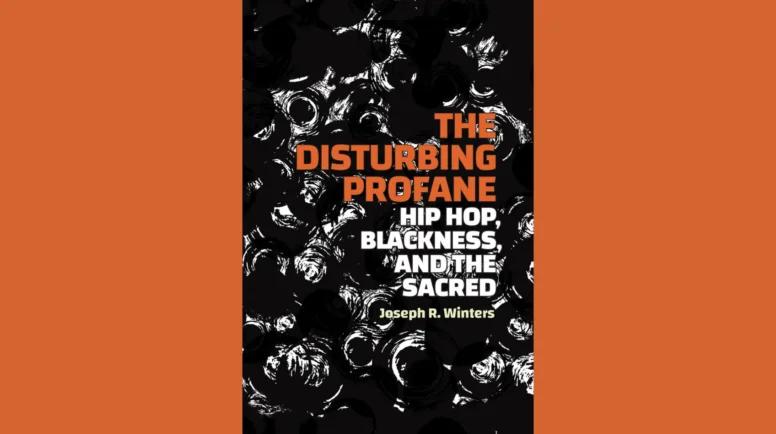
The Disturbing Profane: Hip-Hop, Blackness, and the Sacred
By Joseph R. Winters
Duke University Press, 208 pages
Published August 12, 2025
Hip-hop is a sacred practice. Full stop. Its sacredness lies in its ability to “tell it like it is.” Artists such as Kendrick Lamar, Clipse, JID, Doechii, and so many more have continued to cultivate the garden that is hip-hop in a world that often rejects and commodifies the genre. To call hip-hop sacred is not to place it in a church pew, but to recognize that it carries the weight of memory, survival and expression that has long defined Black cultural production.
As a Duke professor of religious studies and African and African American studies, Joseph R. Winters tries to situate the genre within the broader discourse of Black studies and critical religious thought, and in doing so, he blurs the lines between the sacred and the profane. Winters argues that traditional understandings of “the sacred” are wound up in the world of religion — meaning-making that stems from a single group and often elevates itself over and against another. To be sacred is to be holy and pure, free from any blemish — and, implicitly, White. To be profane is the antithesis — a degraded category that one must avoid and be rescued from: Blackness. These categories reinforce one another, protecting a notion of holiness that depends on the exclusion of Black flesh.
Indebted to Charles Long (scholar of Black religion), Winters uses this world of signifying and significations to parse out a different existence that resists relegating Black flesh into profanity. Instead of identifying with the aforementioned dichotomy of sacred versus profane, he argues that the very existence of hip-hop disturbs the binary, just as Black flesh has. Winters begins with W.E.B. Du Bois and the sorrow songs of the enslaved. These songs did not function purely as simple religious order, but instead they gave the enslaved “a sound to keep alive, and re-express experiences of torment and loss; through dance, song, and surreptitious gatherings.” This expression and re-expression finds itself in gospel music, jazz, blues, art, prose, and – for the present work – hip-hop, with lyrics that ritualize “pouring out liquor in remembrance of the dead, calling out a deceased friend or family member, shouting-out loved ones who have been imprisoned, reenacting the death of those no longer present … ”
Instead of identifying with the aforementioned dichotomy of sacred vs. profane, he argues that the very existence of hip-hop disturbs the binary, just as Black flesh has.
While many in the field of Black religious studies speak only to the academy, Winters skillfully counteracts that tradition with language accessible to a broader audience. He speaks to the hip-hop head who wants to appreciate rappers’ deeper meanings and double entendres, and he broadens the perspective of churchgoers seeking the Divine in all areas of life. His work offers something for everyone – or at least for those who are willing to be disturbed by it.
In the end, Winters offers more than literary criticism or cultural analysis: he invites readers to reconsider where we locate the sacred and why certain lives and practices are labeled as profane. Hip-hop is not a threat to holiness but a witness to survival, grief and joy. It is a sacred practice precisely because it refuses to be contained.
Presbyterian Outlook supports local bookstores. Join us! Click on the link below to purchase The Disturbing Profane: Hip-Hop, Blackness, and the Sacred from BookShop, an online bookstore with a mission to financially support local, independent bookstores. As an affiliate, Outlook will also earn a commission from your purchase.
Sign up for Page Turners, our monthly email newsletter, to receive book-related content in your inbox once a month.
God is in everything, and that includes all the forms of music. Join Chris Burton as he explores hip hop through the lens of faith.