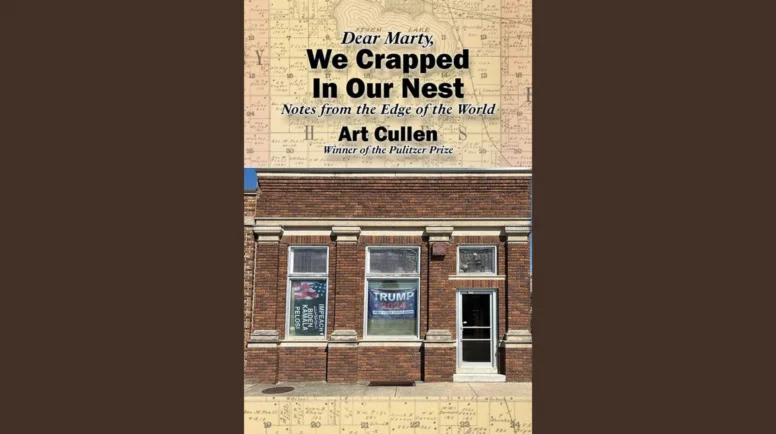
Dear Marty, We Crapped In Our Nest: Notes from the Edge of the World
By Art Cullen
Ice Cube Press, 192 pages
Published September 22, 2025
Cullen’s take on our climate is the most impressive — and depressing — part of this book. He traces hundreds of years of farming practices, explaining how each development has negatively impacted the land, water, air and weather.
The title drew me in. Dear Marty, We Crapped In Our Nest leapt out from the short list of review selections. (I even checked the Outlook digital archives; this is the first time we’ve published the word “crapped.”) I imagined a crustier, extended version of a Dave Barry column — darkly humorous ruminations on the state of affairs from Small Town, USA — an easy read between naps over Thanksgiving weekend. This is not that book.
Art Cullen, editor of the Storm Lake (Iowa) Times Pilot, is a 2017 Pulitzer Prize winner and a Storm Lake native, honored for his series on agricultural surface water pollution in his home state. There’s a fair amount about surface water in this book. There’s even more about the land and the crops, and nearly as much about farm animals. And there is climate change, documented from the ground up.
Cullen’s take on our climate is the most impressive — and depressing — part of this book. He traces hundreds of years of farming practices, explaining how each development has negatively impacted the land, water, air and weather. In engaging and straightforward terms, he describes the overtaking of family farms by a few large corporations and their subsequent push to maximize corn yields. By recounting the interwovenness of animal husbandry and pandemics, Cullen makes clear how disease in the food chain can spread to humans and decimate our food supply (see 2020). It has already happened; the next time is not “if” but “when.”
Cullen, age 68, writes thoughtfully about people, too: the multi-generation European neighbors he grew up with and his current first-generation Mexican neighbors — immigrants who are rebuilding Iowa and, by extension, the nation. He blames big business and Reagan-era union-busting for lowering wages in the farming states, and he blames division-sowing politicians for pointing fingers at immigrant workers instead.
Just when all seems lost, Cullen turns to the surviving family farmers and their (literal) grassroots efforts to restore the soil and clean the water and air by growing organics, shifting crops, fertilizing with onsite animals and more. People, he believes, will continue to demand alternatives to damaging corporate food practices.
As an East Coaster 90 miles from D.C., I mostly experience politics as politics and food as what’s at the grocery store. Cullen writes from a state where politics is entwined with the food we — and much of the world — eat. Deeply woven through that space is the hard and essential work of immigrants building sustainable lives for their families. Political leaders have turned a neat trick, focusing their electorate on cultural issues to distract from big business practices that decimate wages and sully the environment. Dear Marty, We Crapped In Our Nest will help those seeking to understand red-state politics, while serving as a plain-talk paean to God’s beautiful and delicate creation: this planet.
Cullen’s heart is clearly in his homeland. We feel his frustration with politics and his despair as bad choices demoralize his fellow Iowans and ravage the land he loves. The rays of hope he offers in the book’s closing pages were this reader’s reward for Cullen’s dark proximity to the struggle.
Presbyterian Outlook supports local bookstores. Join us! Click on the link below to purchase Dear Marty, We Crapped In Our Nest: Notes from the Edge of the World from BookShop, an online bookstore with a mission to financially support local, independent bookstores. As an affiliate, Outlook will also earn a commission from your purchase.
Sign up for Page Turners, our monthly email newsletter, to receive book-related content in your inbox once a month.