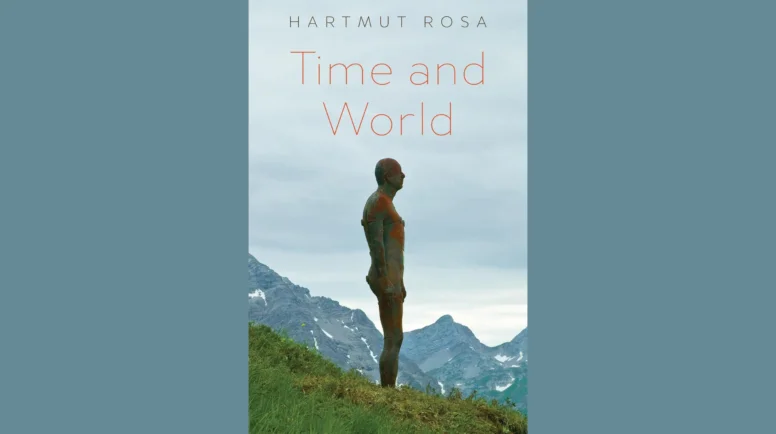
Time and World
By Hartmut Rosa
Polity Press, 220 pages
Published December 10, 2025
Retired Presbyterian minister Phil Reed discusses Hartmut Rosa’s new book, Time and World, with his son Chris, who teaches English and philosophy to high school and college students.
Phil: Chris, how would you introduce Rosa to readers who may never have heard of him?
Chris: Rosa is a “big-idea” German sociologist. He asks a large, philosophical question: Why do we live the way we live?
Time and World is a collection of Rosa’s essays and an effective introduction to his perspective. Two of his big ideas are front and center: acceleration, which describes how we experience time, and resonance, which describes how we relate to the world.
The title echoes Andrew Marvell’s line, “Had we but world enough and time …” Rosa argues that modern people live as if we have neither. When I’m busy, and one of my kids asks for help, I’ll say, “I’ll be with you in a minute.” And then I hear, “Siri, set a timer for one minute.” This moment captures Rosa’s insight. Technology promises to save time, but instead accelerates life.
Phil: Rosa calls this “dynamic stabilization.” I see it constantly in the church. Churches have declined by nearly every measurable standard. Our response has been relentless innovation to bring new people in. In a world where time feels accelerated and scarce, and the future uncertain, growth becomes the primary way we justify our viability.
Chris: Rosa’s response to acceleration is his most distinctive idea: resonance. Resonance names moments when we stop trying to control the world and open ourselves to connection and transcendence. This reminds me of what Jonathan Edwards called “the sense of the heart,” a sudden awakening to excellence that cannot be manufactured by the will. Rosa is not a theologian, but he is pointing toward a reality larger than the self.
Phil: According to Rosa, our obsession with control leaves us increasingly detached from the world. Resonance, by contrast, is a mutual, transforming relationship with it. Contemporary theologians like Andrew Root pick up on Rosa’s analysis and offer theological interpretation. Root insists that ministry must not begin with control or innovation, but with attentiveness to God’s agency.
According to Rosa, our obsession with control leaves us increasingly detached from the world.
Chris: Rosa’s way of thinking has limits. His work reflects a largely Western, White experience of time and world. I found myself wishing the “we” in “how we live” reflected a richer array of voices.
Phil: Let me ask you a practical question. Would you recommend Time and World to your students?
Chris: To my high-school students? Probably not. Rosa is too conceptual. They would get lost reading philosophers like Charles Taylor, historians like Reinhart Koselleck, and sociological thinkers like Niklas Luhmann. Still, reading Rosa makes me a better teacher. His account of resonance points to our capacity to be affected by the world, and that opens us to new ways of living. My turn: Would you recommend Time and World to your ministry colleagues?
Phil: Yes, but not as a how-to manual. Church leaders looking for quick strategies to reverse decline and increase relevance will be disappointed. Pastors who are looking for a deeper sense of what it means to live in our modern world will find Rosa clarifying. I’d say, “This book won’t save your ministry, but it might save your soul.”
Presbyterian Outlook supports local bookstores. Join us! Click on the link to purchase Time and World. As an affiliate, Outlook will also earn a commission from your purchase.
Sign up for Page Turners, our monthly email newsletter, to receive book-related content in your inbox once a month.