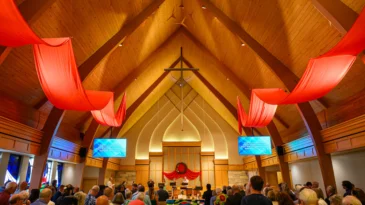
On Wednesday mornings, I teach a section of my seminary course called “Introduction to Spiritual Formation.” An hour before class, I head from my office to room 216 to rearrange the classroom furniture. I maneuver the trapezoidal tables to form a square at one end of the room. At the other end, I drag nine chairs into a circle. In the middle of the circle, I place a weathered plastic table, nabbed from my back patio. I cover it with a bright green cloth – a scarf I borrowed from my wife’s closet – and then set on the table a battery-powered candle (the seminary’s insurance company frowns on open flame in the building), a small icon of Jesus and a cross.
As I think about what prayer is, I imagine this classroom, its two ends a metaphor for the fullness of prayer.
I tell my students at the beginning of the semester that each time we meet, we’ll have “circle time,” just like in kindergarten, sans the sitting crisscross-applesauce on a colorful rug. Circle time is our time of intentional prayer. We start with silence, then speak a few verses of a psalm, and sometimes sing a Taizé chant or a spiritual. Often, we read a passage of Scripture or another piece of spiritual writing and reflect in silence on how God’s Spirit might be addressing us through the passage. Then we share what occurred to us in the silence: what we heard, how we felt moved, where the Holy Spirit led our own spirits. We close by praying for one another.
But we don’t stay in the circle. When we are finished, someone “blows out” the candle. We move to the other end of the room, where backpacks rest next to chairs and laptops wait patiently on tables. We have readings to discuss, ideas to ponder. At this end of the room, we ask what a spiritual life is and how best to live one. We puzzle over topics related to prayer, like how intercession works and what God is doing within us as we sit in contemplative silence. We argue some; we laugh often.
Two ends of a room, one picture of a life of prayer.
No right way
Prayer is a distinct activity: a discipline, a practice. We express this aspect of prayer during circle time. We stop what we are doing, and we pray. Our intention when we pray is to be in communication and communion with God; we give our attention as fully as possible to that work. Prayer, as an intentional practice, has a when and a where, and so it can be distinguished from other activities of our lives: washing dishes and picking kids up from school, writing sermons and completing tax forms.
There is no right way to pray.
My Zen Buddhist friends, who sit zazen every day, call this kind of prayer an on-cushion practice. I sometimes say that to pray, you have to make time to get your butt in the chair.
Unfortunately, my irreverent quip can limit the scope of prayer as an intentional practice, suggesting that prayer has to look or feel a certain way. But there are many kinds of prayer and many ways to pray. Very early in my spiritual formation class, I make the point as clearly as I can: There is no right way to pray. I’m fond of the saying of John Chapman, an early 20th-century Benedictine abbot, who said, “Pray as you can; do not try to pray as you can’t.”
Because what could be more debilitating to prayer than the fear that we are doing it wrong? Or the hope that if we do it right, God might be more pleased with us and reward our exemplary efforts?
A few days ago, I was perusing the book-sale shelves at my local library, where I saw a 2006 book – on sale for 50 cents – called 50 Ways to Pray: Practices from Many Traditions and Times, by Teresa Blythe. Fifty ways! As I write this, I’m looking at a book that has been in my office for years, called Paths to Prayer: Finding Your Own Way to the Presence of God, by Patricia Brown, which includes guidelines for 40 different prayer practices. Both books, and so many like them, testify to the variety of ways to enter prayer. “Circle time” can take many shapes; there is no right way.
Corporate circle time
Through these ways of prayer runs a common thread: When we enter prayer with intention, we seek communication and communion with God, as spiritual writer Marjorie Thompson helpfully puts it.
Prayer involves speaking and listening. We share with God the deepest concerns and profoundest joys of our hearts, and we listen so that we might become aware of what is on God’s heart.
For Christians, corporate prayer, especially worship, stands as the cornerstone where-and-when practice that embodies both aspects of this common thread. When we go to church, we practice communicating with God. We sing our praises to God and offer our confessions. But we also hear from God there. We listen to the Word of God as it is read and proclaimed, after which we respond to God by offering prayers of thanksgiving and intercession as we pray for ourselves, our communities and our world.
If you ask a child what prayer is, they might simply say, “Talking to God.” The flow of worship, however, shows us that the path of communication extends in two directions. Prayer involves speaking and listening. We share with God the deepest concerns and profoundest joys of our hearts, and we listen so that we might become aware of what is on God’s heart.
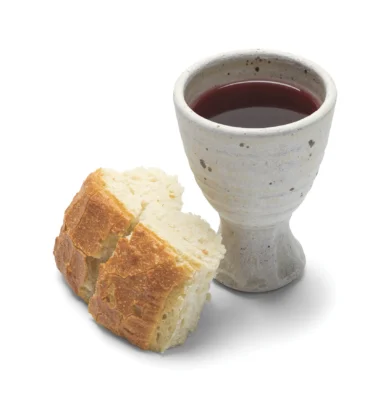
Sometimes, in prayer, we set our words aside and simply enjoy God’s self-giving presence, just as we do at the eucharistic feast. Our taking of the bread and the cup is our sharing in the life of Christ. It is the heart of communion with God.
Christian worship reaches its peak at the table where we celebrate the Lord’s Supper, which moves us beyond communication to communion with God through Christ. “This is the joyful feast of the people of God,” a pastor said, inviting the gathered community to the table. “People will come from the north and south and from east and west to sit at the table in the kingdom of God.” At Holy Communion, we remember that God’s deepest intention is to be with us, to share life with us. Sometimes, in prayer, we set our words aside and simply enjoy God’s self-giving presence, just as we do at the eucharistic feast. Our taking of the bread and the cup is our sharing in the life of Christ. It is the heart of communion with God.
Personal circle time
Prayer also takes place in a personal way when we are alone with God. Sustained by our corporate spiritual practices, we can make space in our lives as individuals to turn our attention to God — and it doesn’t take much time or effort. My friend Roberta Bondi, an emerita professor of church history at Candler School of Theology, likes to say, “Prayer is not a heroic enterprise.”
For people beginning a practice of personal prayer, the temptation is to turn prayer into a glorified New Year’s resolution: You are going to learn all 50 ways to pray — and do them every day! But our personal where-and-when of praying is not a competition. The consistency of showing up for God – to speak, to listen, to enjoy God’s presence – matters more for sustaining a life with God than any heroic efforts on our part.
Prayer will have a more meaningful place in our lives when we embrace its simplicity and put out of our minds any thought of moving from apprentice to master.
Plenty of spiritual writers will highlight the struggle of prayer. Samuel Miller, a Baptist minister and former dean of Harvard Divinity School, wrote, “The training [in a life of prayer] is difficult of course … but by such travail the intern becomes a doctor and the apprentice a master.” Thomas Merton, reflecting on becoming one’s true self through contemplative prayer, said that “to work out our identity in God… is a labor that requires sacrifice and anguish, risk and many tears.” Thompson, in her classic book Soul Feast: An Invitation to the Christian Spiritual Life, offers a more measured assessment: “The capacity to remember and abide in God’s presence comes only through steady training.”
Certainly, practicing prayer intentionally can lead to struggle, as God begins to challenge and change us — to help us release habits that limit our lives and embrace new ways of being that lead to our flourishing and the flourishing of others. Merton was right: Tears are indeed possible. But the training itself – the practice of prayer – is not hard. Prayer will have a more meaningful place in our lives when we embrace its simplicity and put out of our minds any thought of moving from apprentice to master. Given that the love of God, which we embrace through prayer, is infinite, how can we ever be more than beginners?
 So we begin anew each day. Daily prayer will look different for every person (remember, there’s no right way). For me, it looks like a half hour spent in my basement chair most mornings. I usually write in a journal, asking the Spirit’s guidance to help me see the movement of God’s love in my life in the previous day. I follow that with either a brief spiritual reading or an app called Pray as You Go, which fosters both listening to God through Scripture and speaking to God conversationally. Then, for some time, depending on when I need to be somewhere, I sit in silence. This is my personal time of communion: no words, just stillness. Sometimes I say to God, “Well, here you are, and here I am. How lucky for us both!”
For you, personal prayer might look like repeating a breath prayer every morning for two minutes while the Keurig is sputtering out your coffee. Or you might read a passage of Scripture while you eat your yogurt and berries and then chat with God, asking for God’s blessing on the people in your life and on this hurting world. Prayer might involve communing with God through nature while you walk your dog, or flipping to the section on daily prayer in the Book of Common Worship and letting prewritten prayers guide you.
The key is simply to begin and then see where God leads from there, keeping in mind the words of Quaker spiritual writer Douglas Steere: “In learning to pray, no laboratory is needed but a room, no apparatus but ourselves. The living God is the field of force into which we enter in prayer, and the only really fatal failure is to stop prayer and not begin again.”
The other end of the room
Eventually, “circle time” ends. We get up, move on with our day, and turn our attention to what is next on the to-do list. My spiritual formation class marks this transition by moving to the other end of the room. Does that mean we leave prayer behind?
We are indeed placing to one side prayer as an intentional practice. Our where-and-when prayer has ended. As much as God calls us to times dedicated to worship and prayer, God’s grace calls us equally to outward lives of service and love, with all that those entail: meeting a friend for coffee, clocking in at work, wrangling a kid into a car seat to go to daycare and performing all of the other duties and tasks that weave the fabric of our lives.
We can sustain this sense of life as prayer by making it, as best we can, a habit to turn our minds to God throughout the day.
But we have not necessarily moved on from prayer, broadly conceived. One aspect of prayer is oblation, which refers to an offering to God. During corporate worship, when the offering plates are passed or we scan a QR code to give a donation, we are making a monetary oblation. We can think of our whole lives that way, too: They are an offering to God. The care we give to a small child or an aging adult? Offering. The dedication with which we perform the duties of our career? Offering. The way we smile at a stranger, show up at a protest or serve a meal at a soup kitchen or in our own home? All these can be a way we offer ourselves to God. In these ways, life itself becomes prayer.
We can sustain this sense of life as prayer by making it, as best we can, a habit to turn our minds to God throughout the day. Quaker mystic Thomas Kelly writes, “I find that a life of little whispered words of adoration, of praise, of prayer, of worship, can be breathed all through the day. One can have a very busy day, outwardly speaking, and yet be steadily in the holy Presence.” Brother Lawrence, a French Carmelite monk in the seventeenth century, is famous for advocating the ongoing “practice of the presence of God.” Everything he did, from flipping a pancake to picking up a piece of straw, he did for the love of God and with a loving gaze toward God, which was his usual way of prayer. “As for time formally set aside for prayer,” he admits, “it is only a continuation of this same exercise.” In other words, he made no distinction between intentional prayer and the other aspects of life. All of it was drenched in the love of God.
Only one room
After all, there is only one room, even if the furniture is arranged differently at either end. At the seminary where I teach, that room is 216. But for all of us, the room is God’s love, in which we dwell and through which we exist, whether we know it or not, whether we give this love any of our time and attention or not.
Prayer is the name for what happens when we wake up to the fact that we can’t escape this love, so we begin to want to give ourselves to it because this love has given itself to us. Prayer is our response to this love. And eventually, by God’s grace, our whole lives can become circle time.
I think this unity of life and prayer is what the desert monastics – those men and women in the first centuries of the church who fled to the desert to devote their lives to God – were getting at. One account said that Abba Lot approached Abba Joseph and told him how he prayed: through fasting, meditation and the purification of his thoughts. Abba Lott asked Abba Joseph, “What else can I do?”
Abba Joseph, an old man, stood and stretched his hands toward heaven. His fingers became like lamps of fire, and he said, “If you will, you can become all flame.”