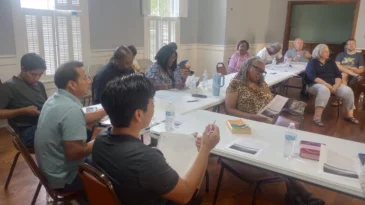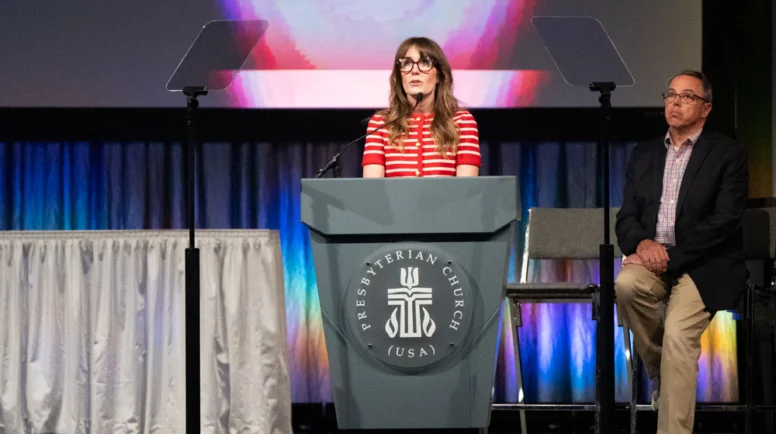
On Monday afternoon, commissioners at the 227th General Assembly approved three major recommendations from the Gender and Sexuality Justice (GEN) Committee after lengthy debate:
- GEN-02: “On Access to Healthcare”
- GEN-06: “Addition of Question to Ministry Discernment Profile–From the Advocacy Committee for LGBTQIA Equity”
- GEN-09: “Beyond Changing Families: Flourishing Relationships and Belonging”
Committee moderator Marilynn Lane, Eastern Oklahoma Presbytery, called the committee’s work both “rewarding and challenging,” saying it left “no one unchanged.”
GEN-02
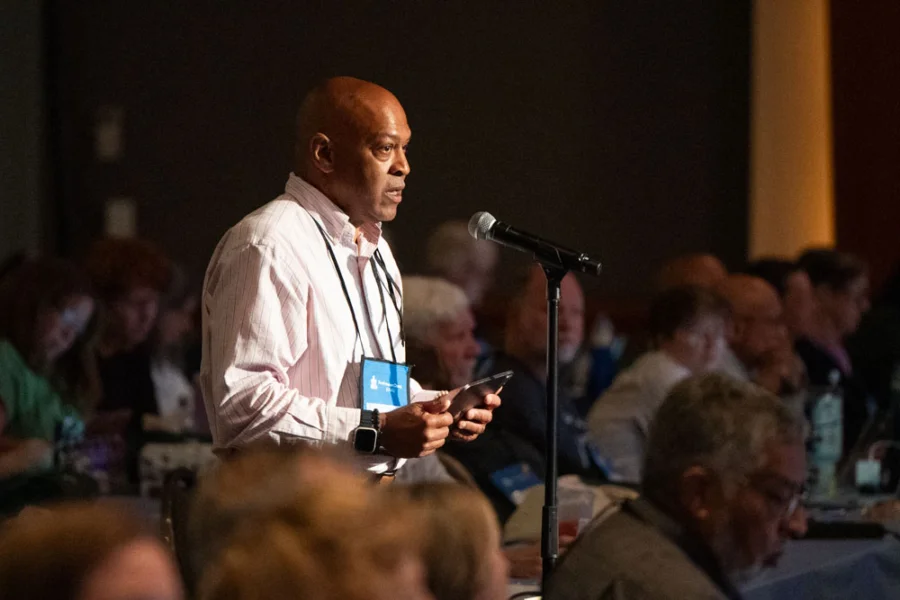
As previously reported by the Outlook, GEN-02 affirms support for gender-affirming healthcare. The GEN Committee amended the recommendation by removing the phrase “including minors” after Young Adult Advisory Delegates expressed concern it could be misused to harm transgender youth, while emphasizing that “all individuals” includes people of every age.
On the assembly floor, Young Adult Advisory Delegate (YAAD) Riley Boerger, Northwest Coast Presbytery, and Zayn Silva, a member of the Advocacy Committee for LGBTQIA+ Equity (ACQ+E), expressed support for the amendment to remove “including minors.”
Silva urged the assembly to consider the significance of this item, saying “the body of the church does not turn away people from healing.”
The item then passed by a majority, 441-30.
GEN-06
GEN-06 sparked a much longer discussion. The recommendation from ACQ+E would direct Presbyterian Life & Witness (previously known as the Unified Agency) to modify the Church Leadership Connection’s Ministry Discernment Profiles so congregations can indicate whether they are open and prepared to call an LGBTQIA+ candidate. Candidates would be able to see and use this information to inform their decisions. According to the Outlook, the GEN Committee approved this overture, 55–4, with a comment.
Commissioners questioned whether congregations that left the field blank might be perceived as unwelcoming and whether the proposal could unintentionally narrow candidate pools or create legal concerns.
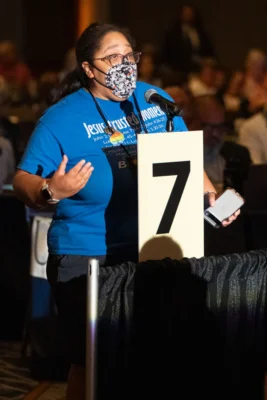
Ashley Birt of ACQ+E said the proposal envisioned more than a checkbox, giving congregations space to explain their discernment. “Honesty doesn’t take away opportunity,” she said.
A motion was made by TEC John Anderson, John Calvin Presbytery, to amend the language from “LGBTQIA+ candidate” to “any candidate,” and it was passed.
The original motion continued to have deliberate back-and-forth, with LGBTQIA+ pastors and members sharing their experiences in their call processes. TEC Hannah Ratliff, Presbytery of Utica, gave testimony in support, saying, “This overture is meant to encourage [Pastor Nominating Committees] to have honest conversations, beyond simply stating that “all are welcome,” when the truth is often much more complex and nuanced than that. In doing so, it is my hope and prayer to make a way for future clergy – like myself – to listen for where God is calling us, confident that we will be received as our full selves.”
Others argued that the topic had too much nuance and that conversations were more helpful than a binary checkbox.
Kati Collins, a TEC of Missouri Union Presbytery, proposed limiting visibility of the designation to candidates rather than making it public. Commissioners rejected the amendment by 83% after debating privacy, transparency, and implementation costs.
Ultimately, GEN-06 passed, 339-138.
GEN-09
GEN-09, “Beyond Changing Families: Flourishing Relationships and Belonging,” calls the church to develop comprehensive theological frameworks addressing human sexuality, gender, flourishing relationships, and the Christian vocation of family. As reported by the Outlook, the Advisory Committee on Social Witness Policy recommended the overture, which includes three directives, all of which were approved by the GEN Committee.
Co-moderator of GA227 Tony Larson invited TEC Lisa Chase, Presbytery of Carlisle and YAAD Tyler Whittmann, The Presbytery of Shenango, to present a minority report that advocated for adding the underlined text:
“The Advisory Committee on Social Witness Policy recommends that the 227th General Assembly (2026) direct the Presbyterian Life & Witness, in consultation with appropriate advisory and advocacy committees, [and including diverse theological views from across the Presbyterian Church (U.S.A.),] to: …”
The proposed amendment was met with strong views on both sides.
Whittmann framed the language as serving the greater church: “We (the church) want to remain a big tent.” Adding, “As Jesus … gave voice to the voiceless, so must we now lift up the voices of those who are now underrepresented in our church.”
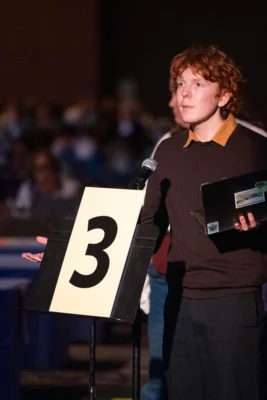
YAAD Dexter Mitchell, Presbytery of de Cristo, offered a reflection on the possible underlying motives of purposefully referencing “diverse theological views,” saying, “It’s clear that we’re talking about the theological view that maybe doesn’t see the LGBTQ community in the same way that the majority here does.”
TEC Mike Goodwin of Winnebago Presbytery and ACQ+E’s Silva viewed the suggested phrase as redundant. Goodwin shared, “I just want to highlight and celebrate that we are a denomination that is already doing this work (of connecting with people who have different views).”
The vote on the amendment failed to pass, disapproved by 81%.
A second amendment was proposed to add language requiring that biblical language scholars and translators with expertise in the original scriptural languages be part of the process. This amendment failed, with 90% of the votes against.
A third and final amendment was proposed by TEC John Anderson, John Calvin Presbytery, requesting to expand the scope of the study in section 1 of the overture to include relevant scientific research alongside the theological resources.
The amendment was approved by a much closer margin than previous votes, with approval from 56% of commissioners.
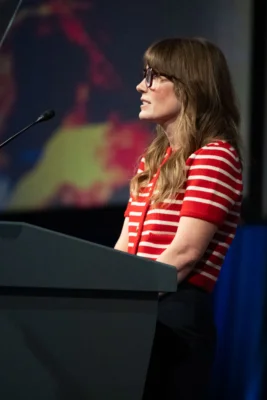
Before GEN-09 went to a vote, YAAD Ethan Chaparro, Presbytery of Tampa Bay, asked commissioners to consider the overwhelming support for the overture from the GEN committee, as well as the time and consideration spent discussing the item.
The assembly then approved GEN-09 as amended, 419-54.
In closing, Lane thanked the committee for accompanying one another through difficult conversations and bearing witness to God’s love. “Thanks be to God,” she said.
Following the plenary, More Light Presbyterians expressed gratitude for the “careful discernments” of the assembly for its approval of the items brought by the committee: “especially those that directly impact and affirm the dignity, belonging, and flourishing of our LGBTQIA+ siblings.”
Brian Ellison, executive director of Covenant Network of Presbyterians, was also pleased with the results: “This study represents the best way to achieve guidance for the church that has depth, practical relevance and Reformed integrity.”