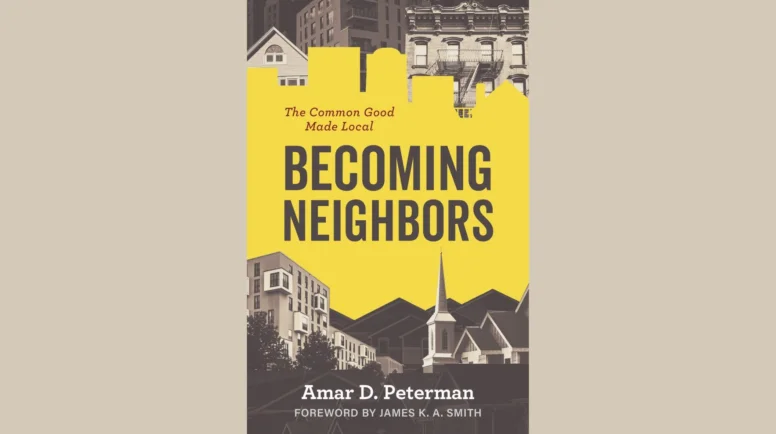
Becoming Neighbors: The Common Good Made Local
By Amar D. Peterman
Eerdmans Publishing, 144 pages
Published March 12, 2026
In an age where “stranger danger” is heightened, borders tightened, and the self-preservation of nation-state, religion and self the sacred trinity, Becoming Neighbors speaks to our better angels. Writing like a doctoral student (which he is at the time of publication) with footnotes and quotes from respected voices in the Reformed faith tradition, Amar Peterman’s voice is also accessible and inspirational. The book reads like a well-crafted sermon with identifiable discussion points, making it a strong choice for small-group study as well as individual reading.
Those discussion starters are especially plentiful in Chapter 3, where Peterman offers six ways to practice neighbor love: compassion, humility, translation, resonance, lamentation, and accompaniment. Churches eager to explore how these practices might look in their particular community will appreciate these resources. Peterman’s description of resonance might be the most powerful and necessary practice — he suggests that when we tune into each other like musicians in an orchestra who “align their instrument’s pitch to those next to them … we can foster a community where we can mutually flourish through practices of attention and empathy.” This posturing of turning our attention toward one another and tuning in to another’s needs offers a welcoming, hope-filled alternative to the individualism that frustrates many Americans today.
Peterman speaks to faith leaders as he draws on John Calvin’s theological musings for the roles of prophet, priest, and king, imagining a community of builders whose deepest desire is the love of neighbor. This shared desire manifests in a shared table, opening the possibility of “shifting our imagination of the world and our place in it.” For some skeptical readers, this may sound too good to be true. But so does the gospel.
I hoped for anecdotes from Peterman’s own neighborly work; the absence of real-life examples, perhaps from his time at Interfaith America, makes the book sound a bit preachy at times. His shared vision to love and live as neighbors can sound lofty, idealistic and, quite frankly, nothing new. Repackaging the standard gospel message as “love thy neighbor” leads to a romantic reading rather than a radical one. We self-select our neighbors, after all, based on housing affordability; our choices are narrowed by socioeconomic status and compounded by our greater isolation from one another. Block parties, welcome-to-the-neighborhood baked goods, and even basic eye contact while passing one another on a neighborhood walk are no longer the norm.
I know these practices still exist in parts of America, yet the practice of choosing our neighbors remains. So, I wonder how Peterman would re-imagine what it means to become neighbors — after all, it’s difficult to be neighborly with those riding the bus if we commute in our new EV. We may require another chapter (or book) on how to develop mixed-income neighborhoods that expose us to new – and different – neighbors in the first place.
Presbyterian Outlook supports local bookstores. Join us! Click on the link below to purchase Becoming Neighbors from BookShop, an online bookstore with a mission to financially support local, independent bookstores. As an affiliate, Outlook will also earn a commission from your purchase.
Sign up for Page Turners, our monthly email newsletter, to receive book-related content in your inbox once a month.