As our nation celebrates the 250th anniversary of the Declaration of Independence, Presbyterians and mainline Protestants writ large face a question at the heart of the state of the church: How do we form Christian citizens in a time of fear, falsehood and democratic unraveling? How do we build worshiping communities at a moment when brazen attacks on ethnic minorities, women and LGBTQ+ people are carried out in the name of our faith?
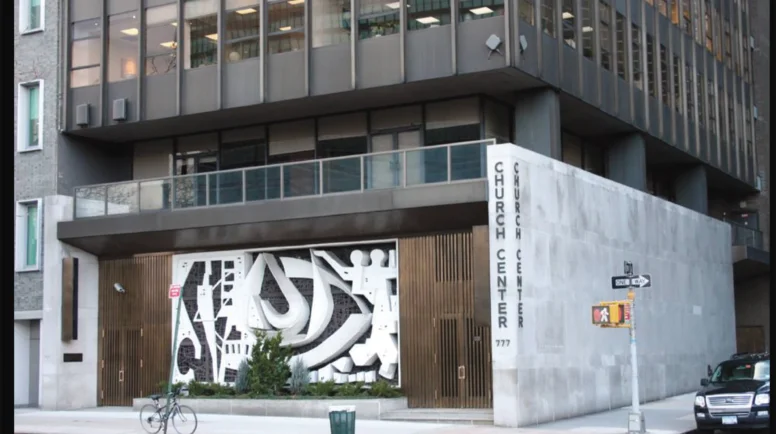
Our history offers a clue to who we might yet be. Presbyterians helped shape democratic habits of governance. For generations, mainline Protestants helped build the moral architecture of a more humane public life. For a decade, I had the honor of representing the Presbyterian Church (U.S.A.) at the United Nations. Our office, housed in the Church Center for the United Nations across from the U.N., stands as a reminder that churches once helped rally support for international institutions that meant to reduce war and protect human rights after the devastation of the twentieth century. That work was not incidental to our faith. It grew from a conviction that God calls us toward human dignity, mutual obligation and the flourishing of all.
Our history offers a clue to who we might yet be.
Yet today, many of the forces that once spoke the language of faith are helping dismantle that vision. Religious nationalism is ascendant in the United States and around the globe. It is not merely contesting policy. It is contesting the moral underpinnings of democratic governance.
Related reading: “John Witherspoon and the hope for a more perfect union” by James Calvin Davis
I began to see this shift early. I stepped into my first ministry at the Presbyterian United Nations office full of hope, charged with advancing gender equality, global health and peacemaking. But I watched the Christian right attack our denominational programs, while too many church leaders falsely assumed our democratic structures would hold. In 2000, at a U.N. review of the Beijing Declaration and Platform for Action – the result of the Fourth World Conference on Women – I saw the same tactics that had already been used in church fights at home: disinformation, procedural manipulation, institutions flooded with disciplined delegates, and the cynical use of religious language to block women’s freedom.
I wrote a book about the globalizing Christian right, and then I spent years helping organize faith-rooted resistance — first at the U.N., and later in public life in the United States.
But this turning point in my life was not just analytical or advocacy-oriented. It was spiritual.
The day something shifted
As a young woman at the United Nations, I watched religious movements silence women across traditions, including my own. It made me question my call to ministry. Then one day, during a panel where Muslim women were speaking about life under religious extremism, an ambassador from their country stormed in and tried to intimidate them into silence. Instead, women across traditions rose to their feet and applauded. By standing together, they also physically blocked the doorway and gave the speaker the courage to continue.
I saw with new clarity that faith could be used either as a weapon of control or as a force for liberation.
Something in me shifted that day.
I saw with new clarity that faith could be used either as a weapon of control or as a force for liberation. The courage of those Muslim women called me not only to claim my faith on my own terms, but to pursue ordination so I could help bring liberationist, feminist theology into a world starved for moral courage.
Over time, I learned that making an explicit argument from faith need not threaten secular democracy. In fact, when grounded in humility and human dignity, such witness can help protect secular democracy. For the sake of women, the world and my own spiritual well-being, I could not let Christian extremists hijack my faith.
That moment illuminated something larger than my own vocation. It exposed a weakness in the way many progressives, including many of us in the church, had come to imagine public life. We assumed that democracy could be defended largely through procedure, institutional norms and a carefully neutral public square. Those things do matter immensely. But they are not enough in a time when our opponents are offering a thicker story: one about identity, destiny, civilizational crisis, enemies, sacrifice, and even God.
The vulnerability of liberalism
Marlene Laruelle, director of George Washington University’s Illiberalism Studies Program, argues that, right now, liberalism is especially vulnerable when it offers rights and procedures but no compelling account of shared meaning.
For Christians, we cannot respond to weaponized religion simply by privatizing faith. We need a public theology that is strong enough to resist domination, yet humble enough to protect pluralism.
That argument does not mean democracy should ignore the First Amendment or church-state separation. It does mean that democracy’s defenders must recover the moral depth on which it already depends.
Liberal democracy rests on sacred commitments, whether we admit it or not: the equal worth of persons, the dignity of conscience, the conviction that no one is above the law, the refusal to make cruelty a governing principle. Laruelle argues that liberalism must become more honest about those commitments and recover a thicker language of solidarity and shared purpose before it can answer theopolitical challengers. For Christians, we cannot respond to weaponized religion simply by privatizing faith. We need a public theology that is strong enough to resist domination, yet humble enough to protect pluralism.
What I was discovering personally was also unfolding institutionally. Even as many people hungered for a liberating faith, the churches most capable of offering it were losing confidence in their own public voice. For decades, mainline Protestants have been told that our decline proves our irrelevance — that we are too liberal, too conflicted, too compromised by modernity to matter.
The numbers are sobering. In the mid-1970s, roughly three in 10 American adults identified as mainline Protestants. Today, fewer than one in 10 do. But numbers alone do not tell the deeper story. As mainline churches lost members, the number of Americans identifying as religious “nones” rose dramatically. For many, that shift looks less like settled secularism and more like disillusionment. Again and again, I meet people who have not rejected the Gospel. They are grieving its absence.
Even as many people hungered for a liberating faith, the churches most capable of offering it were losing confidence in their own public voice.
The steep decline of mainline Protestantism
In his recent book The Vanishing Church: How the Hollowing Out of Moderate Congregations Is Hurting Democracy, Faith, and Us, political scientist and pastor Ryan Burge uses statistical data to show how the steep decline of mainline Protestantism accelerated in the 1980s as Moral Majority, founded by Jerry Falwell, remade Christianity’s public image. To many Americans, faith no longer looked like a tradition wrestling honestly with complexity and moral responsibility. It looked like a partisan identity demanding allegiance.
Related reading: “Presbyterian patriotism: Honestly honoring our history” by Matthew B. Warren
That transformation did not happen by accident. Political operatives recognized that anxieties around race, gender and social change could be mobilized to realign U.S. politics. Wealthy donors financed a movement that fused religious identity with partisan loyalty. Media empires were built. Direct-mail operations bypassed denominations. Radio hosts and strategists began shaping the moral imagination of congregations more effectively than pastors or seminaries could.
Slowly, authority shifted. The patient rhythms of mainline discernment – debate, humility, scholarship, shared governance – were drowned out by a faith that instead promised certainty, power and belonging through exclusion. Moderates and liberals stepped away not because they rejected belief, but because they no longer recognized it.
The patient rhythms of mainline discernment – debate, humility, scholarship, shared governance – were drowned out by a faith that instead promised certainty, power and belonging through exclusion.
So yes, mainline Protestantism declined. But that decline is inseparable from America’s political polarization. We Christians were not merely bystanders to this transformation. We were among its targets. The movement that became modern Christian nationalism deliberately undermined communities that were capable of sustaining moral complexity, public accountability and political difference within shared worship.
What we are witnessing, then, is not the disappearance of spiritual longing but a crisis of credible religious expression.
The crisis today
I still encounter that crisis everywhere I go — not as an abstraction, but in the lives of people who ache for faith and no longer know where to find it. I felt it one morning on the Washington, D.C., Metro. I was riding downtown on No Kings Day with a protest sign on my lap. The train was full of women in scarves, comfortable shoes and handmade signs. I smiled at two groups nearby. No one smiled back. Then I remembered: I was wearing my clerical collar. I do not wear it often, but at protests I sometimes choose to. It is a way of making the church visible, of refusing to cede public faith to extremists. Still, I forget how much suspicion the collar now carries. So I turned my sign around so they could read it: “No Kings but the Migrant Jesus.”
The shift was immediate.
“What kind of pastor are you?” one woman asked.
“I’m Presbyterian,” I said.
That was apparently the password. One woman leaned over and said quietly, “I’m glad to see a pastor here. I had to leave my church.” Soon, others began telling versions of the same story. They had not left faith. They had left churches that no longer resembled the Gospel they loved.
For the rest of the ride, we talked about how Christianity had been misrepresented — how a faith rooted in liberation had been repurposed to enforce hierarchy. We talked about Moral Majority, lost-cause theology and the operatives who learned to weaponize religion for power. Most of all, we talked about the need to fight back rather than walk away.
They had not left faith. They had left churches that no longer resembled the Gospel they loved.
That conversation captures the paradox of this moment: Christianity is losing institutional ground, yet the hunger for meaningful faith is everywhere.
I saw that same hunger during my years leading Faith in Public Life, when people who had little use for institutional religion still responded to faith spoken with moral clarity rather than coercion. We encouraged clergy and faith leaders not to scrub their public voice of religious particularity, but to bring it into public life in a way that welcomed others rather than dominated them.
How to practice faith publicly today
That is the kind of public faith we have too often forgotten how to practice. The answer is not to banish faith from public life, but to recover forms of faith that make public life more humane. Christian nationalism weaponizes religion to claim power over others. Faithful public witness does the opposite: It places moral limits on power, defends human dignity and widens the circle of belonging. Yet many people in our pews have never been given the language for that kind of witness.
Scripture was forged among people who knew the ravages of empire. It was shaped by exile, occupation, struggle and hope. No wonder it still speaks so powerfully in moments like this. But too often we have deconstructed the Bible without reconstructing it — critiquing its misuse while failing to reclaim its liberating moral vision.
The answer is not to banish faith from public life, but to recover forms of faith that make public life more humane.
When faith becomes embodied, when belief moves from abstraction to action, something changes. People find their voices. They discover solidarity, courage and even joy.
Weaponizing this shift is what makes Christian nationalism so dangerous. It is not simply a form of conservative Christianity. It is a political ideology cloaked in religious language: a theology of domination, exclusion and resource capture masquerading as faithfulness. Its purpose is to rob communities of spiritual courage, authority and power for the common good. It aims to render the liberating truths of the Gospel powerless.
We saw the consequences on Jan. 6, 2021, when Christian flags and crosses flew above a mob attacking the U.S. Capitol. Among the most chilling features of this movement is its attack on empathy itself. Compassion – central to Christian ethics – is increasingly mocked as weakness or betrayal. Authoritarian movements cannot succeed if people still recognize the stranger as neighbor. They rely on fear, scapegoating and numbness. They need a compliant population, not a morally awake one.
That is why our current struggle is not merely political. It is spiritual.
Related reading: “PC(USA) labels White Christian nationalism ‘Theological Error’” by John Bolt, Outlook reporting
The struggle is not only American. The global Christian right has polarized politics along the lines of a culture war, seeking to establish autocratic orders in the name of faith while demonizing democracy and human rights as somehow antireligious. As I saw in the late 1990s and early 2000s, these movements share tactics, networks and rhetorical frames across borders. What we face now is not simply a local church fight or even a national partisan struggle. It is part of a broader global contest over what faith will mean in public life and what kind of moral order will shape our future.
Christianity in the American experiment
As the United States approaches the 250th anniversary of the Declaration of Independence, the reality of Christian nationalism feels especially stark. This is less a season of uncomplicated celebration and more one in which we must ask hard questions about the union’s viability and future. Where are we, really? What have we become? How have our past moral failures become our present? What is the role of the church in this moment?
The American experiment has always carried both promise and contradiction: soaring language about equality runs alongside slavery, dispossession, exclusion and entrenched inequality. The church’s story carries a similar tension. At its best, the church offers a witness for human dignity, liberation and moral courage; at its worst, it serves as a chaplain to empire, hierarchy and exclusion.
Now both church and nation are facing a reckoning. This anniversary should invite not so much nostalgia as truth-telling. A “state of the union” reflection asks whether the bonds that hold us together are strengthening or fraying. A “state of the church” reflection asks something similar: Are we still capable of forming people in courage, truthfulness, solidarity and love strongly enough to resist fear and domination?
I think often of those who came before us: enslaved Africans in hush harbors finding the God of Exodus despite a censored slave Bible; Howard Thurman drawing from the teachings of Jesus to confront fear and domination; Martin Luther King Jr. turning spiritual discipline into public moral power; Dietrich Bonhoeffer carrying lessons from Harlem’s Black church preaching back into resistance under the Third Reich. Again and again, in the face of empire and brutality, people of faith have gone deeper into their traditions.
Mainline Protestants have more resources than we often admit. Yes, we face shrinking budgets and declining membership. But we still steward moral credibility, educated leadership, deep institutions, land, endowments and relationships with civic and business leaders. We influence hospitals, schools, nonprofits, law firms, neighborhoods and public life. The question is whether we know what we have and are willing to use it.
What would it look like for more congregations to see themselves as training grounds for democratic courage? For pastors to teach Scripture not as private comfort alone, but as a handbook for resisting tyranny? For churches to become organizing hubs, mutual aid centers, sanctuaries for the vulnerable and places where people who search for meaning beyond consumerism and xenophobia can encounter a faith big enough for this moment?
I see signs of this renewal already: churches sheltering migrants, pastors placing their bodies between ICE agents and their people, congregations telling LGBTQ+ youth without hesitation, “You are beloved.” We need to relearn how to speak our faith aloud so that liberative Christianity shapes public discourse in ways that interrupt the adulterated version of Christianity that now dominates public life.
Even as we partner with secular leaders and people of every faith, we must bring our own theology and sacred texts into public life with humility and clarity. The Bible was written by people dealing with tyrants, empires, exile and oppression. Scripture is not a handbook for domination. It is a witness to liberation, moral courage and the widening of human dignity.
Yes, we are living in a time of unraveling. Institutions are fraying. Old assumptions no longer hold. But unraveling does not always lead to destruction. It can lead to revelation. It exposes what has been hollowed out, and it clears space for what might yet be born. As both church and nation enter this season of reckoning, renewal will not come through denial, sentimentality or some mythic return to the past. It will come through truth-telling, moral courage, and communities willing to embody a different way of being together.
We need to relearn how to speak our faith aloud so that liberative Christianity shapes public discourse in ways that interrupt the adulterated version of Christianity that now dominates public life.
The state of the union is fragile. The state of the church is unsettled. But neither story is finished.
I do not believe this is the end of the church’s story. I believe it is the end of a chapter in which we underestimated our gifts, our responsibility and our calling.
What comes next will not be inherited. It will be chosen by pastors who refuse to surrender Scripture to extremists, by congregations willing to risk comfort in order to tell the truth, and by communities bold enough to imagine that faith might once again serve the flourishing of all.