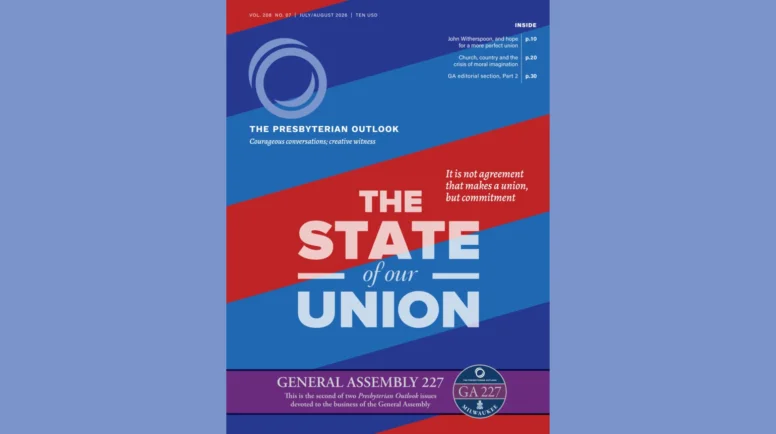
“John Witherspoon and the hope for a more perfect union” by James Calvin Davis
Questions:
- The author states, “Most troubling to many Americans is the sense that our nation has lost its moral compass …” If you are among the “many,” what do you see as examples that cause this concern? If you are not among the “many,” what are your observations?
- The author sees Christian Nationalism as a threat to the future of American democracy. Do you see the movement as a threat? Or do you see it as a course correction? Explain why.
- What have you learned about John Witherspoon from this article?
- As we celebrate the 250th anniversary of the Declaration of Independence, what are your hopes and your fears for the future of our nation?
“Blessed are the peacemakers in a militarized world” by Mihee Kim-Kort
Questions:
- If you are of an age where you remember the Korean War, what do you recall? If you have no memories of the Korean War, what have you learned about it?
- What have you understood the concept of militarism to mean? How has this article expanded your understanding of the concept?
- Reread the portion of the article with the heading, “The Christian response to militarism.” What are some statements in that section that you would highlight? Why?
- In the concluding section, “What might that calling look like for Presbyterians?” the author offers three suggestions. How might the three suggestions be implemented in your congregation? What would you add to the list?
- What insights in this article will you ponder and explore further?
“Church, country, and the crisis of moral imagination” by Jennifer Butler
Questions:
- In the first paragraph, the author poses two important questions. What are some thoughts you have as you consider possible responses to the questions?
- The author writes, “Again and again, I meet people who have not rejected the Gospel. They are grieving its absence.” What is your response to that observation in terms of your experience and your reading?
- Christian Nationalism is a subject of this article. What is your understanding and/or experience with this movement in our nation? How do you respond to the author’s critique of Christian Nationalism?
- Reread the paragraph that begins, “The American experiment has always carried both promise and contradiction …” What are your thoughts about how the Christian church has responded at its best and its worst? Suggest some examples.
- In what ways does this article challenge you and your church to celebrate the 250th anniversary of the Declaration of Independence? What are some faithful actions you and your church could do to ensure the best of Christian witness is expressed?
“Center of Hope (Haiti) cultivates a new generation of leaders” by Gregg Brekke
Questions:
- Having read the story of the Center of Hope (Haiti), what aspect of the story is most inspiring for you?
- What were the steps of the Center of Hope (Haiti) project that you believe are repeatable in other mission settings?
- Are you aware of similar mission projects where a delegation to a mission field returned home to initiate their own mission project? If so, describe the example with which you are familiar.
- What are the elements of this story that you think are relevant to your church’s ministry and mission? How might those elements have an impact on your church’s mission?
- What, if anything, do you see as limitations in such projects as the Center of Hope (Haiti)?