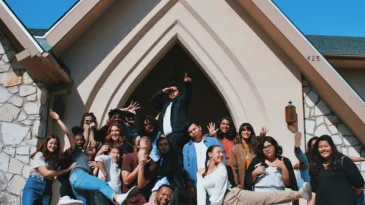
These centers have venerable histories of nurturing the faithful, of challenging the complacent, and of handing down the gospel to each new generation. In addition these centers furnish safe, Christian places for young people and college students to work, to share and explore faith, and sometimes to fall in love.
Often college students are indispensable to programs for children while parents are in conferences. They are lifeguards, waitpersons, and coaches. Sometimes a chaplaincy program serves and supports these students, offering them counseling and Bible study (on a voluntary basis) all summer long. Nothing is mandatory except the work agreed to, and appropriate standards of behavior that befit a Christian conference center. These centers have provided wonderful ministries across the years, and yet new occasions ought to teach us new duties, as the hymn reminds – or perhaps new practices.
I heard about a voluntary Bible study group last summer that was troubling. Led by three seminarians, the college students tackled, in light of the Scriptures, the kinds of topics that have delighted college students for generations: sex, war, freedom and responsibility, the boundaries of belief. We’ve all been there if we’ve ever been to college or in a church college group.
The problem arose in part because of diversity, which is normally valued, a good thing. But the diversity in this group provoked discussions and even anger that apparently remained unresolved. Several students were unabashed, card-carrying fundamentalists. They believed in the inerrancy of Scripture, and were not open to other opinions. Their minds were made up, and they were neither respected nor respectful.
One student carried a Bible with the interpretation written beside the text, telling her exactly what to believe about what the Scriptures said. Even though the text explicitly contradicted what the interpretation claimed, she could not be dissuaded. (Her Bible was similar to the Geneva Bible with its politically explicit anti-royalist commentary. This translation so troubled King James I that it was a contributing factor to his convening the committee that gave English-speaking peoples the King James Bible.) There is nothing new under the sun.
The story of that communication breakdown suggests that conference centers need new practices in the employment of students for what is most often indispensable summer work. Cannot such employment, undertaken by a Christian agency of the church of Jesus Christ, be an opportunity for the nurture of these tender branches by building Christian community? Why not have all students, as a matter of course, sign an employment agreement before they arrive that spells out 1) that these are Christian programs; 2) that they will be held accountable for their behavior as role models, and 3) that they are expected to take part in daily worship and Bible Study. Further, at the first meeting, ground rules for the study of Scripture in small groups would be handed out – and adhered to rigorously. At a minimum we should assume that as we study the Word together, we can expect the presence of the Holy Spirit to open the Scriptures to our minds and hearts, and that no contribution would be rejected, ignored, or mocked.
One example of what is possible is the Iona Community (situated on an island off the coast of Scotland). It runs an extensive volunteer program for people of all ages. These volunteers are indispensable to managing two conference centers on Iona, another on a nearby island, book and coffee shops, cleaning and food services. Ten years ago the volunteer program was disorganized, and did little to help the vollies (as they are called) be incorporated into the traditions of the Iona Community, which are deep and powerful, and which helped transformed the Church of Scotland in the sixties and seventies. Now the Iona Community has turned a corner. There is significant orientation that “incorporates” all vollies into the tradition, and while participation in three worship services daily is not required, it is encouraged and expected.
For a long time, for a very long time, while mainstream Christian culture disintegrated around us, we were foolish to assume that voluntary, undisciplined participation in Bible study and worship would transform lives and build disciples. Surely it is not foolish to expect that when tender plants are given into the hands of a Christian institution, they will be nourished faithfully and intentionally until they become strong and bear fruit. Keeping such nurture voluntary may indicate that we in the institutional church have lost our zeal for handing down what was so lovingly handed down to us – often with great difficulty, and much prayer and anguish.
The most serious question is this: What is the responsibility of church conference centers to encourage, promote, and be intentional about handing down the faith once and for all delivered to the saints? Surely it is our responsibility to hand down what has been delivered to us, that which is dearer than life to us. It is a new practice. It takes diligence, courage, and faithfulness. And it can be accomplished.
It is past time to turn a corner ourselves, and, as the kids would say, take hold of an awesome opportunity. God will give the growth.
Send your comment on this report to The Outlook
Please include your full name, hometown and state.