 by Michael Long
Westminster John Knox Press, Louisville, Ky. 222 pages
Reviewed by Tamara M. Leonard Lara
I was not part of the television audience for the 1968 national launch of “Mister Rogers’ Neighborhood.” I had not yet been born. I remember I was proud and surprised to learn Fred Rogers was a Presbyterian minister. On my bookshelf, I have a used copy of “The Mister Rogers Parenting Book; Helping to Understand Your Young Child.” I looked to Fred Rogers for guidance because I saw in him compassion and gentleness; a true concern for the wellbeing of children.
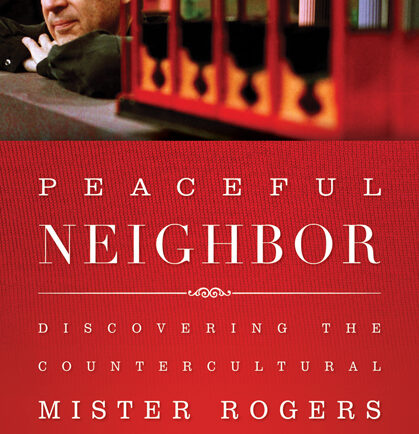
Michael G. Long, the author of “Peaceful Neighbor: Discovering the Countercultural Mister Rogers” states, “The purpose of this book is to take Fred Rogers and his Neighborhood seriously.” I am not sure I would label him a radical, as Long does, but I do agree Rogers was countercultural and should be taken seriously. Rogers paid close attention to the news of the day, made choices about how to reassure children and parents, and encouraged children to learn to share their feelings and to care for one another.
Long’s most powerful observations about Rogers center on relationships. First, Rogers chose to address issues of violence and the work of peacemaking and conflict resolution during his very first week of national programming of “Mister Rogers’ Neighborhood” in 1968. This was a bold choice when seen in the context of the ongoing conflict in Vietnam. Second, he acted from his own deep convictions about the nature of God, “When we hear the word that we are not lovable, we are not hearing the Word of God,” Rogers stated. “No matter how unlovely, how impure or weak or false we may feel ourselves to be, all through the ages God has still called us lovable.” Fred Rogers believed God accepts us exactly as we are. And lastly, Fred Rogers had a clear perspective on the value of identifying heroes during times of violence or disasters to comfort children. Long quotes from Rogers’ 1983 parenting book where he writes, “When I was a child and my mother would read about such events in the newspapers or see them in the newsreels, she used to tell me, ‘Always look for the helpers. There’s always someone who is trying to help.’ I did, and doing so changed the way I saw them. I began to see the world was full of doctors and nurses, volunteers, neighbors, and friends who jumped in to help when things went wrong. That was reassuring.”
Could Fred Rogers have done more to demonstrate the radical and inclusive love of God? Absolutely. But we all could say that. Rogers’ goal was clear: to reach as many children as possible and to avoid alienating his audience. I agree with Michael G. Long’s conclusion about Fred Rogers: “As a compassionate human being, he was also a Christian prophet and a peacemaker who sought to accept us as we are, with all our violence and injustice, while at the same time inviting us to visit a neighborhood marked by unconditional love for one another and the world — the peaceable reign of God — so that we can go back home and build similar neighborhoods in our own communities.”
TAMARA M. LEONARD LARA is the associate pastor of Darnestown Presbyterian Church in Darnestown, Maryland.