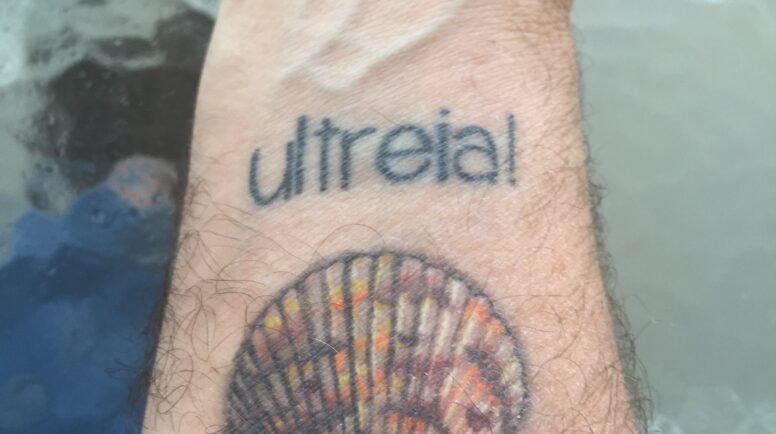
This is the story of a tattoo. It begins in a French village at the base of the Pyrenees Mountains and ends in a Spanish village overlooking the Atlantic Ocean. In between is a path that millions of pilgrims have walked since the 12th century. In the spring of 2015 I was one of them, on sabbatical from my pastorate. The way is known as the Camino de Santiago de Compostela, a 500- mile path over the mountains and across northern Spain. Modern pilgrims are a mixed company of many languages — some traditionally religious and others non-religious, though walking with an explicit and often spiritual intent. I didn’t walk as a religious penitent. I did walk with a purpose that included listening for God’s direction and being free enough from my normal patterns to see them afresh.

The poet Wendell Berry said, “Always in the big woods when you leave familiar ground and step into a new place there will be … a little nagging of dread. It is the ancient fear of the Unknown, and it is your first bond with the wilderness you are going into. What you are doing is exploring. You are undertaking the first experience, not of the place, but of yourself in that place.” From the first day I crossed the mountains, walking through snow and rain in the bitter cold, the Camino became an exploration of self-understanding in an utterly new place. The freedom was exhilarating. The sense of the Unknown and the nagging dread remained with me, along with the company of pilgrims who became my Camino family. Several remain so.
Each day at dawn I would arise from my bunk bed, place my belongings in a small backpack and walk out the door. The Camino winds through wide valleys and small villages, among vineyards and the vast grasslands of the high plains. It crosses the rugged mountains of Galicia before descending to Santiago. The spring flowers are breathtaking, especially the acres of brilliant red tulips on the hills. Songbirds are abundant, including the ubiquitous call of the cuckoo. Most days I didn’t know what I would eat, where I would sleep or whom I would meet. It was a wondrous sense of being on the edge of fear and faith. Daily I prayed, “I will receive this day with gratitude and an open heart.” Sharing simple meals with bread and wine, engaging in slow honest conversations that frequently reached rare spiritual depth, tending the pains of another — the Camino is a profound communal experience of conviviality. In nearly every village, there is a daily mass for the pilgrims who greet each other with “buen camino” roughly translated “enjoy your walk.” The response is “Ultreïa” a French word of encouragement that means “forward always; keep going [into God.]”
I reached Santiago de Compostela in 31 days, celebrating joyously with my Camino family. Two days later, I walked on to Finisterre, the village on the coast known as the end of the world. Here the original pilgrims faced the ocean, literally the end of the road, where the world ends and the unknown begins.
There is a saying: The Camino begins when the Camino ends. I wanted a way to mark this experience into my body reminding me of gratitude, freedom and faith. This is why I have a tattoo. It’s a shell, a symbol of baptism and of the Camino, with the word Ultreïa above it. My spirit is marked with the Camino. So now is my body. I’m grateful.
 ROY W. HOWARD is book editor of the Presbyterian Outlook and the pastor of Saint Mark Presbyterian Church in North Bethesda, Maryland.