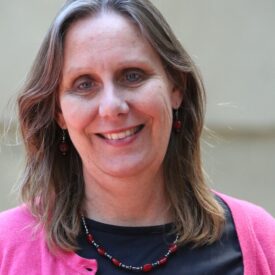
SAN JUAN, Puerto Rico – As the Presbyterian Mission Agency Board meeting got underway March 21 in San Juan, José Gonzalez Colón brought greetings to the board’s executive committee from the Synod of Boriquen – offering gifts of local candy, and also perspective on Puerto Rico’s economic problems and the role Puerto Rican Presbyterians can play in the Presbyterian Church (U.S.A.).
 As a territory of the United States, Puerto Rico “belongs to but is not a part of the U.S.,” Colón said. “Our churches and our people, we keep a culture that is still Latin American” — and there has been debate about whether to become a national church or remain part of the PC(USA).
The Boriquen synod has established a sister relationship with the Presbyterian Synod of Cuba, and there is “an opportunity for us to be a bridge” between the PC(USA) and other Christians in the southern hemisphere, Colón said.
Puerto Rican Presbyterians also can play other roles, including reminding the denomination of its mission work in Puerto Rico, which began roughly a century ago and concentrated at first on the western part of the island where a majority of Presbyterians still reside, Colón said.
There’s also a role of educating Presbyterians about the legacy of colonialism – and the economic implications troubling Puerto Rico today. “We have multinationals that do not pay one cent of tax,” but reap $35 billion annually in revenue – tax revenues on which would be more than enough to pay the debt Puerto Rico owes, Colón said.
The Jones Act gave the people of Puerto Rico U.S. citizenship in 1917, he said. But “the “Jones Act has also been a curse” – requiring, for example, that all imports must come to the island through the U.S. merchant marine. One of the consequences: Most of the food imported to Puerto Rico comes from the Dominican Republic – but that food first must make a stop in Florida, a remnant of the colonial structure.
Both the Presbyterian Mission Agency Board and the Committee on the Office of the General Assembly are meeting in San Juan this week, at the invitation of the Presbytery of San Juan. Presbyterian leaders also have attempted to bring attention to the economic concerns of Puerto Rico, which has more than $70 million in debt – much of it money it borrowed by issuing municipal bonds as government revenues declined, and that it cannot afford to pay back.

Presbyterian leaders sent a letter in February asking President Donald Trump and congressional leaders to seek an “effective, prompt and humane response to the debt and economic crisis in Puerto Rico.”
Colón said he wants these Presbyterian leaders to understand the intricacies of the Puerto Rican debt crisis and its impact on the island’s people. “This is not a plea for money,” he said, but for “how we spread the message” of how U.S. policy affects Puerto Rico.
Colón said he’s from Brooklyn, New York, but since coming to work in the synod, he’s learned about issues central to Presbyterians. “I’ve learned so much about food justice. I’ve learned so much about farming. I’ve learned so much about ecological justice” and immigration.
“I am so thankful that you took this leap of faith to come here,” he told the executive committee.
Governance Task Force
The executive committee also heard an update from Melinda Sanders, chair of the board’s Governance Task Force, which is working on a proposal to reduce the size of the board by more than half and reconfigure the board’s committee structure. Changing the size of the board would require approval from the General Assembly or the Way Forward Commission, but the board could change its own committee structure.
Sanders told the executive committee that the task force’s proposal – outlined in a white paper issued in January – won’t come up for a vote at this meeting, although board members will have a chance to talk about the proposal on March 23.
The task has had conversations with the denomination’s advocacy and advisory committees, two of which have voiced concerns about the proposal, and with the representatives of the Committee on the Office of the General Assembly and Presbyterian Women, Sanders said. Those conversations “have met with varying degrees of success,” she said, adding that she’s confident the result will be “something new and exciting.”
Although some have raised concerns about the advisory and advocacy committees potentially losing non-voting spots on the board in the proposed reconfiguration, they would be part of a new liaison committee under the white paper proposal.
Sanders she believes that new committee could actually have an increased voice through the new proposal, because the representatives to the liaison committee could help craft the report that comes from that committee to the plenary sessions and could comment on the work of the Presbyterian Mission Agency and the work they think the agency should be undertaking. “There’s more freedom there rather than just reacting to what comes up in plenary,” she said. “I actually think there will be better communication.”
Some executive committee members said that they have heard reservations about whether the advisory and advocacy committees would have sufficient voice. David Shinn said he’s concerned about “the optics of it” – about how it looks to have the representatives from advocacy committees representing women and racial ethic concerns assigned to a single committee.
The board will not vote on the white paper proposal at this meeting.
What will likely be up for a vote is a resolution to give the task force more flexibility in working with the 23 committees and organizations across the denomination to which the board currently provides a representative. “We’ve got to handle those with sensitivity and care,” Sanders said.
 Publishing
Ken Godshall, chair of the Presbyterian Mission Agency Board, brought up another issue he wants the board to be aware of: conversations that have bubbled up in conversations in the All Agency Review Committee and the Way Forward Commission about a possible merger between the Presbyterian Publishing Corporation and Congregational Ministries Publishing.
That configuration is being held up as an example of possible redundancy in the PC(USA) structure, of “doing one thing in two places,” Godshall said. The Presbyterian Mission Agency would be “well-served” by participating in those conversations, he said, and by making sure that the agency’s point of view is represented.
Tony De La Rosa, interim executive director of the Presbyterian Mission Agency (PMA), said Congregational Ministries Publishing generates revenue, and he wants to be sure that Presbyterians understand that “we’re not seen as constantly siphoning off all our revenue generators” (the mission agency just transferred responsibility for operating the Ghost Ranch Education & Retreat Center to the National Ghost Ranch Foundation) and that its assets are not “a potential cash cow for other bodies.”
Also, if another entity is interested in combining with PMA’s publishing enterprises, they need to consider the full range of publishing activity – including such things as Presbyterians Today and the Presbyterian Planning Calendar, De La Rosa said. “They don’t get to pick and choose our publishing assets that might be worth of discussion. … It has to be a broader conversation.”
Another factor: PMA contributes $300,000 to $500,000 in unrestricted funds to Congregational Ministries Publishing, said Earline Williams, the PC(USA)’s chief operating officer. If the program transfers, the financial responsibility should as well.
“That will be a very rich conversation,” Godshall said, estimating the talks will take place over the next year. “It’s going to be very interesting.”