ST. LOUIS – Who do you say that I am? That’s the question clerks, sessions and sometimes the church administrator answer in the annual statistical report.
Annual statistical reports
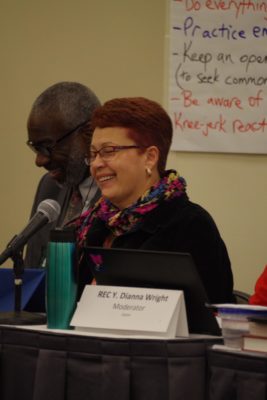
And therein lies the problem, according to Barb Gaddis, moderator of the Committee of the Office of the General Assembly. When presenting the Session Annual Statistical Report (SASR) Update (03-09), which recommends replacing a number of questions on the current report, Gaddis said, “You don’t decide who other people are.” And yet, in practice, this is exactly what happens with the SASR. Gaddis pointed out that whoever is filling out the report asks: “How many people are black? How many disabled people do you think we have?” This reality (and 10 years of work) prompted COGA’s recommendation to change several questions in the report and eliminate others, including the breakdown of men and women in the congregation.
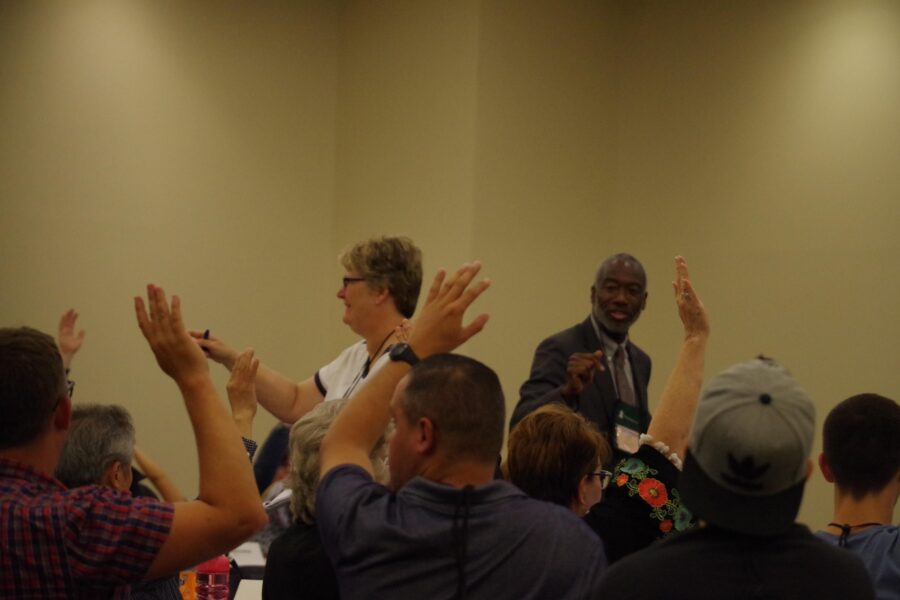
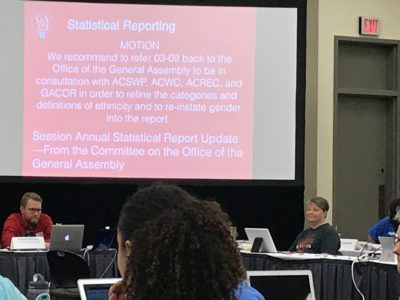 The General Assembly Procedures Committee’s questions focused on categories of race and ethnicity and gender. A number of commissioners noted that gender is non-binary and the denomination’s statistical report should reflect that reality. Gaddis said she recognized from the onset that the reporting, even with the proposed changes, would not be perfect. The committee wrestled with what would be good enough for now.
After voting to recommend the proposal, the committee returned from a break and voted to bring it back to the floor so as to hear from corresponding members who had not previously been given the opportunity to speak.
Susan Wiggins, corresponding member to the Office of the General Assembly for the Advocacy Committee for Women’s Concerns (ACWC), spoke against the proposed changes noting, “Data collected on gender should be broadened” not eliminated, and “being counted matters.”
Thomas Priest, corresponding member of Advocacy Committee on Racial Ethnic Concerns (ACREC), also spoke against the changes, telling the committee that ACREC feels that the changes to categories for race and ethnicity “locks people of color into a box for the necessity of being efficient.”
The committee ultimately voted to approve the proposal with comment, a result that satisfied the representatives from COGA, ACWC and ACREC. The comment reads: “The 223rd General Assembly of the PC(U.S.A.) asks that the Office of the General Assembly, GACOR, the ACWC, and ACREC continue to improve and expand the gathering of statistical information especially in the areas of gender, race and ethnicity, and report back to the 224th GA in 2020.”
Commissioners’ resolutions
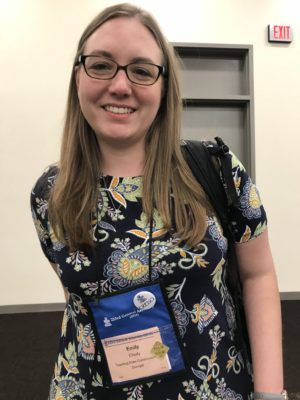
One commissioners’ resolution dealt with the cost of holding the biannual General Assembly meetings. The resolution, brought by Emily Chudy of Donegal Presbytery, “directs the Office of the General Assembly of the Presbyterian Church (U.S.A.) to investigate adaptive and technical issues around cost-reduction measures for future meetings of the General Assembly and to report back with a plan to the 224th General Assembly (2020).” The resolution listed possible ways to do so, including meeting on a university campus or meeting every three or four years.
Tom Hay, associate stated clerk and director of assembly operations at the Office of the General Assembly, spoke to the resolution noting that the Office of the General Assembly has, and does, look for ways to cut costs but is often limited by the GA’s current standing rules, He said he welcomed the resolution as it would allow the OGA to explore cost savings options that they have been unable to examine in the past.
The resolution was recommended for approval by a unanimous vote.
Another commissioner’s resolution addressed who gets to vote for the election of the moderator. This resolution was written by a group of Young Adult Advisory Delegates, signed on by two commissioners and brought by Deb Avery, a commissioner from San Francisco Presbytery.
The resolution asks “that the 223rd General Assembly (2018) direct that advisory delegates have full vote in Moderator/Co-Moderators elections in future General Assemblies.”
A member of the Advisory Committee on the Constitution (ACC),Forrest Claassen,noted that the resolutions had “clear constitutional implications” which, therefore should have disallowed this resolution as a commissioners’ resolution. The committee was informed that commissioners’ resolutions cannot have constitutional implications because they do not give the ACC time to review and share the implications, nevertheless, he said, “Bills and Overtures have passed it to you and you have to deal with it.” He added that the Bills and Overtures Committee is free to ignore the advice of the ACC.
There was lively discussion on the value of hearing from the advisory delegates, their full participation in committees and the importance of listening to their wisdom.
Robert Belz-Templeman,YAAD from Cascades Presbytery, quoted co-moderator Vilmarie Cintrón-Olivieri in her conversation with the YAADs: “You are not the future of the church, you are the church.”
The GA Procedures Committee voted 49-3 to refer the resolution with the following comment: “Recommend that the 223rd GA refer 03-23 to the Office of the General Assembly, to be in consultation with the advice of the Advisory Committee on the Constitution and the Advisory Committee on Social Witness Policy, and to bring a recommendation before the 224th General Assembly for full consideration, including the possibility of constitutional amendment.”