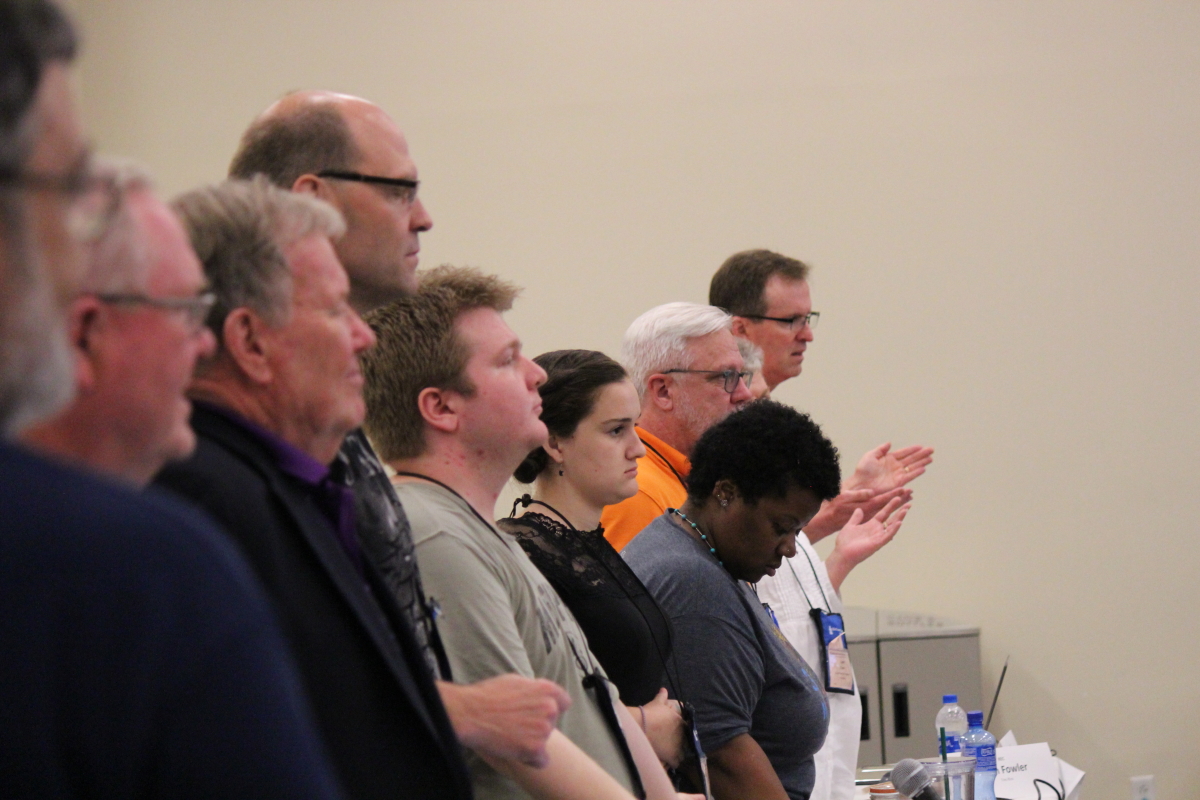
ST. LOUIS – The Way Forward Committee began making progress on parts of its work June 19, plowing through recommendations involving translation services, the role of the stated clerk of the Presbyterian Church (U.S.A.) and more. That followed a long, unusual delay while the Advisory Committee on the Constitution (ACC) sorted through constitutional implications of a recommendation from the Way Forward Commission regarding the PC(USA), A Corporation.
“It’s been a real crazy 24 hours,” said Dan Saperstein of the ACC.
Here’s a short version.
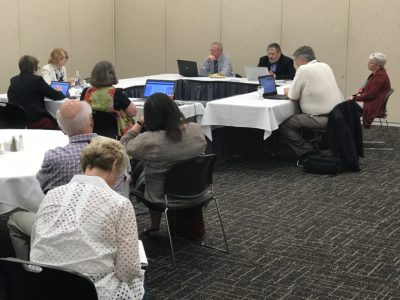
The ACC met during the lunch break June 19 to draft advice to the assembly on constitutional implications in sections of bylaw changes the Way Forward Commission is proposing. At the heart of that advice is the principle that in the PC(USA,) corporate authority needs to be subordinate to church authority.
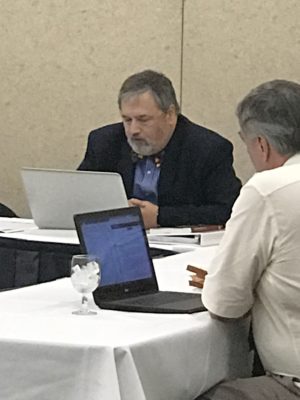
The PC(USA), A Corporation, is a civil corporation that the denomination uses to interact with the secular world (for example, to open bank accounts or conduct property transactions). “We are a church,” Saperstein said. “Civil authority within a church is always accountable to or subordinate to ecclesiastical authority. We want to preserve that principle, that the church governs the corporation. The corporation doesn’t govern the church.”
The ACC advised the assembly to make that explicit in the Way Forward bylaw proposal, and had other suggestions as well. The committee’s consideration of the A Corporation proposal was delayed for hours while the ACC discussed and drafted its advice, but once it was delivered, the Way Forward Commission responded by quickly presenting a series of proposed bylaw revisions essentially adopting wholesale almost all but one facet of the ACC recommendations – not going along with advice to increase the size of a reconfigured A Corporation board to include more at-large members.
Jim Wilson, from the All Agency Review Committee, said the Way Forward Commission and All Agency Review think the 11-member board they’ve proposed is the right size, and say its composition is intended in part to give voice on the board to agencies that use shared administrative series in the denomination.
The Way Forward Committee swiftly approved the commission’s bylaw revisions as a group, with little discussion, although it has yet to act on the A Corporation proposal itself. Once the ACC had delivered its advice, it took The Way Forward Committee relatively little time to deal with it – prompting committee member Julie Emery of the Presbytery of Southern New England to ask why this has just come now: Why didn’t the ACC provide the advice earlier, since the Way Forward Commission recommendations have been available for scrutiny since March?
Saperstein responded that the ACC had reviewed the commission’s recommendations, “which seem pretty straight-forward,” but not the proposed bylaw changes. It wasn’t until representatives of the Presbyterian Mission Agency Board’s Governance Task Force raised constitutional questions during a presentation the afternoon of June 18 “that the lights started going off” for the ACC, he said.
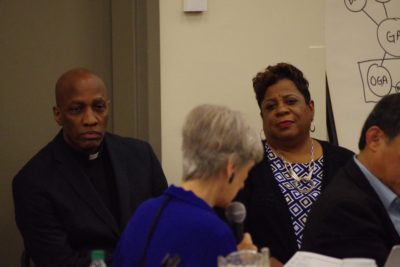
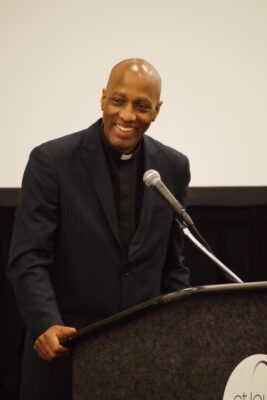
While it was waiting for the ACC to render its advice, the committee invited J. Herbert Nelson, the PC(USA)’s stated clerk, and Diane Moffett, the new president and executive director of the Presbyterian Mission Agency, to address a question that had been raised during a public hearing: whether, if the assembly did not act to make changes regarding the A Corporation, Nelson and Moffett could provide leadership for the Office of the General Assembly (OGA) and the Presbyterian Mission Agency (PMA) to work out problems on their own.
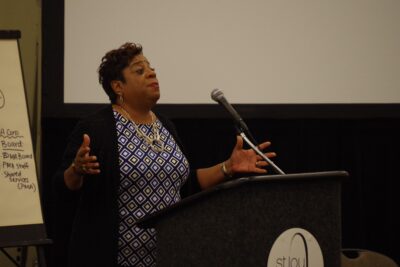
Nelson responded that “the juggernaut or the elephant in the room happens to be the issue of the A Corporation, its ownership” – the reality that all A Corporation’s board of directors are the elected members of the Presbyterian Mission Agency Board, and that OGA has no voice on that board.
Because PMA alone controls the A Corporation, Nelson said he has found “a significant lack of trust” and “some deep concerns about accountability.” Nelson said that “it’s not about throwing anyone under the bus, any agency or organization,” but control of A Corporation “doesn’t belong to a solo group.” He added: “We can possibly restore some trust by sitting at the same table.”
And he said: “Who would not want a seat at the table? … It’s about power sharing, and there are many models by which we can share power. We come up with the best decision we can to make sure all people are heard. There’s something Christian about that.”
The current configuration has been a long time in the making, Nelson said, a long-standing situation, with “an exchange of power needs that have taken place over the years, and compromise after compromise after compromise has landed us here.” “We have a chance to work it out, but we need to work it out collectively.” Nelson said he looks forward to working collaboratively with Moffett, but “this issue is too big for any of us” to work out the dynamics on their own, without help from the General Assembly. “If it were possible, it would have been done already.”
Moffett, who just started on the job earlier this month, said her concern is “the people on the ground who are in need of our care and our ministry.”
Moffett also said, “I believe in working together,” and said she is relying on the Spirit to lead the body to an answer, “releasing us to do the work we need to do. I don’t want us to have a blood clot in the system.”
If the assembly approves a design it thinks is best, “I will take it and move with it,” Moffett said. “If it doesn’t work and it doesn’t fit, I will lift up my voice as a trumpet, and you will hear.”
Moffett said, “I am interested in bringing life to the system and openness to the system” and “I am going to depend on the Holy Spirit to work through the body to make sure we come out with something so we can get to the work of ministry at the end of the day.” To people in the pews, debates over structure of the national church can seem inconsequential – to people ministering to those worried about having food to eat or access to clean water.
“I just want to see it healed and I want to see us working together and create a system so that we can do the work we are called to do,” Moffett said. “There is a lot of work. There is a lot of suffering, and we need to get to it.”
Nelson said the northern and southern branches of the Presbyterian Church reunited in 1983, and lots of decisions were made after that, and “no one has been willing to tell me how some of those things got into the per capita budget. … It’s like an old car. You just keep trying to fix it,” then more things go wrong, Nelson said.
“We are called again to live into something different. I can’t really tell you what we need until we have a system that can offer that answer. … The one we’re in right now, I don’t believe is going to carry us down the road much further.”