 ST. LOUIS – Presbyterians are trying to figure out how to proclaim their commitment to justice, equity and human dignity for all in a public way – to do so strongly and clearly in what feels like a crucial time in American public life. That sometimes cooks up a tension between speaking out now – and the realities of working through the slower and more deliberate Presbyterian system.
That became evident June 20, as the General Assembly discussed business from its Theological and Church Growth Issues and Institutions Committee (not a phrase one will ever find on a bumper sticker).
Letter from Birmingham City Jail
One example: An overture from the Presbytery of the Twin Cities Area recommended that the Presbyterian Church (U.S.A.) adopt Martin Luther King Jr.’s “Letter from Birmingham Jail” as a “contemporary statement of faith, a reliable aid for Christian study, liturgy and inspiration” but without any formal constitutional standing – meaning it’s not part of the PC(USA) Book of Confessions.
The committee voted 42-9 to go another way – to commend it to the church for study, but also to begin the process toward including it in the PC(USA) Book of Confessions. The cost estimate for starting to move the letter toward confessional status is $41,080 from per capita funds – to cover the costs of a 15-person committee meeting in person and by video call over the next two years.
The process of adding a document to the Book of Confessions is not swift. The committee studying the document being considered for inclusion would have to report back to the next assembly, in 2020, with a recommendation. If the committee recommends going ahead, that assembly would decide whether to submit the proposed new confession to the presbyteries for approval, and a super-majority of 2/3 of the presbyteries would need to concur. If that’s achieved, the measure would need the approval of the next General Assembly, in 2022.
The debate on the assembly floor June 20 had to do with what Presbyterians should do: Make the Birmingham letter a confession? Teach it in Sunday school? Save money or spend it?
The assembly eventually voted 352-160 to begin the process of moving the “Letter from Birmingham Jail” towards confessional status – but not everyone was convinced that was the way to go.
Debra Avery, a minister from California, argued that many of the themes of King’s letter can be found in documents already in the PC(USA) Book of Confessions, including in the Confession of 1967 and the Confession of Belhar.
Some argued that it’s important for Presbyterians to do something with the letter now; others said that the current times compel Presbyterians to give the letter the added weight of confessional status.
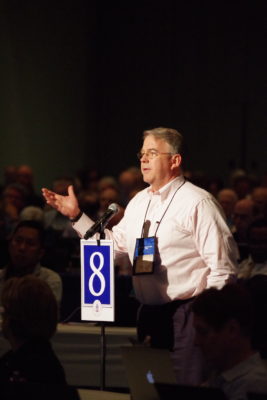
“The letter is 50 years old, is it not?” said Quinn Fox, a minister from National Capital Presbytery. “We talk about the urgency – it is an urgent time, but this is not a new document.” He also said most confessions are written by a group – a council or committee of some sort – and not by an individual.
Sunny Kang, a minister from the Presbytery of the Pacific, said “we have been talking and learning from Dr. King’s prophetic statements” for years. “We cannot simply claim to be good people and remain silent when we see injustice. To simply commend it again (for the church to use) does not accomplish anything more than we are already doing. … The moral necessity of our time demands that we … add Dr. King’s work into our confession.”
In the U.S. today, racism is being publicly expressed, and “we’re battling homophobia and misogyny and the (unfair) treatment of immigrants and those who want to be part of us,” said Jennifer Stroud, a minister from the Presbytery of Tropical Florida. “I would like to see us get together as a church and write another confession.”
Belhar Confession
The question of how to speak publicly to the world’s troubles and injustices and how quickly to move also came up with two other matters before the committee.
The assembly voted 439-73 to create a task forceto develop a letter to accompany the Confession of Belhar from South Africa – a letter that would explore the confession’s themes of racism, reconciliation and repentance in the U.S. context.
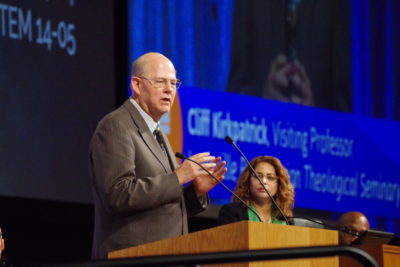
Clifton Kirkpatrick is a former PC(USA) stated clerk who served as co-chair of the special committee which urged the PC(USA) to adopt the Belhar Confession, which it did in 2016 after eight years of effort. Kirkpatrick told the assembly that an accompanying letter does not have constitutional status, but describes the implications of Belhar in a particular context – for example, the “experience we’ve had [in the U.S.) with detention in jail without bail, with detention of children at the border.”
Being Presbyterian, writing that letter won’t happen immediately – it takes a task force.
The measure the assembly passed instructs the task force to develop an accompanying letter that “addresses the participation of the Presbyterian Church (U.S.A.) and other Reformed bodies in racism in our historical context, building on prior statements of repentance and apology.” That letter would include topics such as “unjust land acquisition; genocide of native peoples; the enslavement of African men, women and children; and a system of white privilege that unfairly discriminates against people of color,” the action states.
Reclaiming Jesus and other business
 The assembly also acted on a commissioners’ resolution encouraging the PC(USA) to sign on to the new “Reclaiming Jesus” movement that a group of religious leaders from a variety of denominations announced recently in Washington, D.C. That movement has presented “A Confession of Faith in a Time of Crisis” – speaking of Christian opposition to authoritarian rule, lying in political life, racism and “language and policies of political leaders who would debase and abandon the most vulnerable children of God,” among other things.
The committee had recommended that the assembly refer the resolution to the Presbyterian Mission Agency to develop study materials and resources to help Presbyterians explore “what it means to be a people ‘Reclaiming Jesus,’ the Jesus of the Scriptures.”
The assembly amended that to add language encouraging the PC(USA) to “endorse the Reclaiming Jesus Movement through signing on to its statement.”
Again, the tension between working through a slower procedure and speaking now emerged.
“We can’t wait to get started,” said Paul Uzel, a minister from The John Knox presbytery. “The call for justice must be heard now. … Our distinctive voice as Presbyterians must be heard now as leaders in the Christian community.”
The assembly also voted to:
- Approve recommendations from the General Assembly Special Committee to Study the Reformed Perspective of Christian Education in the 21st Among them: encouraging the Presbyterian Mission Agency to, as it supports ministry in Christian formation, transition to an emphasis on lifelong Christian education and faith formation, especially intergenerational ministry. “While we still believe there is a place for age-and-stage ministry,” such as material for children’s Sunday school or retired men’s Bible study group, “we need focus on coming together more often than we are apart,” said Emily Chudy, a minister who served on the special committee.
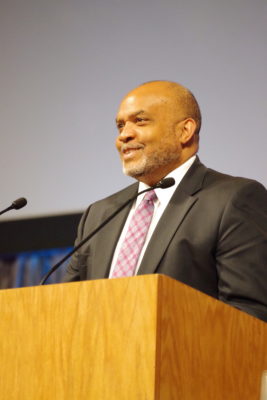
- Approve the selection of Alton B. Pollard III as the new president of Louisville Presbyterian Theological Seminary. Pollard spoke to the assembly briefly, saying he is committed to building bridges within the seminary and “beyond the classroom and into our communities,” reaching out to those who are most in need.
- Honor Katie Geneva Cannon, a professor of Christian ethics at Union Presbyterian Seminary, and Douglas Oldenburg, a former president of Columbia Theological Seminary and a former General Assembly moderator, for their lifetime contributions to theological education.