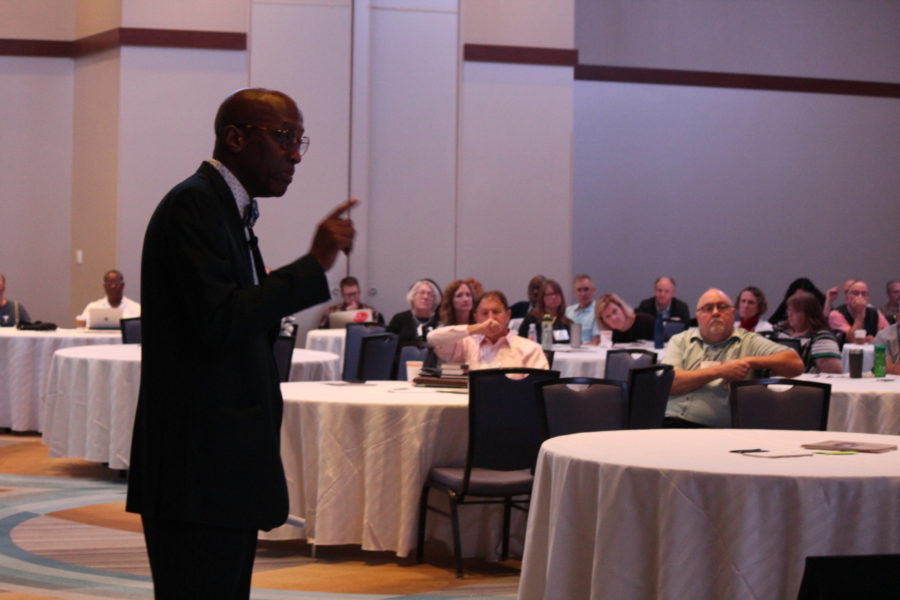
 CHICAGO – J. Herbert Nelson, stated clerk of the Presbyterian Church (U.S.A.), challenged Presbyterians to engage the complicated realities of the current world.
“We have an opportunity to shake up this world, but we have to be believe it, and we have to be willing to pay for it,” Nelson said.
Nelson’s talking about per capita — the per-member fee that pays for most of the expense of the Office of the General Assembly and administrative costs for the Presbyterian Mission Agency. There was pushback earlier this year to his proposal to significantly raise per capita by 39 percent from 2018 to 2019 and by 7 percent from 2019 to 2020.
Facing criticism from mid council leaders, some of whom argued that small congregations particularly couldn’t afford such a financial hit, Nelson revised his request, and the 2018 General Assembly approved a per capita rate of $8.95 per member in both 2019 and 2020 – an increase of just over 15 percent from the 2018 per capita rate of $7.73 per member.
And Nelson continues to make the case that adequate per capita funding is necessary for the PC(USA) to make needed changes to do relevant, contextual ministry in a complicated world.
“When we talk about per capita, this is not about a money grab,” Nelson told the Mid Council Leaders Gathering, meeting Oct. 5-7 in Chicago. “This is about building a pathway for those to come” — building on a strong legacy of Presbyterian faith for new generations.
“We are at a very different time,” Nelson said, with the church almost daily having an “impromptu status of engaging the world.” He pointed out that the mid council leaders had paused their meeting the previous day to pray for the city of Chicago, as a verdict was announced in the murder trial of a Chicago police officer charged with killing a black teenager, Laquan McDonald, in 2014.
 The leaders also prayed for the nation, on the cusp of the Senate’s controversial vote to confirm Brett Kavanaugh, who has been accused of sexual assault, as a U.S. Supreme Court justice.
Nelson encouraged mid council leaders to model in their own communities the kind of commitment to justice that the General Assembly demonstrated last summer when Presbyterians marched through the downtown St. Louis to deliver money used to bail out of jail people incarcerated for minor offenses because they couldn’t afford to pay their fines.
“Let’s be real,” Nelson said, in recognizing that many mid council leaders need training to figure out how to do innovative work in their local contexts. “Our number one priority is retooling mid councils,” he said, because “we cannot have strong churches without strong mid councils and mid council leaders who are strong.”
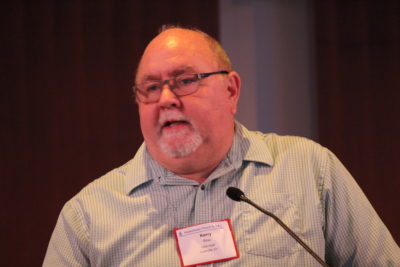
Part of this presentation involved specifics: laying out the history of per capita in the PC(USA) and details of the per capita budget for the next two years.
Kerry Rice, deputy stated clerk, said 69 percent of presbyteries paid per capita in full in 2016. He also said that actions of the 2018 General Assembly had an impact on the per capita budget – with $400,000 in budget cuts still needing to be allocated in 2019 and $753,000 in 2020.
The mid council leaders also heard presentations from representatives of the Board of Pensions, the co-sponsor along with the Office of the General Assembly of this event.
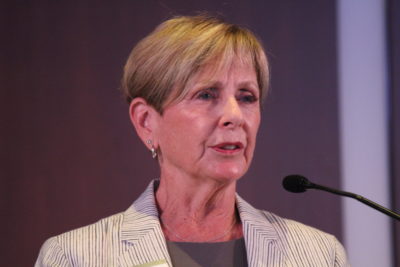
Pat Haines, executive vice president and chief benefits officer for the Board of Pensions, described changes the board is introducing in 2019. “We need to be fearless about change,” Haines said. “We have to be willing to look critically at what we do and how we do it.”
Haines also explained changes to benefits the board will initiate in 2019 – part of an effort to expand the plan to include more employees and address unmet needs.
Among those changes: introducing the option of a high-deductible plan (with an annual deductible of $3,000 for individuals and $6,000 for families) with an accompanying health savings plan. “We did not walk down this path lightly,” she said, recognizing the out-of-pocket costs for those who chose this option could be significant.
So the board attempted to make its offering “a better version of the high-deductible health plans you might find out there in the consumer market,” Haines said, by offering, for example, a more expansive definition of what’s included in preventative care and therefore not subject to the deductible.
Other changes for 2019: offering a range of flexible saving and spending accounts for health care and child care, and vision coverage including both eye exams and corrective lenses.