FORT WORTH, Texas – Let’s talk about money and the way things work in the Presbyterian Church (U.S.A). How about power and church culture too?
Because that’s what the Special Committee on Per-Capita Based Funding and National Church Financial Sustainability spent part of its time May 14 discussing.
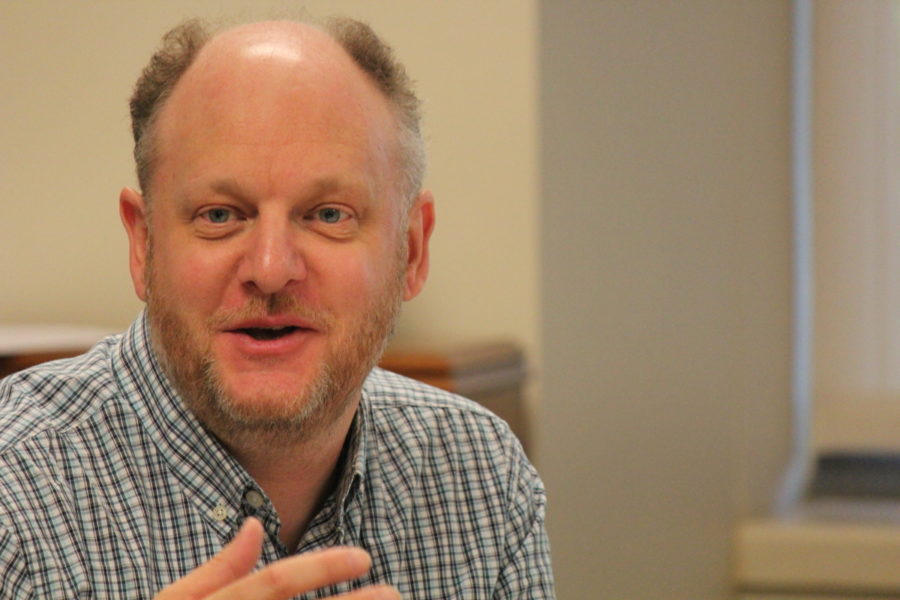
For example: “I don’t think per capita is the big issue,” said Scott Lumsden, a committee member and co-executive presbyter of Seattle Presbytery. “I actually think we have all the resources we need as a denomination to do what we want,” but the problem is how the resources are allocated and distributed (and who gets to make decisions about that).
Or the fact that in a connectional denomination, the budgets of Office of the General Assembly and the Presbyterian Mission Agency depend on funding from per capita – but those of the other four PC(USA) agencies do not, creating a sense of unevenness.
“These are the two agencies that take the hit,” said committee member Kevin Veldhuisen, transitional mission coordinator and stated clerk for the Presbytery of South Dakota. “There’s nothing to hold the other four accountable to the losses those two agencies may receive. That to me is one of the challenges.”
Or how about the reality that, at the local church level, Presbyterians really don’t know or care that there are six PC(USA) agencies. Whether things are going poorly or well, Presbyterians in the pews just chalk it up to the “national church” – sometimes withholding per capita if they’re unhappy.
“Even my best elders, the most informed … have the hardest time differentiating” among the various church entities, said PaulHelphinstine, a committee member who’s a minister in Tennessee. If there’s a problem, even if someone said that “there are all these separate agencies, they would sort of see that as a shell game with the blame” – trying to shift responsibility to someone else.
All the complexity in funding and structure is a sign “we really don’t know how to organize ourselves as a church beyond the congregational level,” Lumsden said. “We don’t have a structure that lends itself to easy interpretation for congregations. … We actually don’t have one person in charge.”
This committee, which the 2018 General Assembly created, is expected to make reports both on financial sustainability of the denomination (by Dec. 31) and on per capita (by Feb 21, although the possibility of making an interim report and asking the 2020 General Assembly for more time has been floated).
The committee is holding its first face-to-face meeting in Fort Worth, Texas, May 13-15. The discussion has included detailed presentations by representatives from the six PC(USA) agencies and the PC(USA), A Corporation (the corporate entity of the Presbyterian Mission Agency and the Office of the General Assembly). But there’s also been an effort to dive into some of the undercurrents – which are deep and sometimes mighty.
Moving Forward
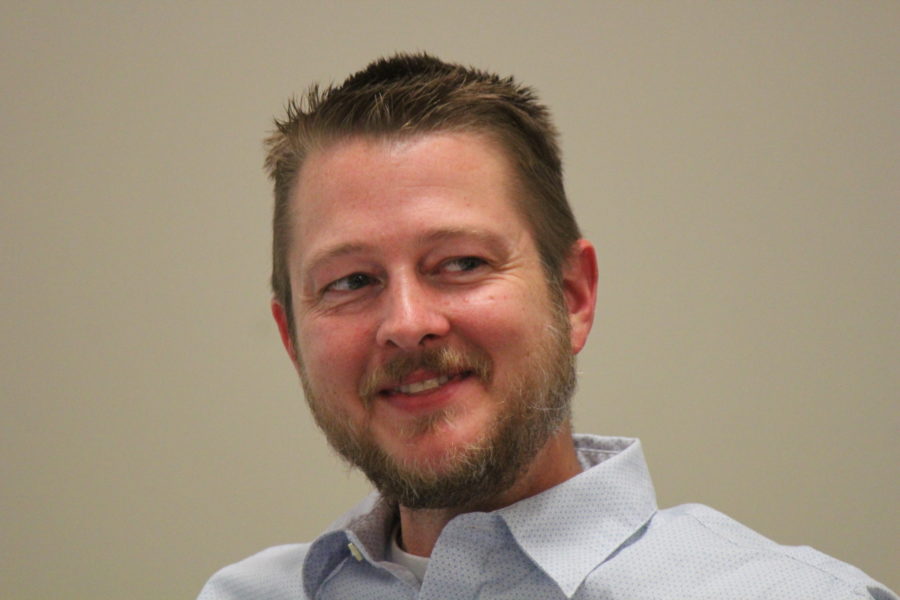
Also attending this meeting was Mathew Eardley, a representative from the Moving Forward Implementation Commission, who stressed the commission’s desire to work collaboratively with the committee.
Eardley pointed out that the 2018 General Assembly, in approving the report of the All Agency Review Committee, also gave this instruction to the six PC(USA) agencies: “To engage in a collaborative self-study of the per capita model and its ability to adequately fund the Office of the General Assembly and the Presbyterian Mission Agency in the immediate and longer-term future and to explore alternative and creative funding resources for both.”
For the agencies, “I imagine that was a very confusing item to get after the assembly,” Eardley said. “It doesn’t give much guidance.”
Committee member Jeanne Radak,the presbytery leader for the Presbytery of Newton, asked regarding that self-study: “When is that going to be done?”
“There was no instruction about when and how it was to be reported out,” or “who was to lead the effort,” said Kerry Rice, deputy stated clerk with the Office of the General Assembly (he’s also currently acting chief financial officer of the PCUSA, A Corporation, which is the corporate entity for OGA and PMA).
“What conversations have there been about that?” Radak asked.
“There have been none,” Rice replied.
Some suggested that the committee itself might shepherd that process. As Valerie Young, a synod executive and the committee’s co-moderator put it, “we can help them live that out.”
Partnerships and per capita
There was conversation about the difficulties in building true partnerships in a denomination in which each agency builds its own budget. Some agencies do their own fundraising. Only two of the six – the Office of the General Assembly (OGA) and, to a lesser extent, the Presbyterian Mission Agency (PMA) – rely on per capita funding.
Rice spoke of the need to help Presbyterians understand “the nature of the per capita system” – and to build support for per capita across the church.
Per capita is the per-member apportionment set by the General Assembly to support the work of the national church. The General Assembly per capita rate is $8.95 per member in both 2019 and 2020, an increase of just over 15 percent from the 2018 per capita rate of $7.73 per member.
That rate was significantly less than what PC(USA) stated clerk J. Herbert Nelson had originally proposed – an increase of 39 percent from 2018 to 2019 and another 7 percent increase in 2020. Mid council leaders balked at that proposed increase – with some calling it “taxation without representation” and arguing that presbyteries and congregations couldn’t bear that large an increase. Not long before the assembly convened last June, Nelson announced a reduction in the proposed increase.
After that experience, leaders at OGA realized that in the preceding years, “OGA and the stated clerk never really pushed the envelope on what we were asking the General Assembly for,” Rice said – keeping the requests for increases to no more than 3%. As a result, “the need to interpret per capita never came up. …. To be honest, we were unprepared for the fact that we had to tell people what we do with per capita. It was never controversial” before, but “that woke us up,” he said of what happened last spring.
If the stated clerk is going to ask for per capita increases, “we need to tell folks what it’s about.”
One of the difficulties, however, is that many entities have a role in interpreting the value of per capita to Presbyterians, Rice said – including representatives of the six agencies and of presbyteries and synods.
“The reputation, if you will, the buy-in that people have is impacted by every one of those partners,” Rice said. “For me, that’s a hard thing to get your arms around. How do you become really viable partners?” For example, how can the Office of the General Assembly work more effectively with mid council leaders? “How do we become better partners, more accountable, more transparent with one another?”
Young also pointed out that some mid councils – at least one synod and some presbyteries – have chosen not to collect per capita. “How do they then remain a partner or be a partner with the larger church when they’re not taking part in that system themselves?” she asked. “They have that ability to opt out. … How do you get that buy-in across the board for any change?”
Something needs to change
Joseph Ngalle, a committee member and elder from North Carolina, spoke of the challenge of “trying to find other ways to raise money to sustain the church” when a congregation is losing members. Previously, Ngalle worshipped in a congregation in Clinton, Massachusetts, that “had a big problem because the membership was dropping so fast” and had gone from having a full-time pastor to a part-time one.
Things changed, he said, after Cindy Kohlmann, who’s now co-moderator of the 2018 General Assembly, became the pastor there, and the congregation began to recognize that the demographics of the community were changing – and that growing the church meant the congregation needed to be open to change, to be more welcoming, and to reach out to new immigrants.
That congregation needed “a change in the strategies to get the church on a good funding level,” Ngalle said – an idea, he said, that might apply to the national church as well.
Culture
There has been a lot of conversation at this meeting about culture – about, for example, how the PC(USA) considers itself to be “one church,” but has many agencies, each with their own priorities, and a long history of mistrust.
Lumsden said of the six agencies: “We speak of them as though they were at the same level,” but they’re not necessarily.
In many PC(USA) discussions, there seems to be a “complete avoidance of the idea that the actual functioning of the church is – I don’t want to be a dooms-dayer, I don’t want to say collapsing, but certainly wobbling,” Helphinstine said.
While some of the denomination’s agencies might seem healthy, if PMA and OGA are vulnerable because the denomination has fewer members and consequently fewer per capita dollars unless the rate goes up, “it’s the responsibility of all of the agencies to build up the whole.”
Rosemary Mitchell, senior director for mission engagement and support at the Presbyterian Mission Agency, gave some glimpses into those cultural issues during her presentation on stewardship.
When she joined the national staff in 2016, the PC(USA) had been through 25 years of infighting, decline, dismissals of congregations, Mitchell said. “All we talked about was scarcity, there’s no money, we’re all going to die,” even though “we’re supposed to be people of hope.”
One of the key questions as she started to make changes was: “How do we rebuild trust?”
Ideas
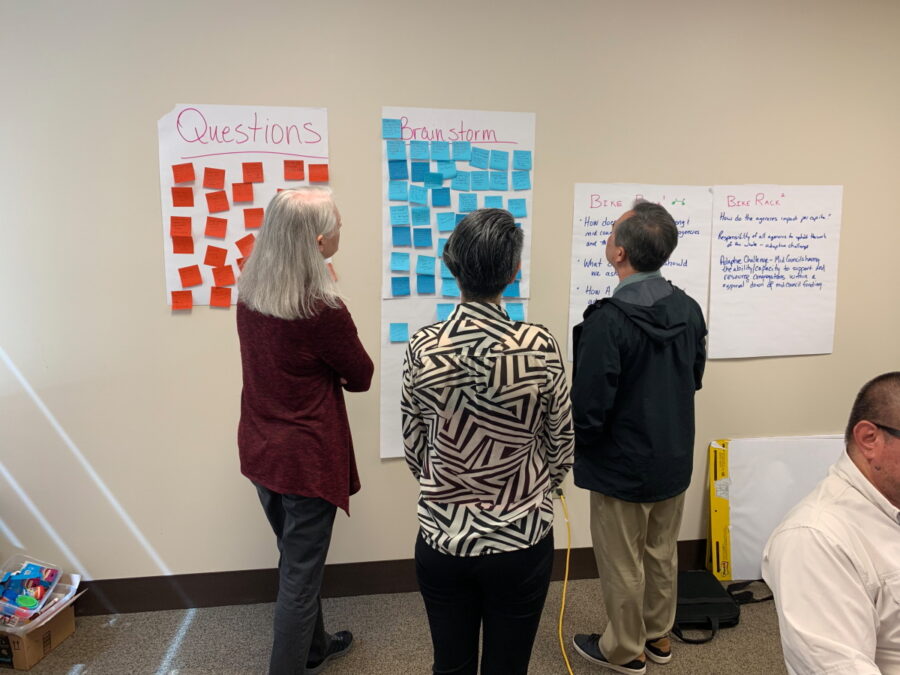
Towards the end of the day, the committee spent some time writing on Post-It notes some of their questions, their values, their ideas for brainstorming.
Among their questions:
- What are we fighting about?
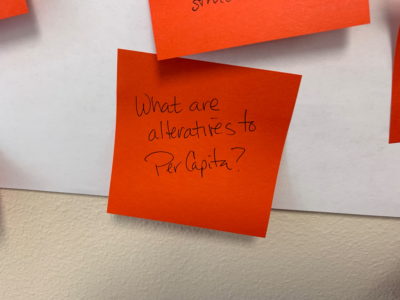
- What are alternatives to per capita?
Among the ideas:
- Putting “teeth” in collecting per capita.
- Give authority to the presbyteries to remedy their own situation.
- Have General Assembly meet only every four years.
Then they went around the table – folks offering a quick few reactions, committee members and agency representatives alike.
 Eardley, who served on the Way Forward Commission and now the Moving Forward Implementation Commission, said he sees all these concerns as being tied to fundamental questions about power, communication and leadership in the PC(USA).
It may be “the matter is more administrative than financial” – a question of “who does what, who makes the decisions,” said José Rosa-Rivera, an elder and committee member from the Presbytery of San Juan.
Young said she’s not sure “how all theses different agencies came to be autonomous … . That autonomy has in some ways defeated the purpose of ‘one church together.’… In some ways they’ve become empires unto themselves.”
Rice said that the current realties are the result of “a lot of folks making a lot of decisions that at the time made sense. … Nobody set up to create something we now view as a very complicated, unworkable system.”