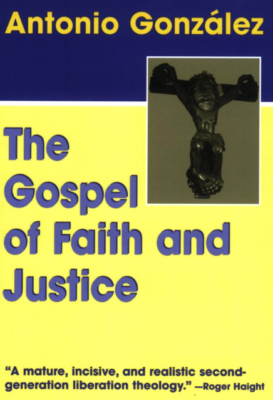
 Antonio Gonzalez
Orbis Books, 179 pages
A second-generation liberation theology? That is what Antonio Gonzalez portends to write, taking a frank assessment of some of the key contributions of this 1960s-era movement and uncovering in the process a gospel that speaks to a 21stcentury progressive church in danger of losing its distinctive message among the many cultural cries for justice.
His perspective comes alive in two specific passages, which he fully exegetes. The first: “And he believed the Lord, and the Lord reckoned it to him as justice” (Genesis 15: 6). For Gonzalez, this means that the primary pathway toward a just society is not a clearer idea of utopia or human efforts to achieve it, but a trust in the One who can pull it off. The Tower of Babel story proves to humankind the futility of human progress when carried out on its own. On the contrary, Abraham takes God’s cue — and this is what leads to blessing in the world. This same reality plays out in the Exodus story: “What is asked of the new community is above all faith in God’s promises, a faith that allows them to begin a journey, abandon the oppressive system and leave behind the other inadequate solutions.”
His interpretation of Matthew 25 (a stumbling-block passage for conservative and progressive alike) takes the understanding of God-created community to a new level. He argues that the litmus test for entrance into the kingdom in this passage is not an act of charity towardthe poor, but rather social and economic engagement as one ofthe poor, since it’s Jesus’ own disciples (referred to as “the least” in the Gospels) who he is referring to as the recipients. In this framework, the “sheep” are simply those who want to be a part of the alternative community and the “goats” are those who do not!
His most developed idea is that what most separates us from God, and indeed from social progress in furthering the welfare of humankind, is the sin of self-justification: “Whoever wishes to justify himself by the fruit of his own actions draws everyone around him into the mad race to produce results, a race that can only bring about human alienation in work and the destruction of the entire planet.” If we do not first submit ourselves to what God is up to, we are destined to look for ways to verify the validity of our work instead of trusting God, on God’s own initiative, to bring about good.
Less helpful but still interesting were his chapters on the state of liberation theology, including what we have learned from the Pentecostal/charismatic churches in Latin America, movements that the poor swarmed to en masse whether or not liberation theologians thought it was “good” for them.
Far from an attempt to condemn secular humanitarian work, Gonzalez simply presents the concerned believer something unique to offer the world: a God who is already redeeming society and who calls us to join Her. We are not proclaiming a God who is for justice; we are proclaiming a God who is bringing about justice now — right under our nose. This changes our message from “Hey, God’s a progressive, too!” to “Look what a good God just did!”
Norm Gordon is pastor of Idylwood Presbyterian Church in Falls Church, Virginia.