BALTIMORE – What priorities should shape the budget of the Presbyterian Mission Agency for 2021 and 2022?
What are presbytery and synod leaders seeing at the local and regional levels of the church that members of the Presbyterian Mission Agency Board should take into account as they craft the budget?
Those questions are at the heart of a 24-hour consultation being held August 4-5 in Baltimore, just after Big Tent 2019.
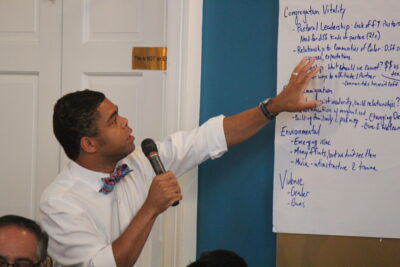
Joe Morrow, a minister from Chicago and chair of the Presbyterian Mission Agency Board, said this is the first time such a consultation has been held – and said the intent is to “ask deep questions about what the church should be doing” as the board begins the process of developing PMA’s budget for 2021 and 2022.
Close to two dozen mid council representatives are attending this consultation — representatives from the denomination’s synods, and from a mixture of small, medium and large presbyteries as well, plus two non-geographic presbyteries (Presbytery of Dakota and Eastern Korean American Presbytery).
The conversation hinted that there’s openness at the top levels of the Presbyterian Church (U.S.A.) for some new ways of doing business — including, perhaps, how overtures find their way to the General Assembly and how voice and attention is given to immigrant fellowships and new worshipping communities.
Bible study
The consultation began with Bible study on Matthew 25, led by Diane Moffett, president and executive director of the Presbyterian Mission Agency (PMA). Moffett has called on the PC(USA) to be a Matthew 25 church — inviting congregations, presbyteries and synods to join that vision to welcome the stranger, feed the hungry, clothe the naked.
In this passage, using parables, Jesus was addressing the nations — calling for systemic change, Moffett said. So that’s a call, for example, to address structural racism and the economic exploitation of those who are poor.
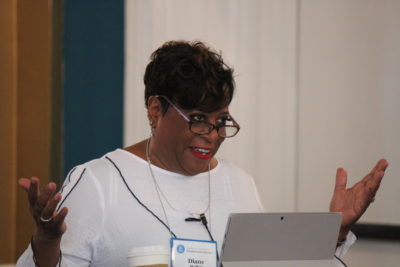
In this passage, “he’s judging the nations,” Moffett said. “He’s really speaking about issues of justice. Everybody should have food to eat. There’s plenty, there’s plenty on the planet. There’s abundance. But people don’t have access” equally to food and to the land.
A Matthew 25 vision “fits us as a denomination,” she said. “It can strengthen us,” and allows the PC(USA) to celebrate Presbyterians and congregations who work “beyond the doors” of the churches to serve their communities.
Numbers and dates
PMA’s budget for 2019 and 2020 is just over $70 million.
The schedule for building the budget for the next two years calls for this to happen at upcoming board meetings:
- September 2019: Comparing funding streams with priorities.
- February 2020: Approve non-financial elements of the Mission Work Plan (the major emphases).
- April 2020: Approve the financial elements of the Mission Work Plan.
The facilitator for this consultation is Presbyterian minister Laurie Ferguson, who runs a therapy, coaching and consulting business in New York state.
Mid council concerns
The consultation is structured with PMA board members and mid council leaders sitting around tables. Ferguson started off by asking presbytery and synod leaders at each table to talk about what they see happening in their geographic areas — what are the key issues and concerns?
Following that, PMA board members from each table reported back on what they’ve heard. Some of what they said:
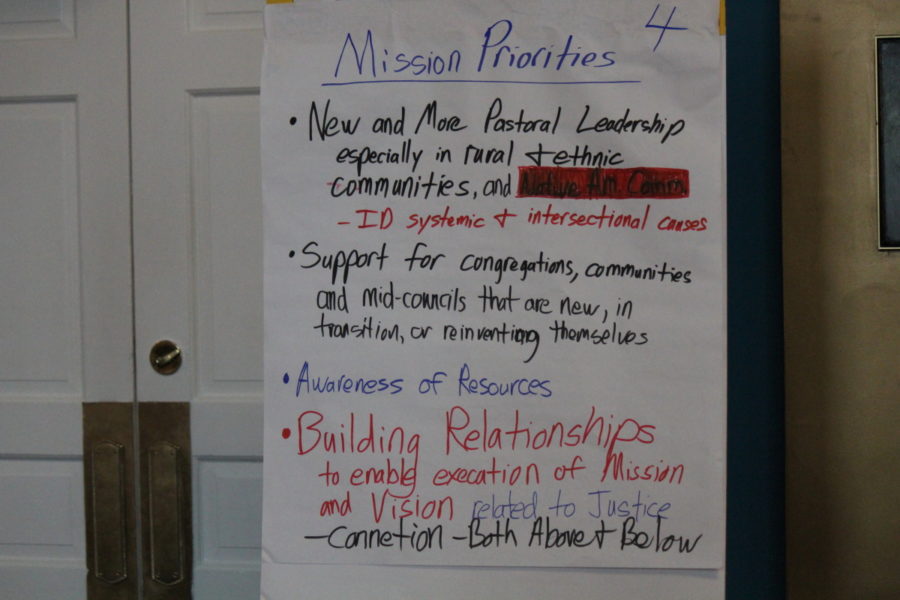
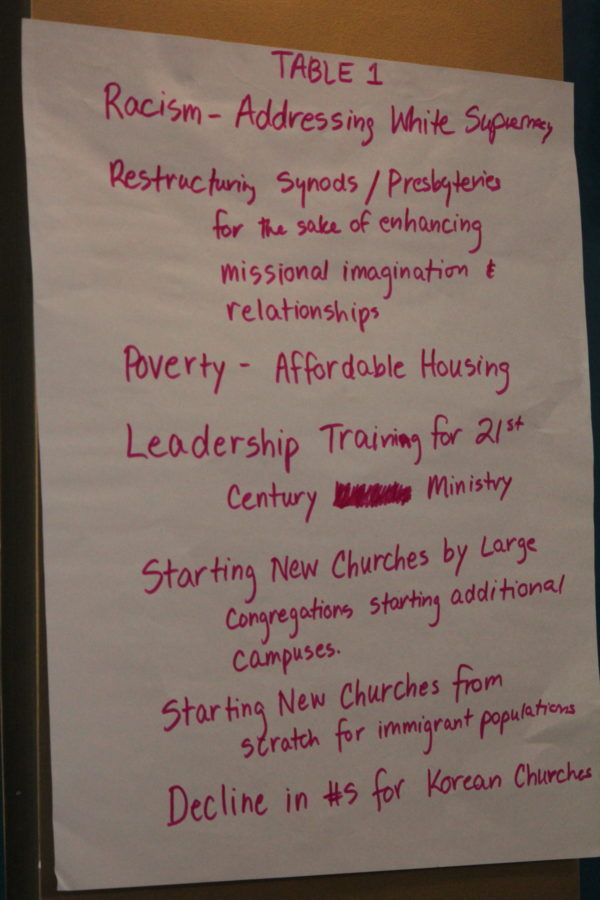
- How can the PC(USA) lift up the voices of immigrant fellowships and new worshipping communities – many of which involve people of color? How can the PC(USA) be a connectional church, beyond particular definitions of membership?
- Presbyterians are have intense concerns on the most urgent social issues of the day: immigration, gun violence, racism and white supremacy, climate change and more. There also are geographic and political differences — and the reality that not all Presbyterians think alike.
- PMA has made congregational vitality a focus, yet “a lot of the churches don’t have pastors,” or don’t have full-time pastoral leadership, said PMA board member James Parks. Small congregations want to pay pastors for 15 hours a week, “but they want them to work 80 hours a week.”
- In rural areas, it can be difficult to find and keep pastors, and training is needed for commissioned ruling elders.
- The PC(USA) tends to have rules and traditions for how things get done. Sometimes presbyteries want and need flexibility.
- As the 2020 election approaches, “how do we help our communities have unity together even if they don’t have unity of mind?”
General Assembly priorities
Another topic of conversation was about priorities that General Assemblies have set for the work of the denomination. The consultation considered a list of 12 “overarching priorities.”
Here’s the preliminary list (in alphabetical order) — derived from considering PMA’s responses to General Assembly referrals for a decade.
- 1001 New Worshipping Communities
- Church Growth of New Immigrant Worshiping Communities and Congregations of Color
- Concern for the Civic Order
- Congregational Vitality
- Focus on the intersection of race, gender and class
- Global Partnerships
- Gun Violence
- Human Trafficking
- Interreligious Relations
- Ministry with Native Americans
- Poverty
- Structural Racism/White Supremacy
The next task: how to narrow that list down to the top three or five?
The mid council executives and PMA board members spent some time discussing that preliminary list in small groups. Here’s some of what bubbled up.
Procedural change? Maybe the process of sending business to the General Assembly needs to change. Cindy Kohlmann, a presbytery executive and co-moderator with Vilmarie Cintrón-Olivieri of the 2018 General Assembly, said folks at her table floated the idea of having presbyteries submit overtures, then having representatives of those presbyteries have a consultation with the agencies those overtures would affect.
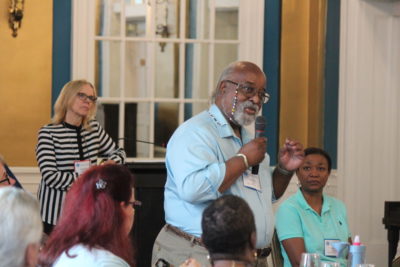
What impact would the overture have on PMA, for example? Is some of the work called for already happening? In that way “the voices are heard, the passions are heard,” Kohlmann said, but there’s some dialogue and chance for refinement before the overture gets dumped in the General Assembly’s lap.
Connections. Are these categories really so distinct? In particular, what role does structural racism and white supremacy play in all these categories? “My brothers and sisters in Christ are not all anti-Trump,” said board member Patsy Smith. “We are not all anti-racism. We are not all anti-white supremacy. That’s something we need to listen to. … The list could be re-categorized.”
Congregational vitality. Throughout the day, the importance of congregational vitality and giving local churches tools for making disciples was a theme.
If local churches don’t have leadership, if the PC(USA) hasn’t figured out how to educate and mobilize people in the pews, “then it’s all kind of a nice shopping list,” until the next General Assembly changes it, said Wendy Tajima, executive presbyter of the Presbytery of San Gabriel and a former PMA board member.
And if the PC(USA) figures out what it really means to be a Matthew 25 denomination, “that in many ways will take care of congregational vitality,” said Ray Jones, who was recently named the denomination’s director of Theology, Formation and Evangelism.