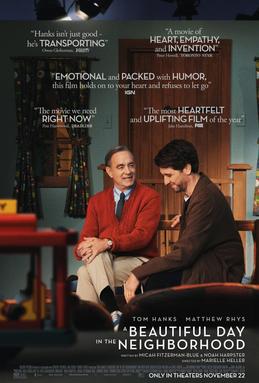
 I’d seen the documentary on Mister Rogers. I cried unashamedly in parts and noted everyone else seemed to be sniffling, too. I felt giddy at the announcement that Tom Hanks had been cast to play my childhood guide in an upcoming movie, then bought tickets online and went with my family to see “A Beautiful Day in the Neighborhood” on its first day in theaters. The lights went down and the familiar songs and scenes from Mister Rogers’ neighborhood filled the theater. I fell through the looking glass, picturing the early 1970s television in the living room of our apartment on Spring Garden Street in Halifax, Nova Scotia. I felt like a little kid again. A combination of nostalgia and longing enveloped me. I like you just the way you are. Please, won’t you be my neighbor? I am so glad to see you. How did Mister Rogers make these simple statements so believable to everyone he met through what he considered the sacred space between screen and child?
The movie recounts a fictionalized version of the true story of a friendship between Fred Rogers and Tom Junod, a cynical reporter assigned to interview the famed Mister Rogers for an issue on heroes. Slowly, through genuine attentiveness, careful questions, patient listening and gentle invitation, Mister Rogers breaks through the defenses of Lloyd Vogel, Tom Junod’s onscreen character, bringing about healing in Vogel’s fraught relationship with his father. The movie is not action packed. The pace is deliberate, even slow at times. The special effects are minimal. The story is both absolutely ordinary and totally exceptional because, in the end, the story is about life and death, love and grief, human relationships, shown in their complexity, pain and beauty.
Leaving the theater my daughter, an aspiring filmmaker, remarked on the clever use of tiny sets, the effective casting, her satisfaction that it was directed by a woman. And then she said this: “It was not really a movie about Mister Rogers. It was a movie about the impact Mister Rogers had on other people.” Her observation captured a profound truth about the film, a deep truth about Mister Rogers’ power, really. The movie, like the program he wrote and hosted, like the life he lived, was not about him. He lived, by all accounts, an other-directed life, present to those in front of him, genuinely believing in the unique, preciousness of each person he encountered. He was sincerely concerned about other people, especially children and other vulnerable people.
 One of the most moving scenes in the film at first seems simple and innocuous, not integral to the plot, but ultimately crucial to revealing the character of Mister Rogers. Fred Rogers kneels in his pajamas beside his bed. A small notebook is open in front of him. Bespectacled and reverent, he reads the names of those on his prayer list. Lloyd Vogel … Andrea Vogel … Jerry Vogel … Gavin Vogel. Interspersed between the names are shots of Mister Rogers swimming laps, evoking almost a call and response, a liturgy of prayer spoken and embodied, a sacrament of caring that belies piety or cynicism. As if swimming in the waters of his baptism, this beloved son of God lifts up beloved children to their Maker. My daughter reflecting on the power of this scene said, “No matter what you believe about God or prayer it showed the importance of being intentionally remembered by someone.” Naming and remembering matter — a simple, powerful truth.
Intentionality defined Mister Rogers, we learn from his wife, Joanne. She tells Lloyd Vogel that her husband is not a saint. He is not perfect and must work at managing his anger. He has practices, rituals that help him be the person he wants to be. Kindness and compassion do not come without intentional practice, not even for Mister Rogers. Perhaps we might learn a lesson from this truth, too. We are all able to practice that which we wish to become. Character can be cultivated.
As the credits rolled the few of us in the theater who remained seated, we sat not because we awaited a teaser for the sequel, but because the space felt safe and sacred and leaving meant re-entry into a world not as hospitable as Mister Rogers’ neighborhood.
Eventually, we walked out into the night and my daughter noted the resurgence in Mister Rogers’ popularity because, she thought, we need him badly right now. Then she said, “It is wonderful that his life is still impacting others for good.” Perhaps the same will be said of us, if we are intentional and practice being neighbors. Mister Rogers certainly believes it is possible for each one of us because we are special and likeable and wanted, named and remembered.