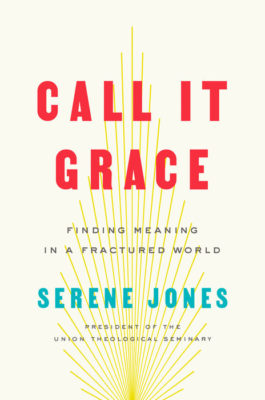
 Serene Jones
Viking, 336 pages
Reviewed by Matt Bussell
Throughout her books, articles and essays, Serene Jones makes the point that life and theology are impossible to separate. In much of her work, Jones uses life experiences to illuminate her understanding of doctrine. However, in “Call It Grace,” Jones changes the focus to telling her story and that of her family. As a masterful storyteller, Jones draws the reader into the story, inviting us to share in her joys and sorrows, fears and reliefs. As she powerfully shares her stories, she unpacks the roles they have played in the formation of her theology. Her grandfather was a judge who experienced God as a judge who dispassionately dispenses punishment for sin. Her grandmother experienced the grace of God in the touch of a cool water jug in the hot Oklahoma summer. Jones’ struggle with forgiveness comes to light amid her messy divorce and her hatred of Timothy McVeigh before his execution. Her views of sin, grace and forgiveness are shaped by these stories.
Jones also tells the story of her experience of racism and original sin. On her 11th birthday, Jones was going to the community pool for her birthday party with a group of friends. Unfortunately, the pool was closed for maintenance. Her dad informed them that they would have to go to a different community pool in a predominantly African American part of Dallas when Jones blurted out, “I don’t want to swim with black people.” Her dad, a civil rights activist, gave Jones the option: go to the other pool or go home and never have another birthday party again. Jones, surrounded by her white friends and inundated in a culture of white privilege, chose going home. Jones looks back at the racist statement of her 11-year-old self as the social sin that she had absorbed and inherited and then perpetuated. While she was raised to see racism as a sin, her racist statement in the car that day reveals the “degree to which our deepest hatreds and fears live within us, burrowed away in places that escape the restraints our conscious minds impose.” For Jones, racism embodies the theological term original sin; it is a sin we don’t necessarily choose, but also a sin that we are nonetheless responsible for. But sin does not have the final say — grace does. Grace is the inbreaking of God’s love amidst our sin and brokenness. The day after her failed party, her father started planning her 12th birthday party with her.
Throughout “Call It Grace,” Jones’ theological reflections on her life are informed by the works of John Calvin, Søren Kierkegaard, Karl Barth, Reinhold Niebuhr, Gustavo Gutierrez and Luce Irigaray. Life and theology come together, but not always in predictable ways. At times, the stories Jones tells are uncomfortable as she lays bare the messiness of her life and her family relationships. Her relationship with her abusive grandfather and the constant conflicts with her mother are hard to read about because it is difficult to imagine grace coming from those relationships.
What makes “Call It Grace” such a wonderful read is how it demonstrates the connection between life and theology. Jones invites us to reflect on this connection in our own lives. She invites us to see God’s grace.
Matt Bussell is the minister at First Presbyterian Church in Jonesboro, Arkansas.