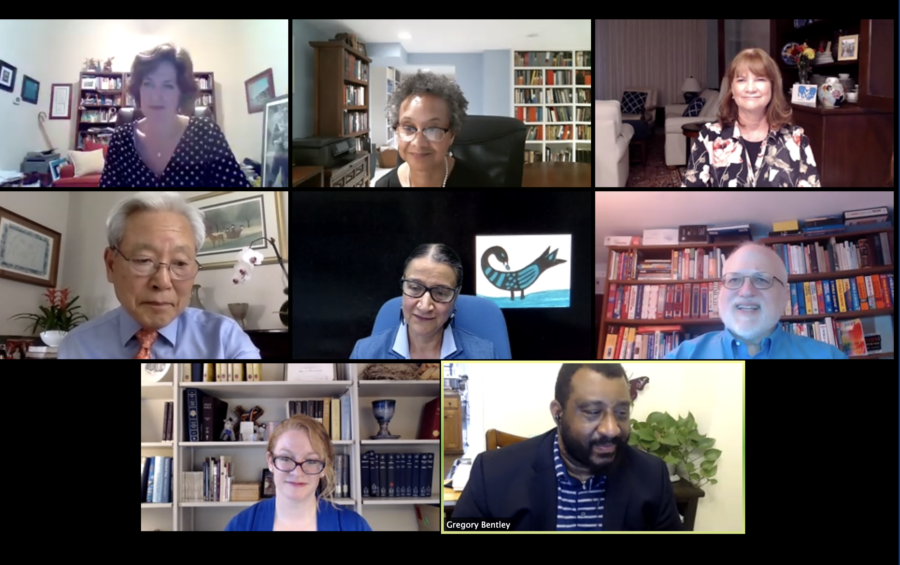
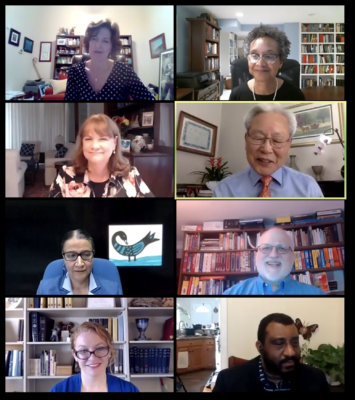
During a 90-minute webinar on June 10, the six people standing for co-moderator of the 2020 General Assembly of the Presbyterian Church (U.S.A.) spoke of their sense of call, described their vision for how Presbyterians can do mission and work for justice in these remarkable times, told how the COVID-19 pandemic has impacted their communities and their congregations and revealed a bit of themselves — their joys and their faith.
With the 2020 General Assembly going virtual this year, the Presbyterian Outlook offered the webinar to give commissioners and other Presbyterians a chance to meet the three teams standing to serve as co-moderators — holding the webinar in place of the Outlook lunch at the assembly, which traditionally has been held the day of the election and offered those standing for the office a chance to make brief remarks.
Three teams are standing to serve as co-moderators of the PC(USA)’s first-ever virtual assembly:
- Gregory Bentley, a teaching elder from Presbytery of North Alabama, with
Elona Street-Stewart, a ruling elder from the Presbytery of the Twin Cities Area; - Sandra Hedrick, a teaching elder from the Presbytery of St. Augustine, with
Moon Lee, a ruling elder from the Presbytery of the Northwest Coast; and - Arthur Fullerton, a ruling elder from Albany Presbytery, with Marie Mainard O’Connell, a teaching elder from the Presbytery of Arkansas.
Here’s some of what they had to say during the 90-minute webinar, in which Outlook editor Jill Duffield asked questions submitted in advance by webinar participants. This recap is far from comprehensive, but gives a flavor of what some of the participants had to say.
Describe your call to stand as co-moderator.
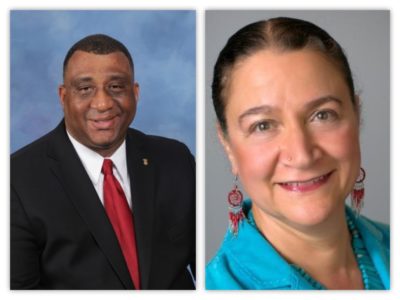
Fullerton said that when he previously worked for the Covenant House shelter for homeless young people, he was an openly gay man working for a conservative Catholic organization — and was successful in raising millions of dollars because “I focused on common ground. … If we focus on that, we can have a very successful General Assembly.”
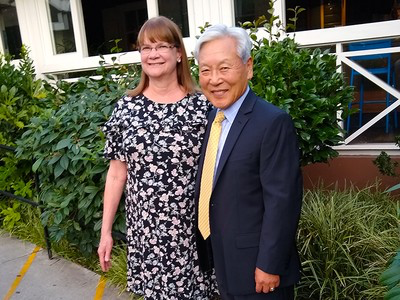
Hedrick, a pastor, former lawyer and mediator, and a yoga teacher, said that about a year ago, she was walking on the beach and “I heard the voice of God speak to me early in the morning,” encouraging her to become a General Assembly commissioner and stand for co-moderator. Her experience teaching yoga has taught her the value of being present and authentic, of listening.
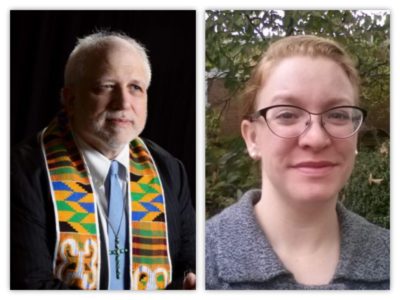
Lee, a clinical psychologist, is an immigrant from Korea whose life has been deeply impacted by PC(USA) world mission — his home church was founded by Presbyterian mission workers and his father came to study in the United States on a Presbyterian scholarship. Lee said he would bring to the role of co-moderator his love of God, his love of the Presbyterian Church, his training in science — and his gratitude for the PC(USA).
How can Presbyterians be more aggressive in working for justice?
Presbyterians are already involved in combatting structural racism and working to eradicate systemic poverty through the Matthew 25 initiative of the Presbyterian Mission Agency, Bentley said. “The wheels are already in motion,” but more Presbyterians need to sign on, he said.
He spoke of the importance of remembrance, “as a nation we have historical amnesia”; of remorse; and of repentance; and – “this is the one we get hung up on – reparations. After reparations, we can have genuine reconciliation.”
Street-Stewart, who serves as the synod executive of the Synod of Lakes and Prairies, said her synod stretches across six states, and “we’re out there in our black and brown communities.” She would ask Presbyterians to use their power, their relationships and their connections to work to change legislative policy and the system. “Racism is structural, and the church has to deal with it,” she said.
The PC(USA) has lots of small, rural congregations that are mostly white, O’Connell said. Those churches need to be in relationship with people in the community who are working on justice issues — and to let those voices be heard during worship. “We already have all the statements we need” in the PC(USA), O’Connell said. What’s needed is action.
How has COVID-19 affected your church and community?
Some have seen the impact of the pandemic up-close. Lee said he lives in a community of working families — some of whom have lost jobs, some of whom work in healthcare. “I can read the tension and anxiety they have,” he said. Fullerton said he knows three people personally who have died from the pandemic — New York and New Jersey have been at the epicenter. And O’Connell just finished a period of quarantine, after a church employee tested positive for the coronavirus.
But those standing for co-moderator also spoke of how Presbyterians have persevered in ministry during these difficult times. Giving at his church has risen, Bentley said, and those involved in helping more than 100 food insecure families every month said “were not even considering not doing food distribution.”
Several described the impact of COVID-19 in particular contexts. O’Connell voiced concern for those who work in the gig economy (her congregation has started a fund to help those in particular need) and Street-Stewart for people who work in agriculture or meat-packing plants and those living on Native American reservations, where the impact of the pandemic has been brutal.
What would you tell an unchurched young adult about the PC(USA)?
“Before I talk about the Presbyterian Church, I want to talk about Jesus first,” Lee said.
“I see you,” Street-Stewart said she would tell them. “You’re not invisible to us.” As young people take to the streets in protest, she would want them to know “we will be there to join them.”
 How can the PC(USA) do justice and environmental work even if this assembly doesn’t consider overtures on those issues?
Do the work at the grassroots, Fullerton said — following the example of Earth Care congregations, those involved in the Matthew 25 initiative and new worshipping communities.
“It’s important to speak officially and authoritatively, but the work is still the work,” Bentley said, If this virtual assembly defers some overtures for two years, “the work doesn’t go on hiatus. Put your hands in the soil and keep doing the work.”
What brings you joy?
Fullerton: “Living sober for 25 years” and debt free for 20, which frees him up to do the work of social justice even if it pays less. Although he lives in upstate New York, “I have a lifelong passion for the Arkansas Razorbacks.” He loves reading, writing, gardening, cooking.
O’Connell, the mother of three: “My kids 100% bring me joy.” Also: “Helping other people find their passion and empower them to do it.”
Street-Stewart: As a grandparent, “my joy is being part of a village to help raise a child” — she helped create a doula program to work with women during and after pregnancy, aware of the disproportionate child and maternal mortality rates among African American and Native women.
Bentley: He sends a pastoral letter every year encouraging people to “read Scripture and pray.” He finds joy in “seeing people for whom Jesus has become real,” and in relationships of solidarity that cross boundaries in working for justice. “That brings me deep joy and brings me deep hope that we can create a better future.”
Moon: He loves meeting people. His joy comes from knowing God and knowing that “by grace I am saved, by grace I know Jesus.”
Hedrick: Nature, travel, her grandchildren – all bring her joy. Also seeing grace at work in people’s lives – as with a young mother at the first congregation she served who became a General Assembly commissioner and stood in line at a microphone to speak on an issue about which she was passionate. Or when, after a time of conflict in a congregation, “the church emerges with new life” and “the grace just flows and flows and flows.”
The General Assembly commissioners will elect co-moderators during the first plenary session, which begins June 19 at 7 p.m. EDT. The election part of the session is likely to begin around 9 p.m. EDT.
Click here to learn how to watch a replay of the presentation.