The $2.4 million renovation planned for the Presbyterian Center in downtown Louisville offers the Presbyterian Church (U.S.A.) a chance to connect a renewal of the city of Louisville following the police shooting of Breonna Taylor in March 2020 with the renewal of the denomination in a changing world.
So hopes J. Herbert Nelson, the PC(USA)‘s stated clerk, speaking July 1 during a Zoom meeting of the Presbyterian Mission Agency Board’s Coordinating Committee.
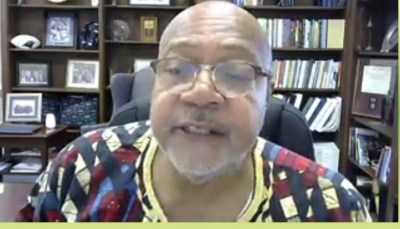
“The vision is to help transform us internally, so we can be transformers” and become “a significant player in the city,” Nelson said. He said the renovation of the first floor of the PC(USA) office building – work on which is expected to begin later this summer so that General Assembly can hold its committee meetings there in 2022 – will give the PC(USA) a second chance to become a transformative force in Louisville in a way the denomination has never been since it moved its national offices to the city in 1988.
“We’re looking at this building as a place of hope and possibility,” Nelson said.
“Building projects can be just that, brick and mortar. It can be a nice shiny building, but the spirit does not change.”
The PC(USA) is trying to reconstruct itself, as is the city of Louisville, Nelson said. “Only God could make something like that happen at this particular time.”
Still, there are practical questions.
Ken Godshall, a Presbyterian Mission Agency Board member, asked whether this is a $2.4 million renovation in preparation for a single General Assembly — asking whether the General Assembly will continue to meet in Louisville in years to come, or whether the plan is to rotate assemblies to sites around the country, as has been the PC(USA)’s tradition. The 2022 General Assembly will be a hybrid one — with committee meetings at the Presbyterian Center in downtown Louisville and most plenary sessions being held virtually.
Nelson said those decisions haven’t been made yet — “we’re trying to take this one day at a time,” with much work needed to get the renovation started.
Because of the COVID-19 pandemic, the 2020 General Assembly was held virtually — at a time when “we had no control over anything,” Nelson said, and with some Presbyterians angry because they couldn’t gather in person.
“I realized at that moment just how emotional” the idea of gathering in person at an assembly is for some in the PC(USA), Nelson said. But another factor that has to be considered is per capita funding — and the expense of holding an in-person gathering. “It’s a real issue,” Nelson said. “To ask for a General Assembly that people are not willing to pay for” needs to be discussed.
For now, “we are trying to get through this one,” complete the renovations, and figure out later what future assemblies will be like, Nelson said. The Committee on the Office of the General Assembly has also said the 2022 General Assembly should have a voice in what will happen in 2024.
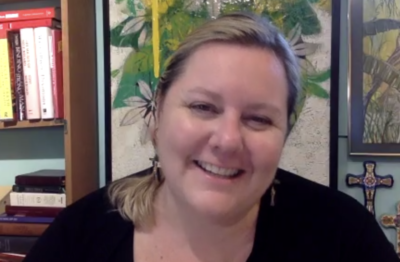
Shannan Vance-Ocampo, chair-elect of the Presbyterian Mission Agency Board, said the building renovations will also provide more flexible space for other PC(USA) groups to hold hybrid meetings, and perhaps meeting space could be rented to nonprofit and other groups. “I’ve been a proponent of us getting out of hotels (as meeting spaces) for a while,” she said.
The Coordinating Committee meeting was in preparation for a virtual July 21 meeting of the full board, which will include updates on the work a Leadership Innovation Team is doing — the latest step in the Presbyterian Mission Agency’s ongoing, intense Vision Implementation Process for how it will live into the Matthew 25 initiative.
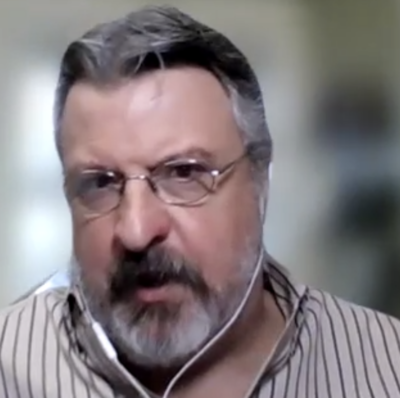
The Coordinating Committee also discussed work being done to re-evaluate how some restricted funds might possibly be used in the future. Barry Creech, PMA’s director of policy, administration and board support, said the historic understanding has been that unrestricted funding goes to PMA and that new restricted gifts were given to PMA to allocate. “We are now starting to question some of those assumptions,” Creech said — in part because of budget pressures facing the Office of the General Assembly.
A review team is looking at about 2,000 restricted funds — approximately 10% of which have restrictions imposed by donors years ago that possibly might be viewed more broadly, Creech said. Doing that involves making decisions about what particular terms might mean today. “What does mission mean?” What’s national mission? Home mission? Overseas mission? Ecumenical work?
If a determination is made that some funds could be used more broadly, then decisions about priorities would come into play. As Creech put it: “Just because something could be shared more widely, should it be shared more widely?”
Figuring all that out “is a lot of work,” said Diane Moffett, PMA’s president and executive director.