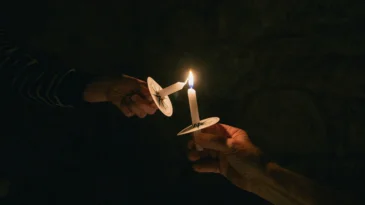

Editor's Note: Linda Valentine was elected executive director of the General Assembly Council at the 217th General Assembly, held in Birmingham, Ala., in June 2006. Outlook Editor Jack Haberer recently sat down with her to reflect on her first year in this leadership role.
JH: You're coming up on your first anniversary in the role of executive director of the GAC. First the easy question: What have you enjoyed most about this new calling?
LV: The people. Just meeting people all around the church. Seeing the breadth and depth of mission activity that we're engaged in. Truly you sense that this is bigger than any one congregation or any one presbytery.
JH: The obvious second question: What has been difficult or disappointing?
LV: There's so much to do. There's so much opportunity. Choosing the right ones to pursue. I continue to be disappointed, as so many of us are, with the ... contentiousness in the denomination that is distracting. Some of it is important. But there's so much positive going on that giving equal or more attention to that is a continual challenge.
When the General Assembly closed up shop in Birmingham last summer, there was a whole lot of shaking going on -- mostly from folks not too happy about the report on the Trinity or another from the Theological Task Force on the Peace, Unity, and Purity of the Presbyterian Church (U.S.A.).
But now, a year later, the quaking seems to have subsided, at least in some spots on the map. Some presbyteries are reporting relatively little tumult related to the theological task force report, with none of their congregations having initiated steps to leave the PC(USA).
While that may be true, there certainly have been some high-profile cases of churches heading off for the Evangelical Presbyterian Church (EPC) -- among them, Kirk of the Hills in Tulsa; Signal Mountain (Tenn.) Church; and most recently, the Memorial Church in Pittsburgh. A June 3 congregational meeting produced a vote of 951 to 93, to join other New Wineskins churches in a transitional non-geographic presbytery, in anticipation of ultimate affiliation with the EPC.
Can practicing homosexuals now be ordained in the Presbyterian Church (U.S.A.)?
The short answer is "No." The more complicated answer is "Maybe."
What has been the Presbyterian Church's rule about ordaining practicing homosexuals?
The current law of the PC(USA) says:
Those who are called to this office in the church are to lead a life in obedience to Scripture and in conformity to the historic confessional standards of the church. Among these standards is the requirement to live either in fidelity within the covenant of marriage of a man and a woman (W-4.9001), or chastity in singleness. Persons refusing to repent of any self-acknowledged practice which the Confessions call sin shall not be ordained and/or installed as deacons, elders, or ministers of the Word and Sacrament.
This is section G [for Government] 6.0106b of the Book of Order, part of the Constitution of the Presbyterian Church (U.S.A.). This section, sometimes called Amendment B by its opponents, was adopted by the General Assembly and a majority of presbyteries in 1997. For a decade it has withstood repeated challenges.
Recognizing that it's something of a hard sell to convince folks that it's a terrific idea to rewrite the denomination's constitution, the Form of Government Task Force of the Presbyterian Church (U.S.A) is planning its strategy for communicating to a broader audience the gist of its complicated work.
Questions people are asking include: "Who formed the task force?" and "Why do we need a new Book of Order? Doesn't the PC(USA) have more important issues" to deal with, said task force co-moderator Sharon Davison, who's an elder from New York City.
A draft introduction to the Revised Form of Government the task force is proposing states that "we have asked two core questions throughout this work: Who does God call the Presbyterian Church (U.S.A.) to be (the identity of the church)? and What does God call the Presbyterian Church (U.S.A.) to do (the polity of the church)?"
Young adults (ages 22-30) are missing from many mainline congregations. Their absence is one reason those congregations' average age is passing 60.
In our opinion, congregations can be successful in reaching young adults. But doing so will require our understanding who they are and what they are going through.
I recently attended a Presbyterian event where the keynote speaker taught something that deeply grieved me: "Presbyterians are more concerned about the glory of God and the coming of God's reign than the salvation of souls." This was proposed as one of the five key tenets of Reformed Theology. The Reformed doctrines of Sola Fides, Sola Gratia, Sola Scriptura and question one from the Westminster Shorter Catechism were used as supporting statements in this supposition. The conclusion drawn was that "salvation is God's business," inferring that it was not ours as Presbyterian Christians. The statement "salvation is God's business" was then echoed by others in two small groups in which I participated.
Could this attitude, if prevalent throughout our denomination, be why we are decreasing in numbers while other denominations are flourishing?
Please bear with me for one history lesson -- so that we can go over it and go on with living in today.
Starting in 1964, membership in mainline denominations went into a long and steady decline. Much has been made of this decline. Church partisans have used it as a weapon to denounce whatever they didn't like. Look at what happens, they argued, when you open the door to new liturgies, women, gays, liberals, conservatives, renewal hymns -- take your pick.
Louis Weeks, the retiring president of Union Theological Seminary-Presbyterian School of Christian Education in Richmond, describes the ordination of Stephen Nkansah this way: "I never saw so many cabs in a Presbyterian parking lot."
Nkansah says more than 600 people worship at his congregation in Woodbridge, Va., now -- cabdrivers, custodians, truck drivers, delivery people, nurses, "all kinds."
They worship at Ebenezer Church both in Twi, the language of their native Ghana, and in English. By worshipping this way, "you come from the bottom of the heart," Nkansah said. He compares what happens at his church to the multitude of languages the apostles heard filling the room, as described in Acts -- all voices, all tongues, all manners of expression. "That is the best way to preach the Bible and to teach, in your own native language," he said. "We are trying to be like the apostles."
This is a story of one man -- two, actually, Nkansah and his friend and colleague, Mark Frimpong -- who have come far from home, made new homes, and planted new churches that are growing faster than many established congregations. It's a story too of struggle, of finding a way to connect with the predominantly white Presbyterian Church (U.S.A.), which has been both welcoming and unsure of what to do with these people who come with their own customs and music and food and language, wanting to worship God in their own way.
Space has been made, but it has sometimes been painful.
While Christians nationwide wrestle to find ways to help settle immigrants coming across our national borders, a handful of Presbyterians in Texas carry out a little noticed outreach to short-term foreign workers. Seafarers, those sailors who transport cargo and fuel from country to country, are greeted by Ben Stewart and David Wells, Presbyterian pastors who serve as chaplains at the Howard T. Tellepsen Seafarers Center in Houston. The Seafarers Center, sponsored by the Presbytery of New Covenant, is the only ministry of its kind in the Presbyterian Church (U.S.A.).
c. 2006 Synod of Living Waters.
Used by permission.
A Kentucky church gives free legal advice to explain complicated federal law and hear grievances that otherwise go unremedied. A Tennessee parish gives rides to the hospital and help with college preparation. An Alabama congregation offers Spanish-language worship and a sympathetic ear.
Slowly, the synod's churches are finding ways to put their stamp, and their values, on one of America's biggest controversies, an issue that stirs alarm, confusion and compassion.
An ESL class
The controversy is immigration, pressing the nation to fix a system that oversees the more than 30 million foreign-born workers -- about 11 percent of the U.S. population -- now living here legally or illegally.
Churches are stepping in to put a human face on a messy political debate about how (or whether) to grant legal status to more immigrants, acculturate them into American life, or increase deportations and secure the borders.
As the rain poured in
And the thunder cracked
It pounded my ears
And soaked my soul
Much like this journey has done
Hearing the echoes of many cries
And feeling drenched in their stories
My heart longs for calm
To be away from the misery
We are sojourners before you and are sojourning just as all our fathers (1 Chronicles 29:10, 15).
The capacity for the transformation of church and community requires deep, intentional remembering. Our core memories are essential to our common identity as Christians. Memories give power for spiritual energy and growth. In spite of many warnings from Scripture about the perils of forgetting, we do forget.
Frederick Weidmann is director of the Center for Church Life and Professor of Biblical Studies at Auburn Theological Seminary in New York City. In an article about the early church, he recalls a core memory, one that formed the identity of the Christian movement in the first and second century. Citing writings by early Christian leaders, he recalls how our identity was formed by our ancestors, the Israelites.
In the 1970s I came of age theologically in a Presbyterian Church (PCUS) that was facing two threats: the formation of the Presbyterian Church in America and the charismatic movement. Though the PCA decimated the PCUS in some areas, it was the charismatic movement that seemed to inspire more fear. Stories abounded of church members, or sometimes ministers, attending charismatic conferences and coming back to split their congregations. Everything connected with the Holy Spirit became suspect. Just mentioning the Spirit was the kiss of death for candidates being examined on the floor of presbytery. The specter of fanaticism and schism hung over anything deemed to be "spiritual."
For decades, John Anderson, as a seminary student, chaplain, pastor, and denominational servant, served Presbyterian work in the United States. Now his alma mater, Austin Presbyterian Theological Seminary in Austin, Texas, is honoring him by providing new housing for its students.
John Anderson grew up in Dallas, Texas, in the 1930s, graduated from Highland Park High School in 1937. First Church, Dallas contributed greatly to his early formation. He received a BA from Austin College in Sherman, Texas, and enrolled in Union Theological Seminary in Virginia, where he was president of the student body before graduating in 1944. After two years as a U.S. Navy chaplain in WWII, Anderson began 38 years of service to churches in Texas and Florida, with nearly half of those years in two separate calls to his boyhood church. In 1953, while serving as senior pastor and head of staff at First Church, Dallas, Anderson earned the Master of Theology degree from Austin Seminary. He has served as an ordained minister for more than 60 years.
You might be surprised to learn there may be more Presbyterians in Mexico than in the United States of America. Even though I could get no solid membership figures from the Office of the General Assembly of the National Presbyterian Church of Mexico, the total membership is around two million -- with thirteen synods and sixty-two presbyteries.
There has been a Presbyterian/Reformed presence in Mexico since 1865. It was a courageous Mississippi schoolteacher ("a transplanted Yankee") who set up a small primary school, largely on her own, in Monterrey in that year. By 1872 a presbytery had been organized. Missionaries from four denominations have shared in a Presbyterian/ Reformed mission presence in Mexico over the years: the Presbyterian Church (U.S.A.), the Presbyterian Church, US, the Reformed Church in America, and the Associate Reformed Church. These mission boards have invested countless mission dollars and hundreds of years of missionary service in one of the most responsive fields for the growth of Reformed Christianity in the last century.
The 2007 Sprunt Lectures at Union-PSCE in Richmond, Va., were notable for a number of reasons: a timing change from winter to spring, the marking of a presidential transition, a thematic emphasis upon worship and Scripture and a marvelous address by Katherine Paterson. Paterson, a distinguished writer of children's stories, spoke to a capacity crowd on May 3 at the annual PSCE alumni dinner. She was honored along with nine classmates as members of the Class of 1957. Dr. Freda Gardner, past moderator of the Presbyterian Church (U.S.A.), introduced her former PSCE roommate.
Katherine Womeldorf Paterson was born in Quinn Jingo, China. She is a graduate of King College and holds masters degrees from both the Presbyterian School of Christian Education and Union Theological Seminary in New York City. She lived and worked for four years in Japan. The Patersons now live in Barre, Vt., where her husband, Dr. John Paterson recently retired as pastor of the First Church. They are the parents of four grown children and four grandchildren.
Editor's Note: Union Seminary-PSCE dedicated a portrait to James H. Smylie on May 3. Dr. Smylie is a frequent contributor to the Outlook in addition to being professor emeritus of church history at Union/PSCE. We happily share the following excerpts from the dedication tribute offered by Dean Thompson, president and professor of ministry at Louisville Theological Seminary. He wrote his Ph.D. dissertation under the supervision of James Smylie.
The purpose of this event is to celebrate the fruitful ministry of James Hutchinson Smylie, teacher and scholar for the church in the field of church history. Specializing in American church history and American Presbyterianism, James Smylie has served God for one-half century by serving ministerial students, pastors, local congregations, his denomination and his academic guild with remarkable effectiveness and energy.
He was born in 1925 in Huntington, W. Va., where his father was pastor of Second Church. He was educated at Washington University, St. Louis, B.A., 1946; and at Princeton Theological Seminary, B.D., 1949, Th.M., 1950, and Ph.D., 1958. He served as assistant minister, First Church, St. Louis, 1950-1952, where he met Elizabeth Roblee in the summer of 1950. They were married in that church in November 1951. Then they moved to Princeton Theological Seminary where Jim taught during and beyond his years of doctoral study, 1952-1962.
Energy will follow need and interest. So even though, from a practical standpoint, you could start anywhere and build toward a balanced program, your most pressing needs will be a reasonable starting point.
Many congregations, for example, are concerned about declining membership. Mainline Protestant denominations have been losing members steadily since 1964, when Baby Boomers began to graduate from high school. Partisans have used that decline as a weapon against whatever they didn't like. In fact, growth had come too easily in the two decades after World War II, and we just weren't geared up to retain current members and to recruit new members.
In the midst of our heartache and loss, we have been absolutely overwhelmed too with a new sense of church.
The Rev. Dr. Leonora (Nora) Tubbs Tisdale joined the Yale University Divinity School faculty in 2006 as the Clement-Muehl Professor of Homiletics. Before going to YDS, Dr. Tisdale served for four years as Consulting Theologian at the Fifth Avenue Church in New York City. She also served as Adjunct Faculty at Union Theological Seminary. Prior to that she taught Preaching and Worship at Princeton Theological Seminary and Union Theological Seminary in Virginia (now Union-PSCE). She began her ministry as co-pastor with her husband of an ecumenical parish of four churches in central Virginia. Dr. Tisdale is married to the Rev. Dr. W. Alfred Tisdale Jr., a Presbyterian minister. Outlook Editor Jack Haberer recently talked with her about the subject of preaching.
Editor's note: "Preaching is what God does, and we have to learn and re-learn that" (William Willimon). Chris Brown, a student at Pittsburgh Theological Seminary, covered a three-part lecture series delivered by William Willimon at PTS on April 27 with the theme, "God's Activity in Preaching." The lectures, titled "The Miracle of Preaching: Preaching as God's Word," were presented as a part of the seminary's annual J. Hubert Henderson Conference on Church and Ministry. Willimon, who is bishop of the North Alabama Conference of the United Methodist Church and author of nearly 60 books, spoke with natural humility and humor to the pastors, alumni, and seminarians in attendance. His message, however, contained a powerful challenge to preachers: "In order to be a preacher, you have to keep practicing miracle."
c. 2007 Religion News Service
c. 2007 Religion News Service
Big Sky, Mont. -- Go outside.
Sometime today, walk out into the fresh air and just be for a few minutes.
And look up. There, hopefully, you will find sky.
Sky is good and natural and sometimes, even on a cloudy, grouchy day, even if you catch just a peek of it between skyscrapers or by craning your neck from the bathroom window that faces the alley, really quite beautiful.
Marveling at creation is easy to do when you're sitting where I am now, in an Adirondack chair on the porch of a cabin in the mountains of Montana, listening to the rush of a spring-swollen river. I can hear the occasional cry of two hawks that have been chasing a smaller bird around the hills all afternoon. I'm in place called Big Sky, and it is aptly named. They filmed "A River Runs Through It" here. This is perhaps the most beautiful place on earth, or at least as much of it as I've seen thus far. All of western Montana is like God showing off: "Look what I can do! Look what I can do!"
Sometime today, walk out into the fresh air and just be for a few minutes.
And look up. There, hopefully, you will find sky.
Sky is good and natural and sometimes, even on a cloudy, grouchy day, even if you catch just a peek of it between skyscrapers or by craning your neck from the bathroom window that faces the alley, really quite beautiful.
Marveling at creation is easy to do when you're sitting where I am now, in an Adirondack chair on the porch of a cabin in the mountains of Montana, listening to the rush of a spring-swollen river. I can hear the occasional cry of two hawks that have been chasing a smaller bird around the hills all afternoon. I'm in place called Big Sky, and it is aptly named. They filmed "A River Runs Through It" here. This is perhaps the most beautiful place on earth, or at least as much of it as I've seen thus far. All of western Montana is like God showing off: "Look what I can do! Look what I can do!"
c. 2007 Religion News Service
I call our Church Wellness Project a "best practices guide to nurturing a healthy faith community."
The concept of "best practices" is widely accepted in many fields, but often is resisted in churches.
Briefly, the concept means that some methods and processes are better -- more effective, more productive, more likely to achieve desired ends -- than others.
In medicine, for example, complicated surgical procedures tend to follow widely accepted best practices. In sales, best practices include prompt response to inquiries, consistent follow-through on commitments, and tracking interactions with prospects and customers.
This month our congregation celebrated its 30th anniversary. We did so with a joyful banquet on Saturday night and a celebratory worship..
A reporter asked me this morning prior to worship: "What will be the first words that you speak to your congregation on..
© Copyright 2026 The Presbyterian Outlook. All Rights Reserved. Privacy Statement. Website by Web Publisher PRO