

Andrew F. Walls, The Missionary Movement in Christian History: Studies in the Transmission of Faith. Maryknoll: Orbis Books, 1996. 266 pages; and The Cross- Cultural Process in Christian History. Maryknoll: Orbis Books, 2002. 284 pages.
An intriguing intramural debate is being waged today among members of the mission studies academy -- a debate about terminology. What is the best phrase to describe the result of revolutionary change in Christian demographics that occurred at the end of the 20th century? This change concerns the center of gravity of Christian adherents in the world. Mission demographers, David B. Barrett and Todd M. Johnson, document in their massive publication (The World Christian Encyclopedia, Oxford, 2001) that by the year 2000 there were more Christians in the southern and eastern hemispheres than in historic Christendom--Europe and North America. Philip Jenkins has highlighted this phenomenon in his work, The Next Christendom (Oxford, 2002), claiming that perhaps as many as two-thirds of the world's Christians will live outside the West by 2050. Shall we refer to this global Christian movement as "world Christianity" or "global Christianity"? By either name 21st century Christianity not only now is firmly established as a world-wide phenomenon but also has become predominantly a non-Western religion.
by Lamin Sanneh. Grand Rapids: Eerdmans, 2003. Pp. xii, 138. ISBN 0- 8028-2164-2. $12.
In the course of the 20th century, Christianity finally outgrew its long Western phase of development, underway since the time of Constantine. A world religion had emerged by the end of the modern era, an "ambi-cultural" network of Christian faith communities that will not be bound by past patterns of social, aesthetic, or even theological conformity. Lamin Sanneh, D. Willis James Professor of Missions and World Christianity at Yale Divinity School, is not concerned to establish these facts here. Instead, his burden is to explore the implications of Christianity's unfolding polycentric future, where the edges of greatest growth are to be found in places like China and sub-Saharan Africa, rather than in the old North Atlantic heartlands of 19th century Christendom.
Books reviewed:
Jean Bethke Elshtain, Just War Against Terror: The Burden of American Power in a Violent World. New York: Basic Books, 2003. 250 pages.
Edward Leroy Long Jr., Facing Terrorism: Responding As Christians. Louisville, KY: Westminster/John Knox Press, 2004. 117 Pages.
Oliver O'Donovan, The Just War Revisited. Cambridge, UK: Cambridge University Press, 2003.
by Jonathan Sacks
(New York: Continuum, 2002 with four reprints; ISBN 0 8264 6850 0)
If you are concerned about the world, and wonder if there is any hope for the crises and complexities of our times, and if you care about faith and relationships around the globe, this is a book for you.
The year: 2020. Jonathan Sacks, philosopher and theologian, Chief Rabbi of the United Hebrew Congregations of the Commonwealth (UK), paints two different pictures of how the world could be.
In one wonderful vision, the year 2020 brings the dawning of "a world of global prosperity and peace." Information technology and high-speed communication have doubled real incomes in the space of 20 years. The dangers of overpopulation have been removed. Genetically modified crops have made starvation a thing of the past. The latest in education curricula reach the most remote African villages via the Internet. Low-cost medical treatments have brought AIDS, TB and malaria under control. International agreements have put an end to the injustices and tensions, the inequity and exploitation that characterized the first years of the 21st century.
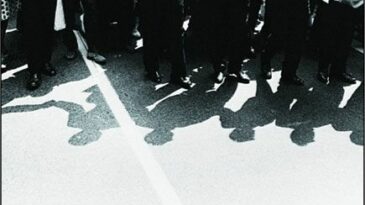
by Drew Hansen. New York: Ecco, 2003. ISBN 0060084774. $13.95. 293 pp.
It has been 37 years since an assassin's bullet tragically ended the life of Martin Luther King, Jr. on the balcony of the Lorraine Motel in Memphis. A stone marker at the base of that balcony on the grounds of what is now the National Civil Rights Museum has an eerie quotation from the book of Genesis, "Behold, this dreamer cometh. Come now therefore, and let us slay him ... and we shall see what will become of his dreams."
Dr. King's "dream" led to monumental changes in American culture and we all share a debt of gratitude for his selfless prophecy and vigilance. But if he were alive today, I am certain Dr. King would remind us that his "dream" has not been fully realized. In our country today, the issues of "residential segregation, inequalities in education and poverty among Americans of all races" threaten the very fabric of our democracy.
By Ronald C. White Jr. (New York: Random House, 2005. Pp. xxiii, 448. $26.95)
Ronald C. White's new book is a thorough and engaging study of the rhetoric of Abraham Lincoln's major speeches and public letters. The focus on language is clear throughout: White argues that Lincoln carefully crafted his words to address specific situations and persuade his immediate audiences. Yet The Eloquent President is not a literary study per se; it avoids technical, theoretically informed analysis in favor of straightforward readings discussed against the background of the day-to-day life and social encounters of the Civil War President. This is a well-written book without a heavy-handed message or strong thesis. It reads easily and yet makes serious points.
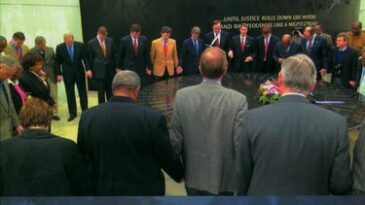
by Donald W. Shriver Jr. (New York, Oxford University Press, 2005, 285 pages)
A dishonest patriot believes that his or her country can do no wrong and calls anyone who disagrees a traitor.
A dishonest patriot benefits from prejudicial laws and advocates special interests above public interest.
An honest patriot is acutely aware of both the strengths and weakness of his or her country. He or she works hard to celebrate the good while correcting the bad so that a spirit of humility and gratitude will bless the future.
This book, by the well-respected ethicist, Donald W. Shriver Jr., is a sustained effort to develop in responsible detail a portrait of an honest patriot. It is a sequel to Shriver's 1995 work, An Ethic for Enemies-Forgiveness in Politics. The author is president emeritus of Union Theological Seminary in New York City.
by Francis Taylor Gench, (Louisville: Westminster/John Knox, 2004).
In this recent book by the author of Hebrews and James in the Westminster Bible Companion series, Francis Taylor Gench provides a sparkling discussion of six gospel encounters between women and Jesus. This book offers fresh readings of familiar stories by allowing a range of scholarly voices, especially feminist voices, to raise key questions and new perspectives about the meaning of the narratives in their ancient and contemporary settings.
The book begins with Matthew's story of the Canaanite woman (or the Syro-Phoenician woman, as Mark refers to her) and Jesus. This story is notable for being the only one in the gospels in which Jesus, who is portrayed in an unflattering light, receives instruction rather than gives it! Gench notes the persistence and ingenuity inherent in Matthew's presentation of the woman who changed Jesus' mind regarding his mission to the Gentiles.
Testimony: Talking Ourselves into Being Christian, by Thomas G. Long. San Francisco: Jossey-Bass, 2004. ISBN 0-7879-6832-3.
The writer of 1 Peter encouraged followers of Jesus to be prepared always to account for the hope that is in them (1 Peter 3:15-16). Perhaps this accounts for the fear that is within us.
Gilead, by Marilynne Robinson. Farrar, Straus and Giroux.
ISBN 978-0-374-15389-2. 247 pages. $23.00.
Gilead, the 2005 Pulitzer Prize-winning novel, is a quiet book. The rhythm is slow, the thought deep, the language reserved, and the action understated. A reader looking for lurid sex, violence, or dramatic action scenes, will be disappointed.
by Jim Wallis. (Amazon Link)
Though I am not a big fan of bumper sticker theology, during the 2004 presidential elections, I did find one bumper sticker that I strongly felt should have a place on my car. I ordered the bumper sticker from the Sojourners community in Washington D.C. The sticker reads, “God is not a Republican or a Democrat.” Amen!
by Steven P. Eason. Louisville: Geneva Press, 2004. ISBN 0-664-50263-6. $19.95.
(Amazon Link)
The Book of Order states that “The minutes of session shall record the completion of a period of study and preparation” for newly- elected officers in the church. After that time of preparation, “the session shall examine them as to their personal faith; knowledge of the doctrine, government, and discipline contained in the Constitution of the church; and the duties of the office.”
by Andrew Purves. Louisville: Westminster John Knox Press. 2004. pp. ixxxv, 236.
Pastors ought to read this book. It concerns the very important foundations that underlie much that we do as pastors. Its title, Reconstructing Pastoral Theology: A Christological Foundation, indicates the combination that makes this book so valuable—pastoral care with Christology.
By Ernest Lee Stoffel
Smythe & Helwys. 1999. 104 pp. ISBN 1-57312-261-0
— Review by Robert V. Sturdivant, Cary, N.C.
In The Apocalyptic Resurrection of Jesus, Ernest Lee Stoffel offers a refreshing account of Jesus' resurrection.
Reacting against interpretations of the resurrection as mere myth, legend or symbol, and likewise that of literal persuasion, Stoffel prefers an alternative he identifies as embodying apocalyptic language, imagery and thought. Apocalyptic language, he notes, was known and in use at the time of Jesus.
by Warren Goldstein (New Haven: Yale University, 2004)
In his biography entitled, William Sloane Coffin Jr.: A Holy Impatience, Warren Goldstein reminds us of a person who made a deep impression on may of us during the last four decades of our lives.
By Arthur Herman
New York: Three Rivers Press (Random House), 2001, ISBN 0-609- 80999-7, 472 pp. $14.95
The title of Arthur Herman’s book, How the Scots Invented the Modern World, has that flavor of a college debate topic: The students are called to show a more confident than comprehensive grasp of some enormous subject, like modernity.
Living on the Borders of Eternity, by Robert Bluford, Jr.; Historic Polegreen Press: Mechanicsville, Va.; 500 pages, paperback. ISBN: 0-9754215-0-6,
Cost: $24.95, shipping and handling included.
Here is a little quiz. Pick out the people who are not Presbyterian in this list: Andrew Jackson, Woodrow Wilson, Dwight D. Eisenhower, Ronald Reagan, John Foster Dulles, John C. Calhoun, John Witherspoon, John Glenn, Jimmy Stewart, Fred Rogers.
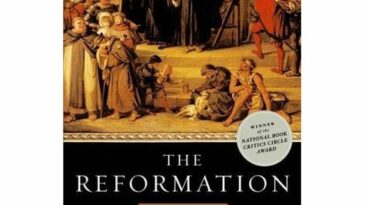
The Reformation: A History, by Diarmaid MacCulloch, Viking, 2003. 700 pages
When I picked up McCulloch's magisterial history of the Reformation, I thought perhaps I would spend a couple of hours dipping into it. I was in for a surprise. This large work of nearly 700 pages became almost an obsession for me as I engaged in a dialogue with this British theologian who has given us a passionate and opinion-filled discussion of the events we call the Reformation.
By Douglas John Hall
Augsburg Fortress. 2003. 2243 pp. Pb. $17.
— Review by Edwin W. Stock, Raleigh, N.C.
The author is a Canadian Lutheran scholar whose book was first delivered in 2002 as 10 lectures at Trinity Lutheran Seminary, Columbus, Ohio. It is easy to read because it has an oral style. Yet, it is scholarly as it addresses Martin Luther's "thin tradition," a theology of the cross (theologia crucis) not well known or appreciated in Reformed Calvinistic branches, whose theology begins with the foundational pillar of the Sovereignty of God.
By James M. Gustafson
Augsburg Fortress. 2004. 128 pp. $15.
— Review by Ralph D. Bucy, Harrisonburg, Va.
From the cowardice that dares not face new truth
From the laziness that is contented with half-truth
From the arrogance that thinks it knows all truth
Good Lord, deliver us. (p. vii)
By Jeanne Stevenson-Moessner
WJKP. 2003. 134 pp. Pb. $14.95.
— Review by Stephen R. Montgomery, Memphis, Tenn.
It has become a cliché in book reviews to state that "this is a book that should be on every pastor’s bookshelf and every church library." In the case of Jeanne Stevenson-Moessner’s The Spirit of Adoption: At Home in God’s Family, the cliché rings true.
By William J. Weston
Geneva. 2003. 116 pp. Pb.
— Review by Louis Weeks, Richmond, Va.
How can the Presbyterian Church (U.S.A.) end its fixation on the issue of whether to ordain self-avowed, practicing homosexuals? How can it become a healthy denomination, focusing on evangelism, service and mission?
By Margie Little Jenkins
Integrity. 227 pp. Pb. $12.99. ISBN 1-59145-013-6
— Review by — Judy Haas Smith, Bedford, Pa.
Margie Jenkins, a Presbyterian elder, has written an important book. It ranks somewhere between the first-aid manual and the phone book, and should well be in every home. With a master's degree in social work, she has specialized in grief counseling and therapy for nearly 30 years.
By Charles C. Brown
Trinity Press International. 2002. 333 pp. Pb. $20. ISBN 1-56338-375-6
— Review by Robert Dunham, Chapel Hill, N.C.
A decade after publishing the acclaimed hardback edition of Charles Brown's appreciative intellectual biography of Reinhold Niebuhr, Trinity Press International has made this important work more widely available in a paperback edition, updated by the author. The timing could not have been more auspicious (nor, perhaps, intentional), given the turn of world events in recent years.
© Copyright 2026 The Presbyterian Outlook. All Rights Reserved. Privacy Statement. Website by Web Publisher PRO