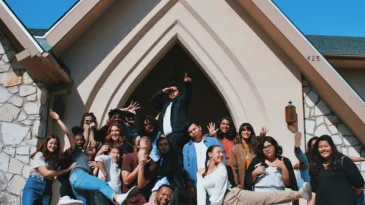
The community that surrounds the church and visitors’ center struck me as depressed. From the appearance of the buildings and the appearance of the people walking the streets, I had the impression that it was an area of rather intense poverty, an area where the residents were significantly unemployed or underemployed. As I took in what I saw around me, I perceived that this was a place where many people probably would never have a full opportunity to realize their God-given potential.
As I continued to look around, I noticed that in the distance, about three miles away, the giant corporate headquarters skyscrapers reached toward the clouds. Undoubtedly there in that neighborhood were men and women who were being given the opportunity to fulfill their life’s vocations. There in that neighborhood were men and women who probably live each day almost oblivious to the kind of difficult struggles that the people endure in the streets around Ebeneezer Baptist.
As I continued to peer toward those distant tall buildings, those centers of power and wealth, the word “Equitable” appeared. In bold white letters, emblazoned on the side one of the tallest towers in Atlanta’s business district, was the word “Equitable.”
I later learned that the sign was designating the Equitable Insurance Building. But beyond its intended purpose, it seemed to me that the sign was almost a symbolic taunt from one community to another. It seemed to me that the sign was a symbolic way of communicating the message that the status quo in Atlanta — and in virtually every other American city — is equitable. It seemed to me that the sign was a way of the rich proclaiming to the poor that the inequalities and the injustices that are imposed on them ultimately are equitable and should be accepted as such.
Unfortunately our churches often proclaim “Equitable” to the suffering people we encounter. We frequently strive to help people bear the suffering and hardships that are placed upon them by attempting to prove to them that the suffering and hardships they are enduring are actually fair and just. In some mysterious way, we say to people, their afflictions are God’s will for them.
Yet what Dr. King did, and what our churches need to do today, is to offer people an alternative vision, a dream of the way that God wants people’s lives to be. Instead of aiding people to cope with and accept the evils that are inflicted upon them, our true calling is to paint a compelling picture of the new future that God intends for us and for all of God’s people.
As we observe the anniversary of Dr. King’s birthday this month, may we have the courage to name the inequities that still exist in our society. And may we have the boldness to speak into existence an alternative way of living together, a way that is rooted in the equitable life that God intends for us.
Posted Jan. 16, 2004

C. Edward Bowen is pastor of the Crafton United Presbyterian Church in Pittsburgh, Pa. He is a frequent contributor to Lectionary Homiletics and LectionAid.
Send your comment on this guest viewpoint to The Outlook.
Please give your full name and hometown.