The Psalms contain a collection of metaphors for God that focuses on protection. These include: shield, high tower, fortress, high place, refuge, rock, and stronghold. These images use “homeland security” language. But in the Psalms there is also a minority point of view that describes God as “the good shepherd” (Psalm 23), the good woman (Psalm 131:1-2), and the good father (Psalm 68:5-6).
In spite of its overwhelming prominence in the Psalms, “homeland security language” is totally absent in the New Testament even though this book is quoted throughout its pages more often than any other in the Hebrew Scriptures. Is this because homeland security language can create fear of the outside world and cause people to withdraw from it? We cannot know. What is evident is that in Luke 15 Jesus uses all three of the above minority images for God and he begins, as do the Psalms, with the good shepherd.
The famous 23rd Psalm is the opening scene of a seven-scene drama that moves the reader from Psalm 23 to Jeremiah 23 to Ezekiel 34 and on to Luke 15, Matthew 18, John 10, and I Peter 15. Each of these seven scenes is worthy of much study and reflection. This essay focuses on the first scene.
Psalm 23 is rhetorically constructed using “ring composition.” Its sections include: the Lord — food/drink — security — sin/death — security — food/drink — the Lord. The scenes climax in the center: even sin and death do not frighten the psalmist.
Scene one opens with the familiar words, “The Lord is my shepherd.” Had David written, “The Lord is my King,” the reader would have looked to a political institution for security. Had he affirmed, “The Lord is my commander,” the military would have been an image for God. Instead he writes, “The Lord is my shepherd.” Shepherds lead their sheep into uninhabited places in open wilderness. With no cell phones, helicopter surveillance, or desert patrols, the appearance of a lion or two, or thieves with heavy sticks, would threaten the flock with great danger. The language David chooses is worthy of serious reflection. It means, at the very least, “I do not rely on police protection for my security.”
For 40 years I was privileged to serve in the Middle East through seven wars. Claiming no particular virtue, “fortress America” meant nothing to me because I lived outside its bounds. When 9/11 occurred, the penetration of that fortress did not frighten me because I had never known its protection. David did not find his security in political institutions, the military, the economy, or some mythical attachment to the land. He found it in “the Lord.” Such rooting surely set him free to deal with all of the above list — but without fear because his security was established elsewhere.
Scene two turns to food and drink for animals. In the Holy Land, pastures are green each year for a maximum of two and a half months in the middle of winter. The rest of the year the fields are brown. Sheep are afraid to drink from a moving stream lest it hide deep water into which they could fall and drown. Still waters and green pastures are, for a sheep, the best of all worlds.
Scene three reads literally: “He brings me back; he leads me in the paths of righteousness for his own names sake.” I am lost, wandering in the paths of unrighteousness. The shepherd finds me, carries me back to the right paths because of his own integrity. He does not do it because of who I am, but because of who he is.
The late Andrew Roy was a missionary to China who opted to remain after the Communist takeover in 1950, he was placed under house arrest and his interrogators attacked the person of Jesus by noting that Jesus told of a shepherd who left “the flock” and went after the one who was lost. The communists argued that such an act was utterly foolish and irresponsible. The collective mass was all that mattered. Roy defended Jesus by pointing out that when the good shepherd in the parable goes after the lost sheep he gives ultimate security to the rest of the flock. Each sheep thereby knows, If I get lost, he will come after me. On the other hand, if the good shepherd cares only for the herd and does not put himself out for the lost sheep, each sheep is left with the ultimate insecurity. They will think, If I fall one step behind, he will leave me to die.
The climax of the psalm appears at the center where the psalmist declares that neither death nor sin frightens him. Christians have the right to read this psalm in the light of the passion of Jesus, which gives even greater force to the imagery. In Christ I am not afraid of death and sin because I have “been there and done that.” We have died with Christ and have been raised with Christ in newness of life. The promise of the psalmist is given new meaning and power in the event of the Cross and the Resurrection.
The “rod” of the shepherd was a handmade wooden mace with blacksmith nails driven into it. The “staff” was the traditional shepherd’s staff that could be hooked around a lamb’s neck to guide it back onto the path. The psalmist knew that the first instrument would protect him from exterior attacks and the second would guide the flock in its interior life together.
The shepherd had no table, but only a cowhide that could be spread on the ground. God, we are told, will take on the task of a woman and prepare a meal for me and he will do this “in the presence of my enemies.” He does not withdraw from me when powerful opponents seek to do me harm. Rather, he deliberately spreads a banquet in their presence to let all know that I am his guest and that he will protect me come what may. The powerful realities of Middle Eastern duties to a guest are living actions when this language is used. To be the guest of God in the presence of powerful enemies quiets fears on a deep and existential level.
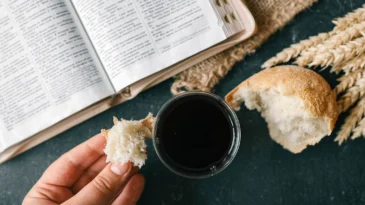
Food (a table) and drink (a cup) are symbols invoked by Paul in a discussion of the Eucharist (1 Cor. 10:21).
Finally, goodness and covenant faithfulness (khasad) will follow me (not wolves and thieves) to the end of the days. Does he mean “God’s days” (KJV: “forever”) or “our days” (RSV: “My life long?” I prefer to think that both are true.
Following the dictates of ring composition, the climax is in the center, not at the end. Victory over fear of sin and death are paramount and that victory, as noted, comes to its finest expression in the Cross and the Resurrection.
May that deliverance come to us afresh this Easter.
Kenneth E. Bailey is an author and lecturer on Middle Eastern New Testament studies living in New Wilmington, Pa.