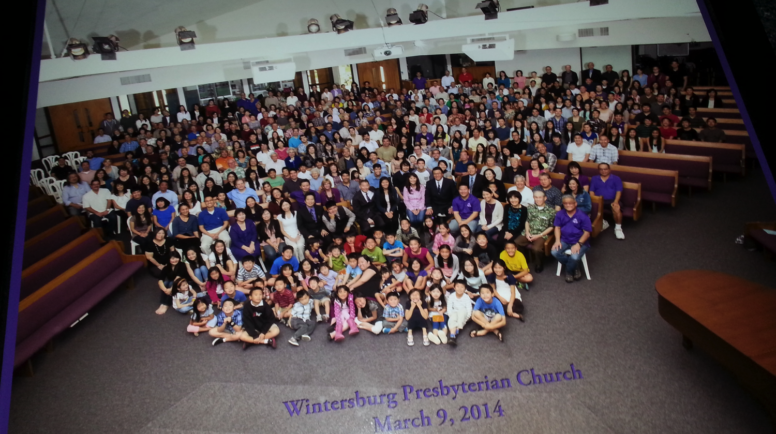
SANTA ANA, CALIF. – It is a story of both deep pain and deep gratitude – inextricably woven together, though spanning more than six decades. When Wintersburg Presbyterian Church, a historically Japanese American congregation, sought dismissal from the PC(USA) and the Los Ranchos Presbytery, what transpired was, unexpectedly, grace.
“As we discerned God’s direction for Wintersburg and determined that we would want to seek dismissal we felt that it was important for the presbytery to consider the congregation’s history,” explained Fred Tanizaki, pastor of Wintersburg Presbyterian Church. It is a history that includes two beginnings: first in 1904 and then again in 1945 when the congregation reopened after being disbanded for three years during World War II. Wintersburg was forced to close its doors from May 1942 to November 1945 as a result of the forced evacuation of its congregation to Japanese internment camps after the outbreak of the war.

Though it was the not the PC(USA) that arrested and incarcerated Wintersburg’s members in 1942, the denomination did little to advocate and shepherd the people of Wintersburg. Because of this, it was felt that a longer view of history was necessary in the discernment process for dismissal from the PC(USA).
“We didn’t make any demands – we were not militant,” he continued. “We told our story because we thought that our story was not well known and we asked that the presbytery be gracious.”
“As Presbyterians we believe that justice and peacemaking are important matters to consider along with the dynamics of the trust clause – which is more of an accounting principle.” Tanizaki, also employed as a CPA, is well aware of the importance of such things, but as a pastor he thought that it was as important to communicate to the congregation the importance as well of justice and peacemaking.
“We didn’t want to leave in a huff – we are still, in the overall scheme and from the eyes of God, one church.”
Of course every congregation has a distinct story. But that of the Wintersburg congregation is perhaps a bit more unique.
Dennis Shintani, an elder at Wintersburg, was born in a ‘camp.’ Though he was only 5 months old when the war ended and his family was able to leave the camp, that experience was as defining for him as it had been for his family. “My parents didn’t want to talk about it – they were ashamed of what happened even though they had done nothing wrong,” Shintani explained.
Shintani is third generation Japanese, Sansei (Japanese for ‘3’). Though his parents were born in the United States they, along with the more than 120,000 Japanese Americans, were rounded up, their property and possessions taken from them and sent away to camps that would become their homes for the next four and a half years.
Shintani was raised to be an ‘American’ – not being allowed to learn Japanese as his parents feared the accusation of being Japanese loyalists.
There is a word in Japanese that Shintani did learn, though – Gaman. “It means perseverance, endurance and patience,” he explained. “Those people really displayed it – they didn’t complain though they were bewildered and disappointed.”
The other Japanese word to describe the situation is Shikataganai – “what can we do?” It has the sense of don’t dwell on the past, you can’t change your circumstances, so move on as best you can.
“That is basically what the people did when they returned – to move forward with their lives as best they could and to put the past in the past,” explained Shintani.
So it was with that backdrop that, on June 28 at a gathering of the Presbytery of Los Ranchos, Susan Thorton on behalf of the presbytery’s council read the terms of the dismissal – terms that included allowing the congregation to leave at no cost, but that also included a letter of apology to the congregation for the wrongs of the past.
“When the presbytery council began to consider the request for dismissal, we were doing what we did with every joint solution – considering the particular merits of the specific situation,” explained Thorton.
The council, she explained, at first did not know how to respond to the historical information that had been included in the report. “We didn’t know what to do with that,” admitted Thorton.
 Then, in the midst of the council’s deliberations, a suggestion was made. Maybe this particular situation called for an act of radical grace.
“I felt like the Holy Spirit was present in that basement room in the presbytery office,” shared Thorton. “All of a sudden hearts were changing and we began to see the situation from the perspective of the congregation and the people in it who still remembered so vividly what it meant to be abandoned – that their citizenship didn’t matter, that their church membership didn’t matter, to feel suspect of things that had no basis in fact.” They decided it was the right thing to do.
“When we told the congregation what had happened at the meeting they were stunned,” shared Tanizaki.
“For Los Ranchos to write this letter of apology – that was a shock to the congregation,” he continued. “You write something off because you think you will never find it – you lost it and it will never be there and then, decades later, here it is. It is incredible to fathom.”
“You move on – but you still remember,” he said. And then, out of nowhere, all of a sudden, someone says, “I still care, and I am sorry.”
“That is a powerful experience – it is amazing grace,” Tanizaki said.
Erin Dunigan is a freelance writer, photographer, and pastor who lives in a small coastal community in Baja California, Mexico when she is not following her wanderlust out into the world.