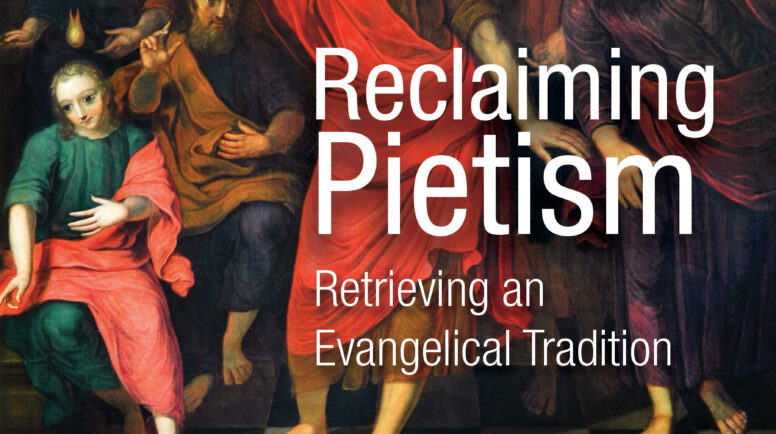
 by Roger E. Olson and Christian T. Collins Winn
William B. Eerdmans Publishing Company, Grand Rapids, Mich. 204 pages
Pietists are a misunderstood and much beset breed, the authors of “Reclaiming Pietism” assert. They are routinely accused of “religious subjectivism, emotionalism, anti-intellectualism, and otherworldliness.” Albrecht Ritschl’s “The History of Pietism,” a three-volume work that appeared between 1880 and 1886, castigated the movement as “an attempt to resurrect medieval monasticism outside the cloisters.” And Karl Barth, though hostile to Ritschl’s liberal theology, matched him in his disdain for Pietism, accusing it of unbridled individualism. “I would rather be in hell with the world church,” he grumbled, “than in heaven with Pietism.”
Roger Olson and Christian Collins Winn are unabashed Pietists. Olson teaches theology and ethics at George W. Truett Theological Seminary in Waco, Texas, and Collins teaches historical and systematic theology at Bethel University in St. Paul, Minnesota. They wrote this book to set the record straight and reclaim Pietism for the Evangelical tradition.
The authors contend that Ritschl’s and Barth’s polemical fireworks were really a reaction to the “excesses and distortions” of the movement, not to its authentic mainstream tradition. To prove their point, they treat the reader to a general overview of Pietism from its medieval precursors in the anonymous “Theologia Germanica” (ca. 1350) and Thomas à Kempis’ “The Imitation of Christ” (1418) to Reformation thinkers such as Martin Luther, Johann Arndt and Jakob Böhme. Then they move on to the great seventeenth- and eighteenth-century founders of the movement itself: Philipp Jakob Spener, August Hermann Francke, and Nikolaus Ludwig von Zinzendorf. Taking a break from history, they next devote an entire chapter to summarizing the main points of the movement before reviewing developments in the eighteenth and nineteenth centuries, noting the influence of Pietism on such seminal thinkers as Friedrich Schleiermacher. The final chapter portrays theologians of the twentieth and twenty-first centuries whose works suggest a strong Pietist influence: Donald G. Bloesch, Richard Foster, Stanley J. Grenz and Jürgen Moltmann.
In addition to arguing that Pietism is a generally positive and healthy form of Christianity, a major contention of the book is that it is also one of the two great roots from which American Evangelicalism sprang at the time of the Great Awakening in the 1740s.
“Reclaiming Pietism” is a good introduction to the subject. It succeeds in correcting popular misconceptions as well as parrying the critiques of hostile theologians, and it shows the enduring importance of Pietist themes in American Evangelical religion. The authors, however, may at times exaggerate the short shrift Pietism has received from theologians and historians. For example, though the authors cite writers who have ignored the Pietist stream in American history, standard works such as Sydney Ahlstrom’s “A Religious History of the American People” give ample recognition to the Pietist tradition in American history. Nonetheless, whether Pietism needs “reclaiming” or just a little brushing up, this book is an earnest effort at commending a generally praiseworthy but sometimes unfairly maligned and slighted movement.
MICHAEL PARKER is director of graduate studies and professor of church history at Evangelical Theological Seminary in Cairo, Egypt.