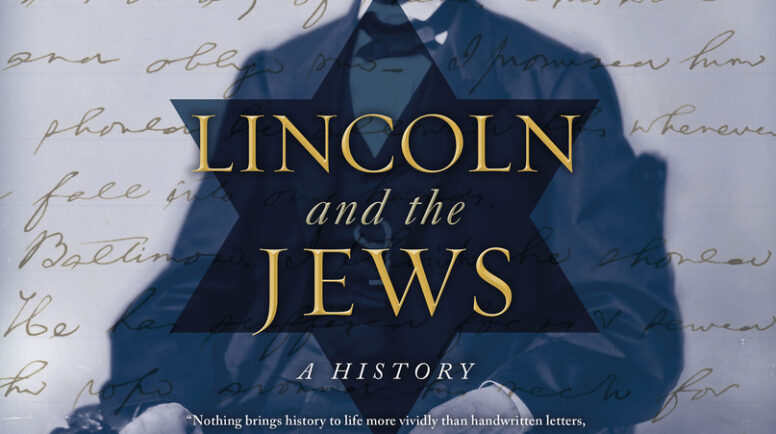
 by Jonathan D. Sarna and Benjamin Shapell
Thomas Dunne Books, New York. 288 pages
For professional historians, Civil War specialists and enthusiasts of all stripes, Abraham Lincoln is a seemingly endless source of fascination. Benjamin Shapell observes that 16,000 books on our 16th president have already been published and hundreds more appear each year. Given this dense literary wealth, is there anything left to say on the subject? Unsurprisingly, the authors of “Lincoln and the Jews: A History” give a resounding “yes.”
Having spent 35 years hunting among private collections and obscure auctions for Lincoln letters, Shapell cannot help but show off the sacred relics of his passion, liberally illustrating his book with images of memorable papers and other artifacts. With the passion of a true devotee, he admits to having been “transformed as a collector” upon encountering numerous documents in which Lincoln expressed his respect and compassion for the Jewish people.
At the beginning of the 19th century there were about 3,000 Jews in the United States, who mostly lived along the eastern seaboard. It is unlikely, therefore, that Lincoln encountered any Jews during his boyhood in Kentucky. But Jewish immigration continued apace throughout the century, and by 1865 there were about 150,000 Jews in the country. Lincoln came to know Jews as acquaintances, friends and colleagues. Most important among these was Abraham Jonas, whom Lincoln referred to as “one of my most valued friends” and who played a crucial “backstage role in the maneuverings that led to Lincoln’s nomination” for the presidency.
In his first two years as president, Lincoln frequently referred to Americans as a “Christian people.” As he gained experience, however, he learned and grew; by the 1863 Gettysburg Address, he used the inclusive phrase “this nation under God.”
In an age of intense and unreflective anti-Semitism, a characteristic common among his generals, Lincoln naturally and unpretentiously acted without prejudice. He appointed Jews to be postmasters, consuls to foreign states, quartermasters for the army and military chaplains. When General Grant issued his Orders No. 11 that expelled Jews from his war zone, Lincoln immediately countermanded it.
Lincoln had a lifelong love affair with the Old Testament. The authors note that “he quoted, and referenced, the Old Testament about a third more times than he did the New; and in referencing the Deity some 420-plus times, used the phrase ‘Savior’ but six,” and he never directly referred to Jesus. In his 770-word second inaugural address, he quoted and alluded to all Old Testament references. In 1866, Mary Todd Lincoln recalled that during a carriage ride on his last day on earth he expressed the desire to visit Palestine.
Jews formed only a tiny minority in the United States during Lincoln’s presidency, and the majority of Jews were Democrats who sided with the South. Lincoln’s genuine affection and fair-treatment of the Jews, therefore, can have had little to do with political calculation. Yet by the end of the war, the authors conclude, “he had done more than any previous president to promote Jews’ advance in American society.”
This is an important story, told with warmth and charm, revealing yet another fascinating side to one of our most engaging presidents.
MICHAEL PARKER is director of graduate studies and professor of church history at the Evangelical Theological Seminary in Cairo, Egypt.