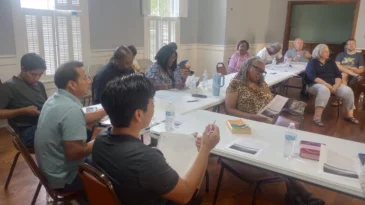
PORTLAND, Ore. – The Way Forward committee at the 2016 General Assembly has begun to consider possibilities – not deciding what to do yet, but to get a sense of the range of ways to push for real change in the Presbyterian Church (U.S.A.).

Some of these conversations are technical (such as: What kind of committee or commission or task force might be empowered to do particular work?) But underneath them all simmers a desire that commissioners expressed for Presbyterians to be hopeful and not afraid; to not ignore systemic problems; to build the kind of denomination the PC(USA) needs to be to do creative ministry in a multicultural world.
“The way things are currently should not be the way forward,” said Dorothy LaPenta, a teaching elder from National Capital Presbytery, reporting back to the committee after small-group discussions.
Here are some pieces of The Way Forward discussion the morning of June 20.
All-agency review. The committee is considering recommendations from review committees for the Presbyterian Mission Agency (PMA) and the Office of the General Assembly (OGA), both of which are recommending that the assembly create a new committee with specific representation to explore the possibility of a merger between PMA and OGA.
The Way Forward committee is also discussing the possibility of folding that task into the work given to the all-agency review committee – a 14-member group that is to begin a required holistic review of how all six agencies of the PC(USA) work together. The all-agency review is scheduled for every six years. In between, each of the six agencies is reviewed individually.
Among the ideas The Way Forward discussed:
- Could the all-agency review group be specifically instructed to discuss particularly questions of what changes are needed at OGA or PMA, including a possible merger?
- Could there be a subcommittee of the all-agency review committee given that task? Or an outside agency be hired?
- Could members of the OGA and PMA review committees be added to serve on the all-agency review?
Other possibilities. The Way Forward also discussed other possibilities – including creating a committee with the distinct charge of looking at the relationship between OGA and PMA, or a commission with the power to implement its own proposals for change, and not have to wait for the 2018 General Assembly.
Eliana Maxim, chair of the PMA review committee and associate executive pastor of the Presbytery of Seattle, said the review committee debated whether the word “merger” (discussion of a possible merger between OGA and PMA) ought to be part of its recommendation, and now “I wish we had not agreed on inserting that word,” because that’s just one of many possibilities that a committee the assembly created might consider.
“This is not a recommendation to merge,” Maxim said – but the idea of creating a group to talk about possibilities. “I don’t want you to get stuck on the word ‘merger.’ That is one of many, many options.”
Speaking during an opening hearing, Mark Hostetter, a teaching elder from New York, encouraged the committee to “seize the day” and consider naming a commission “with the most hopeful minds” and with the authority to act.
“Have courage. Act boldly. Seize this kairos moment,” he said.
John Wimberly, a teaching elder from Washington, D.C., who also spoke during the hearing, suggested having a small group do the work – no bigger than nine members. A group that’s too large will have a hard time making decisions, Wimberly said. “Think small in terms of numbers, and think very clearly about skill sets.”

Presbyterian Mission Agency. The PMA review committee found evidence of systemic, pervasive problems in PMA – difficulties that Tony De La Rosa, PMA’s interim executive director, told the committee he’s working hard to address.
An all-agency review “addresses the questions you are directly asking,” he said. “How do we shape our national structures to address what the church and the world needs from the church going forward?”
Committee member Tom Tripp, a teaching elder from Sacramento Presbytery, said he would understand some defensiveness – as the PMA review committee report “was very sharp” in describing a lack of vision and strategic focus at PMA, a lack of transparency and cultural humility, conflict avoidance, a dearth of spiritual life.
“You just quoted my to-do list since I arrived” in the interim job last December, De La Rosa said. He added: “While you may hear defensiveness, we are taking the findings to heart.”
Robert Field, a teaching elder from Palo Duro Presbytery, said the PMA review committee report contends there are systemic problems, and “there’s a denial of the systemic problems” by senior management. “How will they address systemic problems that may be in our blind spots?” or about which there’s denial, he asked.
“I think after the review that we don’t have any blind spots,” responded Melinda Sanders, who leads the Governance Task Force of the Presbyterian Mission Agency board, which is reconfiguring how the board does its work with the intent of focusing more energy and attention on critical issues for the church.

De La Rosa described the review committee report as being “a snapshot in time,” and that “we have progressed since that time.”
Some committee members, however, voiced skepticism about how much change there’s actually been at PMA – pointing out that the agency has endured a decade of layoff and conflicts.
The committee heard of “huge systemic issues,” and “we have not heard about ways those are being dealt with,” said Josh Robinson, a teaching elder from Mission Presbytery.
Moving forward. For a while, The Way Forward committee discussed in small groups three questions:
- What have you heard?
- What questions do you have?
- What do you need?
“General Assembly is hard,” said Amy House, a teaching elder from Scioto Valley, in reporting back the results from her group.
From then on, that phrase – “General Assembly is hard” – became one of the refrains of The Way Forward’s discussion.