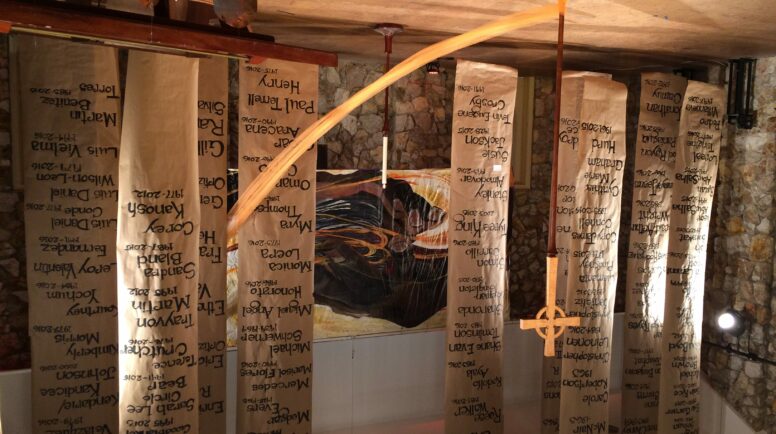
 Brown paper banners hung around the cavernous, stone auditorium. Names inscribed in black paint decorated the banners from ceiling to floor. Most names came with a birth and death date; some were familiar: Emmett Till, Martin Luther King Jr., Trayvon Martin, Philando Castile. Others were not, at least to me, a white woman from suburban Houston. I guessed that some of the names marked the lives of those killed in the shooting at Orlando’s Pulse nightclub. Whether familiar or unfamiliar, it was clear that what joined this cloud of witnesses together was that their deaths came violently, because of their race.
These banners marked my introduction to the Disgrace Conference at the Montreat Conference Center. The contrast between the beauty of the North Carolina mountains and the sorrow of these deaths jarred me. And that was a good thing. The conference planning team structured our time together around lament. As Jose Morales noted in his sermon during our first worship service together, “Racism has turned us all into small, inauthentic selves.” He posited that the only way through our inauthenticity was lament.
We practiced lament in our worship, structuring our liturgy around Good Friday, Holy Saturday and Resurrection Sunday. We heard the stories of people of color – stories of marginalization, of micro-aggressions of having “problematic bodies.” We heard from people caught in the intersections of race, gender and sexual orientation, and how their lack of power was compounded by these intersections.
As a pastor, I know what it is to lament, at least to lament the problems and pain that plague all of humankind – the grief that attends death, even death at old age, the pain of losing a loved one to dementia, the fears associated with job loss, the guilt tied with divorce, addiction or anything that doesn’t seem very “Christian” to our pious selves. In the last year, I even sensed my heart and mind breaking open to our nation’s deep sin – racism, a sin, that, in my privilege and desire to be a “good person,” I had chosen to ignore. So, I was ready to lament. I wanted to lament. I wanted to be present with people who have been wounded by my race, wounded by the “racist god” of our country, as Anthea Butler so challengingly named it.
 I wasn’t ready for what lament actually meant or felt like, especially as a person of privilege who represented the majority of the conference’s attendees. Lament meant receiving all over again the story of slavery and hearing a woman wailing and feeling the depth of pain that wasn’t mine but was perpetuated by my people. Lament was hearing Anthea Butler in anger rail at her audience for not doing anything about police violence, black death – for talking about caring about racism, but not doing anything about it. I continue to come back to Anthea Butler’s comment in her plenary, “To ask me [a black woman] to come and talk to you [majority white audience] about white supremacy is white supremacy!” She was right and I felt so ashamed and helpless and frustrated.
For me, as a white woman, to enter the lament of marginalized people, is to open myself up to their pain, anger, frustration and suffering without trying to explain it away or fix it. It is to receive that anger and pain without defensiveness, without saying, “That’s not me!” It is to consider deeply how my privilege has contributed to the racist systems of our country and to act to change those systems. It is to sit in the pain without seeking absolution from the people lamenting. It requires me to let go of control – and I think that’s probably the hardest thing for me to do as a middle class white person. I’m used to being in control, used to having what I need, used to being the normal one. To be the one who is out of place in the midst of pain is hard, uncomfortable and frightening.
And yet, I believe this is the only way through – it’s the only way I’m ever going to truly change, going to give up my privilege for the sake of the humanity of others. Lament is hard, but it’s necessary. Lament, as Jose Morales reminded us, is not nice news, but it is good news.
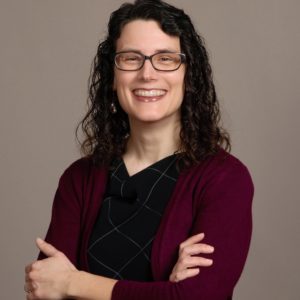
 Rachel Young is the associate pastor of spiritual formation at Clear Lake Presbyterian Church, in Houston, Texas. She is married to Josh, who also serves on staff at Clear Lake Presbyterian as the director of contemporary worship and media.